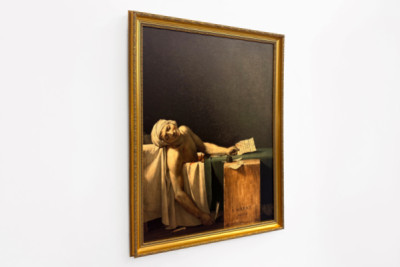
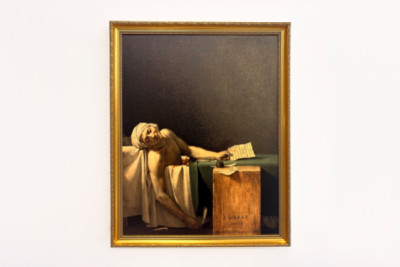
Jean-Paul Marat lies dead in his bath, his head, wrapped in a white turban, lolling to one side, his arm stretched out over the edge of the bath. In his left hand he still holds the letter from his murderer, Charlotte Corday, who had gained access on 13 July 1793 with a petition; the knife lies on the floor below. Jacques-Louis David, a leading painter of French Classicism and himself a staunch Jacobin, painted the picture that very same year - as a political memorial to a friend, composed like a Pietà. The upper half of the picture remains almost empty, a dark, grainy background against which the light on the skin, the sheet and the green cloth stands out all the more. On the simple wooden box, which served as a writing desk, is the dedication: ‘À Marat, David’. There is no pathos in the gesture, no wound at the centre - the silence of the painting is its true power.
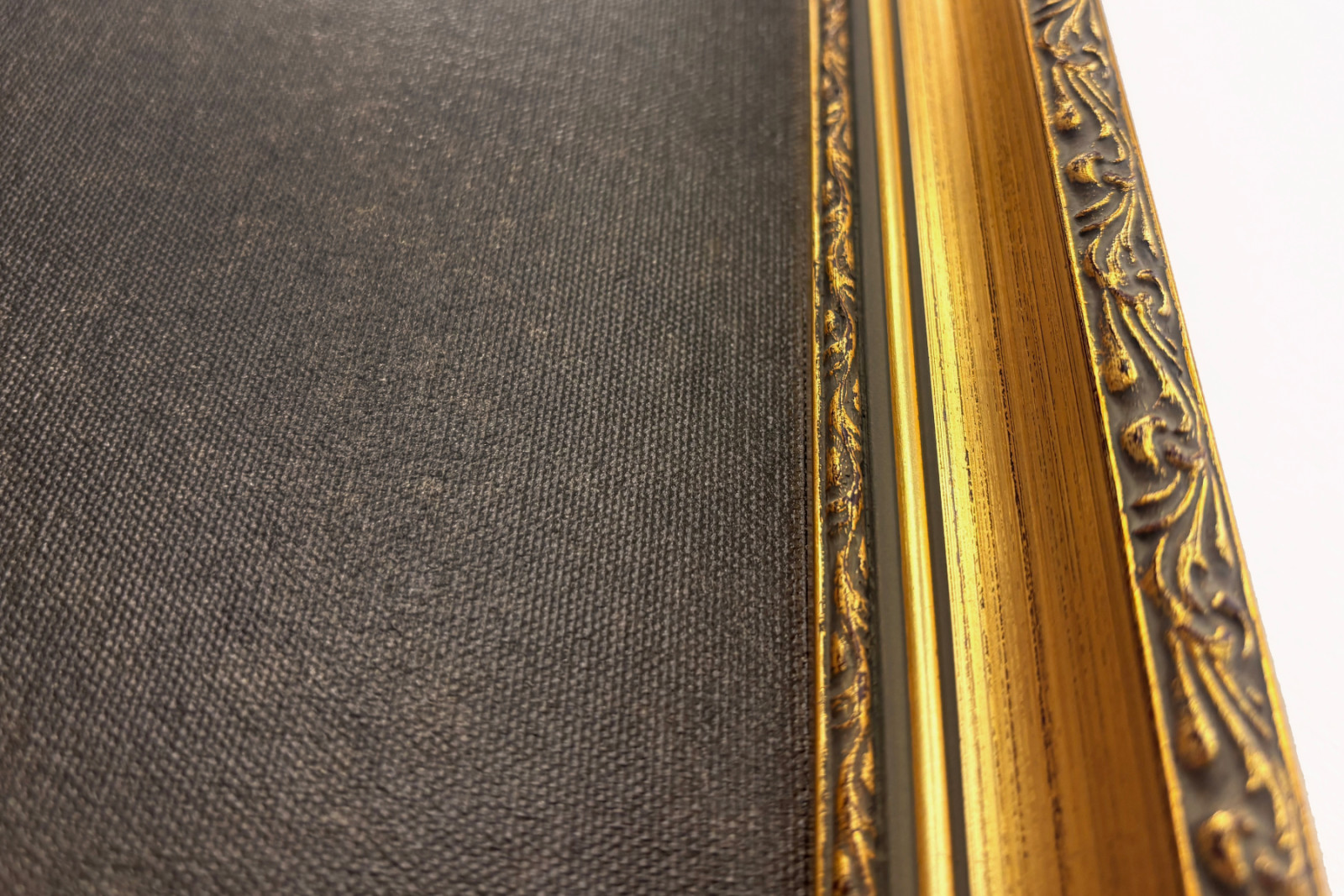
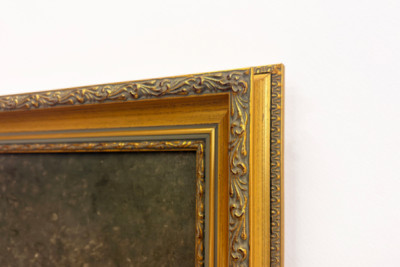
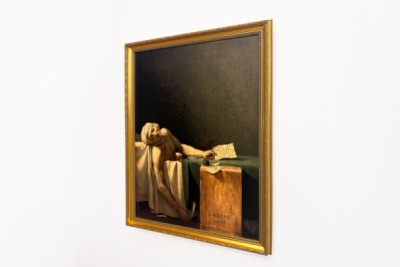
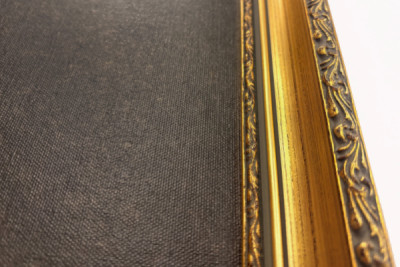
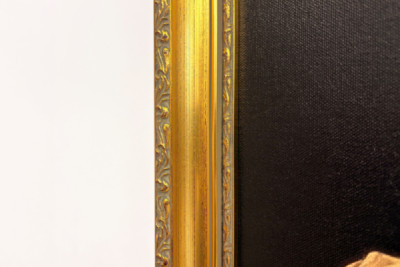
Measuring 53 x 70 cm, this version hangs considerably more compactly than the Paris original, which is over one and a half metres high - yet this detracts surprisingly little from the subject. Against the light-coloured wall, the portrait in portrait format stands as a solid, dark block; the large empty space at the top draws the eye downwards towards the figure, exactly as David intended. The sat print on canvas is framed in ‘Leonardo in Natascha’, a narrow real-wood frame in gold with red-rubbed trimmings; at a good four centimetres wide, it does not look bulky, but rather provides a fine, ornamented border to contrast with the dark picture plane. Viewed from the side, it is striking how flat the whole piece sits against the wall - not a heavy museum-style frame, but a format that can also find a place in a study or hallway without overwhelming the space. A commission that we, too, took great pleasure in.
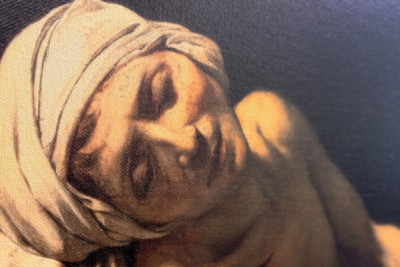
Particularly with a painting that derives so much of its power from its dark emptiness, attention to detail is crucial: the writing on Corday’s letter remains legible, the modelling of Marat’s face retains its soft transitions, and the fine shimmer of David’s underpainting is still visible against the black-green background. The fact that the reproduction captures these nuances is what makes it convincing - whether viewed up close or from a distance of three metres.
 ×
×






 +43 4257 29415
 support@meisterdrucke.com
 Mo-Do: 7:00 - 16:00 | Fr: 7:00 - 13:00