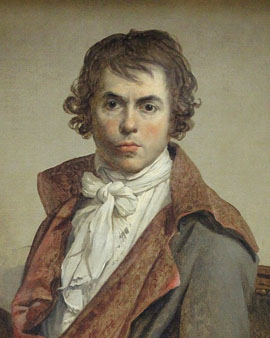
The French painter Jacques-Louis David became famous above all through a series of classicist history paintings. As a Jacobin member of the National Convention and the Security Committee, he was a prominent player on the political stage during the French Revolution. Among his painted commentaries of this period of upheaval were above all "Die Ermordung des Marat" (1793). David later became a transfiguree of the imperial era with works such as "Krönung Napoleons I." (1806).
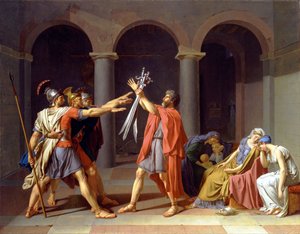
Art historians associate David with the breakthrough of classicism in painting. In 1785 David's oil painting "Der Schwur der Horatier" (1784) was presented to the public with enormous success. The painting, which in clear contrast to the playfulness of the rococo painting that had dominated until then, propagated determination and a will to act, represents a pathetic scene from early Roman history: The three brothers of the Horatier family are to fight for Rome against Alba Longa in a proxy fight to the death. Before the fight, the father takes the oath of arms from his sons and holds their swords. In contrast to this group of four determined by energy and fighting tension, David has placed women crouching in mourning. A dark background and antique arcade elements complete the picture composition. In retrospect, David's contemporaries speculated on the call for revolution into the picture, which today appears rather stiff.
The painter, who was ostracized as a revolutionary, was driven out of France after 1815 by the Restoration. He died in 1825 at the age of 77 in exile in Brussels.
 ×
× 






 Passionate Customer Service

.jpg "Napoleon Crossing the Alps by Jacques Louis David")
.jpg)
.jpg "The Death of Socrates by Jacques Louis David")
.jpg)
.jpg "The Death of Marat by Jacques Louis David")
.jpg)
.jpg "Napoleon Crossing the Alps on 20th May 1800 by Jacques Louis David")
.jpg)
.jpg "The Emperor Napoleon in His Study at the Tuileries by Jacques Louis David")
.jpg)
.jpg "Male Nude Hector by Jacques Louis David")
.jpg)

 - (MeisterDrucke-96538).jpg "Sketches of Napoleon Bonaparte, 1797 by Jacques Louis David")
 - (MeisterDrucke-96538).jpg)
.jpg "The Coronation of Napoleon by Jacques Louis David")
.jpg)
.jpg "The Sabine Women, 1799 by Jacques Louis David")
.jpg)
.jpg "Napoleon Crossing the Alps on 20th May 1800 by Jacques Louis David")
.jpg)
_had_to_drink_cig_-_(MeisterDrucke-924723).jpg "Suicide of Socrates, ancient Greek philosopher (5th century BC), who had to drink hemlock after being accused of impiety and corrupting youth by Jacques Louis David")
_had_to_drink_cig_-_(MeisterDrucke-924723).jpg)
.jpg "The Consecration of the Emperor Napoleon 1769-1821 and the Coronation of the Empress Josephine 1763-1814 by Pope Pius VII, 2nd December 1804, 1806-07 (detail of 18412) by Jacques Louis David")
.jpg)
 Crossing the Alps at the St Bernard Pass 20th May 1800 c1800-01 - (MeisterDrucke-78037).jpg "Napoleon (1769-1821) Crossing the Alps at the St Bernard Pass, 20th May 1800, c. 1800-01 by Jacques Louis David")
 Crossing the Alps at the St Bernard Pass 20th May 1800 c1800-01 - (MeisterDrucke-78037).jpg)
.jpg "Portrait of a young girl, c. 1795 by Jacques Louis David")
.jpg)
.jpg "Cupid and Psyche by Jacques Louis David")
.jpg)
.jpg "Patroclus by Jacques Louis David")
.jpg)
.jpg "Napoleon at the Great St. Bernard Pass by Jacques Louis David")
.jpg)
.jpg "Empress Joséphine, The Coronation of Napoleon, Detail by Jacques Louis David")
.jpg)
.jpg "Marat Assassinated, 1793, 1937. by Jacques Louis David")
.jpg)
.jpg "The Intervention of the Sabine Women by Jacques Louis David")
.jpg)
_1790_-_(MeisterDrucke-577142).jpg "Robertine Tourteau, Marquise d")
_1790_-_(MeisterDrucke-577142).jpg)
.jpg "Leonidas at Thermopylae, 5th century BC, c1814 by Jacques Louis David")
.jpg)
 and the Coronation of the Empress Josephine (1763-1814) by Pope Pius VII (1742-1823) 2nd December 1804 1806-07 detail of Napoleon - (MeisterDrucke-77531).jpg "The Consecration of the Emperor Napoleon (1769-1821) and the Coronation of the Empress Josephine (1763-1814) by Pope Pius VII (1742-1823), 2nd December 1804, 1806-07, detail of Napoleon by Jacques Louis David")
 and the Coronation of the Empress Josephine (1763-1814) by Pope Pius VII (1742-1823) 2nd December 1804 1806-07 detail of Napoleon - (MeisterDrucke-77531).jpg)
.jpg "The Fight Between Mars and Minerva, 1771 by Jacques Louis David")
.jpg)
.jpg "The Farewell of Telemachus and Eucharis, 1818 by Jacques Louis David")
.jpg)
.jpg "Napoleon Bonaparte in his Study at the Tuileries, 1812 by Jacques Louis David")
.jpg)
.jpg "Portrait of Madame Pierre Seriziat and her Son, Émile by Jacques Louis David")
.jpg)
_handsome_brother_of_the_artist_Painting_-_(MeisterDrucke-948115).jpg "Portrait of Pierre Seriziat (1757-1847), the artist")
_handsome_brother_of_the_artist_Painting_-_(MeisterDrucke-948115).jpg)
.jpg "The Vegetable Seller by Jacques Louis David")
.jpg)
.jpg "Portrait of a Lady Dressed in Black by Jacques Louis David")
.jpg)
.jpg "Madame David by Jacques Louis David")
.jpg)
.jpg "Oath of the Horatii by Jacques Louis David")
.jpg)
.jpg "Nude Study of Pope Pius VII Seated by Jacques Louis David")
.jpg)
.jpg "The Lictors Bring Brutus the Bodies of His Sons by Jacques Louis David")
.jpg)
.jpg "Belisarius Begging for Alms by Jacques Louis David")
.jpg)
.jpg "The Tennis Court Oath, 20th June 1789, 1791 by Jacques Louis David")
.jpg)
.jpg "Equestrian Portrait of Napoleon I Bonaparte by Jacques Louis David")
.jpg)
_murdered_in_his_bathtub_on_130717_-_(MeisterDrucke-1001875).jpg "French Revolution: “Jean Paul Marat (1743-1793) murdered in his bathtub on 13/07/1793”. Painting by Jérôme Martin Langlois (1779-1838), member of Jacques Louis David")
_murdered_in_his_bathtub_on_130717_-_(MeisterDrucke-1001875).jpg)
.jpg "The Death of Socrates, 4th century BC, 1787 by Jacques Louis David")
.jpg)
.jpg "Reclining Nude by Jacques Louis David")
.jpg)
_dans_son_cabinet_de_travail_aux_Tui_-_(MeisterDrucke-1171245).jpg "Full-length portrait of Napoleon I (1769-1821) in his study at the Tuileries, 1812. Private collection. by Jacques Louis David")
_dans_son_cabinet_de_travail_aux_Tui_-_(MeisterDrucke-1171245).jpg)
 - (MeisterDrucke-126223).jpg "Tennis Court Oath, 20th June, 1789 (left section of the painting) by Jacques Louis David")
 - (MeisterDrucke-126223).jpg)
 and the - (MeisterDrucke-374877).jpg "The Consecration of the Emperor Napoleon (1769-1821) and the Coronation of the Empress Josephine (1763-1814), 2nd December 1804, detail from the central panel, 1806-7 by Jacques Louis David")
 and the - (MeisterDrucke-374877).jpg)
.jpg "Presumed portrait of the jailer of the painter Jacques Louis David, who remained in prison after Robespierre")
.jpg)
.jpg "Madame Récamier, 1800 by Jacques Louis David")
.jpg)
_murdered)_Detail_Painting_by_Jac_-_(MeisterDrucke-1002786).jpg "The Death of Marat (Jean-Paul Marat (1743-1793) murdered). Detail. Painting by Jacques-Louis David (1748-1825). 1793, dimensions 1.62 x 1.3 m, Louvre Museum, Paris by Jacques Louis David")
_murdered)_Detail_Painting_by_Jac_-_(MeisterDrucke-1002786).jpg)
.jpg "The Death of Marat, detail of the face, 1793 by Jacques Louis David")
.jpg)
.jpg "Coronation of Napoleon I, Empress Josephine on her knees before Napoleon ... by Jacques Louis David")
.jpg)
 - (MeisterDrucke-69632).jpg "Academy Study of the Male Nude by Jacques Louis David")
 - (MeisterDrucke-69632).jpg)
.jpg "Andromache mourns Hector, 1783. by Jacques Louis David")
.jpg)
 - (MeisterDrucke-89182).jpg "Apelles Painting Campaspe in the Presence of Alexander the Great (356-323 BC) by Jacques Louis David")
 - (MeisterDrucke-89182).jpg)
.jpg "The Fight Between Mars and Minerva, ca. 1771 by Jacques Louis David")
.jpg)
.jpg "The consecration of Emperor Napoleon I and coronation of Empress Joséphine by Jacques Louis David")
.jpg)
_after_the_Distribution_-_(MeisterDrucke-948311).jpg "Oath of the Army made to Emperor Napoleon I (1769-1821) after the Distribution of the Eagles at the Champ de Mars, 5/12/1804 (detail) by Jacques Louis David")
_after_the_Distribution_-_(MeisterDrucke-948311).jpg)
 and the Coronation of the Empress Josephine (1763-1814) by Pope Pius VII 2nd December 1804 detail of Josephine and her ladies-in-waiting 1806-7 - (MeisterDrucke-70009).jpg "The Consecration of the Emperor Napoleon (1769-1821) and the Coronation of the Empress Josephine (1763-1814) by Pope Pius VII, 2nd December 1804, detail of Josephine and her ladies-in-waiting, 1806-7 by Jacques Louis David")
 and the Coronation of the Empress Josephine (1763-1814) by Pope Pius VII 2nd December 1804 detail of Josephine and her ladies-in-waiting 1806-7 - (MeisterDrucke-70009).jpg)
.jpg "Portrait of Madame Récamier, 1800, 1911 by Jacques Louis David")
.jpg)
.jpg "The Coronation of Napoleon at Notre-Dame de Paris on 2nd December 1804, 1807. by Jacques Louis David")
.jpg)
.jpg "The Consecration of Emperor Napoleon I and the Coronation of Empress Joséphine in Notre-Dame Cathedral, 2nd December 1804, detail of the left section depicting the ladies-in-waiting and the chamber by Jacques Louis David")
.jpg)
_murdered)_Painting_by_Jacques_Lo_-_(MeisterDrucke-1022141).jpg "The Death of Marat (John Paul Marat (1743-1793) murdered). 1793. H. 1.62 x 1.3 m. Louvre Museum, Paris by Jacques Louis David")
_murdered)_Painting_by_Jacques_Lo_-_(MeisterDrucke-1022141).jpg)
 Viceroy of Italy and Duke of Leuchtenberg - (MeisterDrucke-89848).jpg "Portrait of Prince Eugène de Beauharnais (1781-1824), Viceroy of Italy and Duke of Leuchtenberg by Jacques Louis David")
 Viceroy of Italy and Duke of Leuchtenberg - (MeisterDrucke-89848).jpg)
.jpg "Belisarius Begging for Alms, 1781 by Jacques Louis David")
.jpg)
_Two_Drapery_Studies_for_t_-_(MeisterDrucke-1280141).jpg "Nude Soldiers Gesticulating with Their Weapons (recto); Two Drapery Studies for the Figure of Tatius (verso) by Jacques Louis David")
_Two_Drapery_Studies_for_t_-_(MeisterDrucke-1280141).jpg)
 - (MeisterDrucke-103750).jpg "Napoleon Crossing the Alps on 20th May 1800, 1803 (detail of 101627) by Jacques Louis David")
 - (MeisterDrucke-103750).jpg)
.jpg "Portrait of Monsieur de Lavoisier and his Wife, chemist Marie-Anne Pierrette Paulze by Jacques Louis David")
.jpg)
_introduced_in_Rome_in_1806_the_C_-_(MeisterDrucke-955476).jpg "Napoleon I Bonaparte, French emperor (1769-1821), introduced the Code of Laws in Rome in 1806 by Jacques Louis David")
_introduced_in_Rome_in_1806_the_C_-_(MeisterDrucke-955476).jpg)
_Jeanne_Francoise_dite_Juliette_-_Paint_-_(MeisterDrucke-948178).jpg "Portrait of Madame Récamier (1777-1849), Jeanne Françoise, known as Juliette - Painting by Jacques-Louis David (1748-1825) by Jacques Louis David")
_Jeanne_Francoise_dite_Juliette_-_Paint_-_(MeisterDrucke-948178).jpg)
 - (MeisterDrucke-652377).jpg "The Coronation of Napoleon (1805-1807) by Jacques Louis David")
 - (MeisterDrucke-652377).jpg)
_-_(MeisterDrucke-1583631).jpg "Napoleon Crossing the Saint Bernhard Pass, One of Five Versions by Jacques Louis David")
_-_(MeisterDrucke-1583631).jpg)
.jpg "The Emperor Napoleon in His Study at the Tuileries, 1812 by Jacques Louis David")
.jpg)
_avec_Madame_Lavoisier_Painting_-_(MeisterDrucke-977876).jpg "Detail of")
_avec_Madame_Lavoisier_Painting_-_(MeisterDrucke-977876).jpg)
_1798-99_-_(MeisterDrucke-34698).jpg "Portrait of Madame Raymond de Verninac (1780-1827), 1798-99 by Jacques Louis David")
_1798-99_-_(MeisterDrucke-34698).jpg)
.jpg "Bonaparte Crossing the Great St Bernard, 20 May 1800 by Jacques Louis David")
.jpg)
_-_(MeisterDrucke-951353).jpg "Portrait of a young girl. Painting by Jacques Louis David (1748-1825) by Jacques Louis David")
_-_(MeisterDrucke-951353).jpg)
.jpg "Countess Daru by Jacques Louis David")
.jpg)
.jpg "Self-Portrait by Jacques Louis David")
.jpg)
.jpg "The Rite of Napoleon. Detail of Napoleon wearing the crown during the consecration of Emperor Napoleon I Bonaparte and coronation of Empress Josephine at Notre-Dame de Paris on December 2 by Jacques Louis David")
.jpg)
.jpg "Mars Disarmed by Venus and the Three Graces by Jacques Louis David")
.jpg)
.jpg "The Coronation of Napoleon. Detail depicting the Emperor")
.jpg)
.jpg "Cupid and Psyche by Jacques Louis David")
.jpg)
.jpg "The Emperor Napoleon in His Study at the Tuileries, 1812 by Jacques Louis David")
.jpg)
.jpg "The Oath of the Tennis Court (preparatory drawing) by Jacques Louis David")
.jpg)
_-_(MeisterDrucke-1660974).jpg "Napoleon Crossing the Saint Bernard Pass, One of Five Versions by Jacques Louis David")
_-_(MeisterDrucke-1660974).jpg)
.jpg "Sappho, Phaon and Cupid, 1809 by Jacques Louis David")
.jpg)
.jpg "Sketch for The Coronation of Napoleon, c. 1807, 1921. by Jacques Louis David")
.jpg)
.jpg "The Rite of Napoleon. Detail depicting the Cardinals and Jean Baptiste Jules Bernadotte (1763-1844) during the consecration of Emperor Napoleon I Bonaparte and coronation of Empress Josephine at Notre-Dame de Paris on December 2 by Jacques Louis David")
.jpg)
.jpg "The Departure of Marcus Attilius Regulus for Carthage, 1785-86 by Jacques Louis David")
.jpg)
.jpg "The Army takes an Oath to the Emperor after the Distribution of Eagles, 5 December 1804 by Jacques Louis David")
.jpg)
.jpg "Cupid and Psyche by Jacques Louis David")
.jpg)
 and the Coronation of the Empress Josephine (1763-1814) by Pope Pius VII 2nd December 1804 1806-7 - (MeisterDrucke-54924).jpg "The Consecration of the Emperor Napoleon (1769-1821) and the Coronation of the Empress Josephine (1763-1814) by Pope Pius VII, 2nd December 1804, 1806-7 by Jacques Louis David")
 and the Coronation of the Empress Josephine (1763-1814) by Pope Pius VII 2nd December 1804 1806-7 - (MeisterDrucke-54924).jpg)
.jpg "Sappho and Phaon, 1809 by Jacques Louis David")
.jpg)
.jpg "Leonidas at Thermopylae. Episode of the Battle of Thermopylae in 480 BC, opposing the Greeks to the Persians of Xerxes I: Leonidas I, King of Sparta, holding his arms, sits on a rock near the altar of Hercules; in the background a troop of Spartans by Jacques Louis David")
.jpg)
.jpg "Death of Joseph Bara by Jacques Louis David")
.jpg)
.jpg "The Oath of the Horatii, 1784 by Jacques Louis David")
.jpg)
_-_(MeisterDrucke-1721958).jpg "General Étienne-Maurice Gérard (1773-1852) by Jacques Louis David")
_-_(MeisterDrucke-1721958).jpg)
.jpg "The Death of Seneca by Jacques Louis David")
.jpg)
_in_General_Painting_by_Lou_-_(MeisterDrucke-960618).jpg "Unfinished Portrait of Napoleon Bonaparte by Jacques Louis David")
_in_General_Painting_by_Lou_-_(MeisterDrucke-960618).jpg)
.jpg "Portrait of a Young Woman in White, 1798 by Jacques Louis David")
.jpg)
.jpg "Portrait by Jacques Louis David")
.jpg)
.jpg "Madame François Buron, 1769 by Jacques Louis David")
.jpg)

 +43 4257 29415
 support@meisterdrucke.com
 Mo-Do: 7:00 - 16:00 | Fr: 7:00 - 13:00