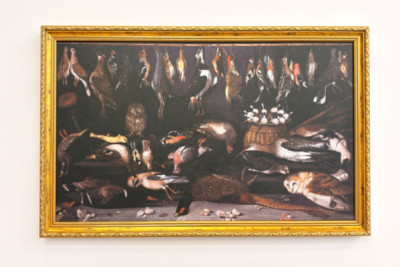
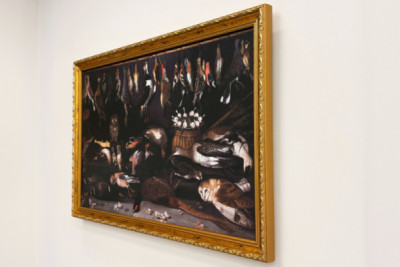
Two horizontal zones organise the abundance: at the top, the birds hang in dense rows against an almost black background; below, their prey is spread out across tables, baskets and shelves. This layering creates a curious rhythm, at once austere and restless. Light-coloured bellies, outstretched wings and long beaks emerge from the darkness; small patches of red plumage provide brief accents amidst them. On the left sits an owl with wide-open eyes, the only animal facing the viewer head-on - one’s gaze lingers on it longer than on anything else. Its gaze enlivens the scene without dispelling its gravity. In the lower half, larger birds lie one on top of the other, some with their necks arched back, others stretched out to the side. A basket of white tubers forms a bright island near the centre, whilst scattered individual pieces at the front edge mark the transition into the room. The light is not distributed evenly, but seeks out feathers, eyes, beaks and body shapes; everything else is submerged in brown, black and muted red. Thus, the still life appears less as a sober inventory than as a reflection on abundance and transience. The painting is attributed to Michelangelo Merisi da Caravaggio, that artist on the cusp of the Baroque era whose name is closely associated with dramatic chiaroscuro contrasts. Here, in particular, there is no need for human figures: the motionless arrangement possesses an almost theatrical tension in its own right.
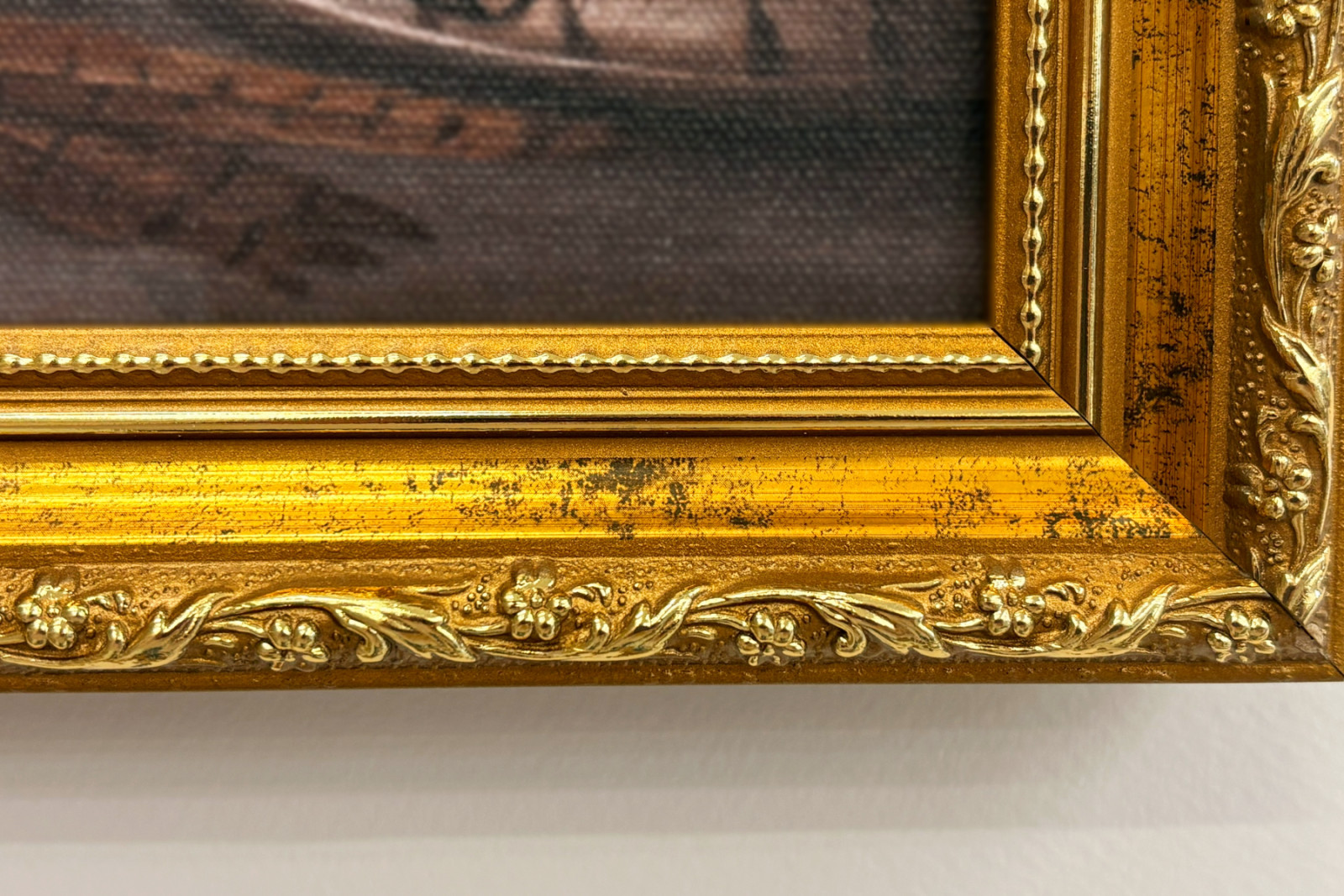
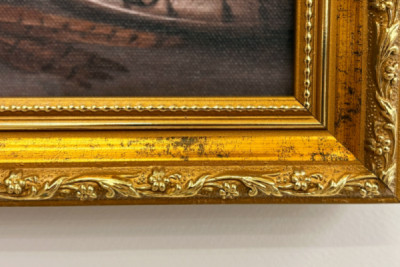
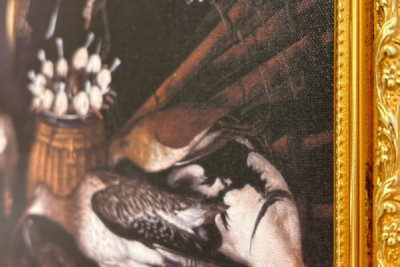
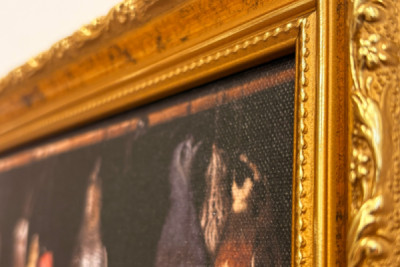
In this version on Leonardo (Satin) canvas, the dark painting meets Zumera, a Baroque picture frame in gold, directly; neither a passe-partout nor glass comes between them. What is crucial here is not gold as a mere decorative colour, but its relationship to the tones in the subject. Along the inner edge, a rich ochre stands alongside the deep black-brown of the background. Further out, lighter golden areas alternate with darker streaks, and it is precisely this broken interplay of colours that complements the brown wings, the basket and the rust-coloured shadows. Even the few red accents in the plumage gain strength from the warm border without appearing garish. This is particularly evident on the right, where a white bird’s body extends close to the golden edge: a stark, well-defined contrast emerges between the cool white of the feathers and the warm metallic tone. When oblique light falls on the surface, it becomes apparent just how precisely the print and the frame are coordinated - a detail that only catches the eye on second glance. The gold does not simply brighten the composition; rather, it draws a firm boundary around its darkness, ensuring the numerous individual motifs remain legible. Measuring 64 x 39 centimetres, the landscape format retains the character of a wide stage. Against a light-coloured wall, the image retains its nocturnal depth, and one quickly realises why a more understated frame would not have been appropriate.
 ×
×






 +43 4257 29415
 support@meisterdrucke.com
 Mo-Do: 7:00 - 16:00 | Fr: 7:00 - 13:00