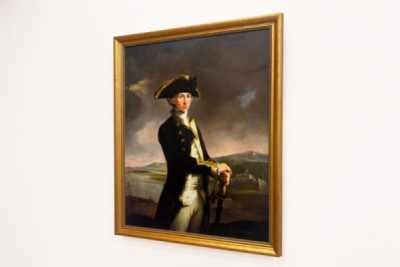
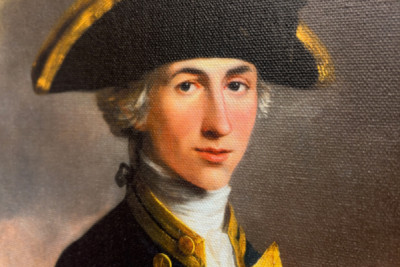
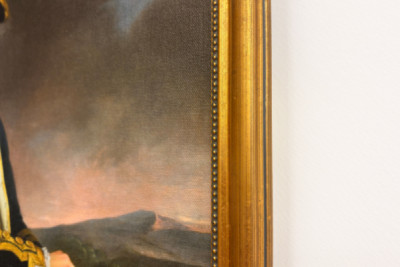
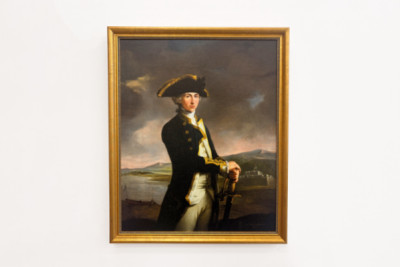
Nelson’s upright figure occupies almost the entire height of the painting; his body is turned slightly to one side, whilst his gaze leads directly out of the picture. The tricorn, uniform and sword reveal his rank and public role even before the subject’s name is mentioned. Behind him lies a coastal landscape featuring a boat, fortifications and distant mountains. Light streaks of cloud break through the brown sky, whilst a muted shade of pink lies on the horizon. Against this backdrop, the black of the uniform, the white of the neckerchief and individual golden trimmings stand out with great clarity. In this portrait from 1781, John Francis Rigaud combines dignified grandeur with a personal presence: Nelson appears in an official capacity, yet his face remains youthful and almost reserved. I am particularly fascinated by how much clothing and posture can reveal about a person - even those unfamiliar with Nelson’s later history can sense the significance of this figure. Thus, the work is part of the portraiture of the late 18th century whilst also preserving the memory of a historical figure.
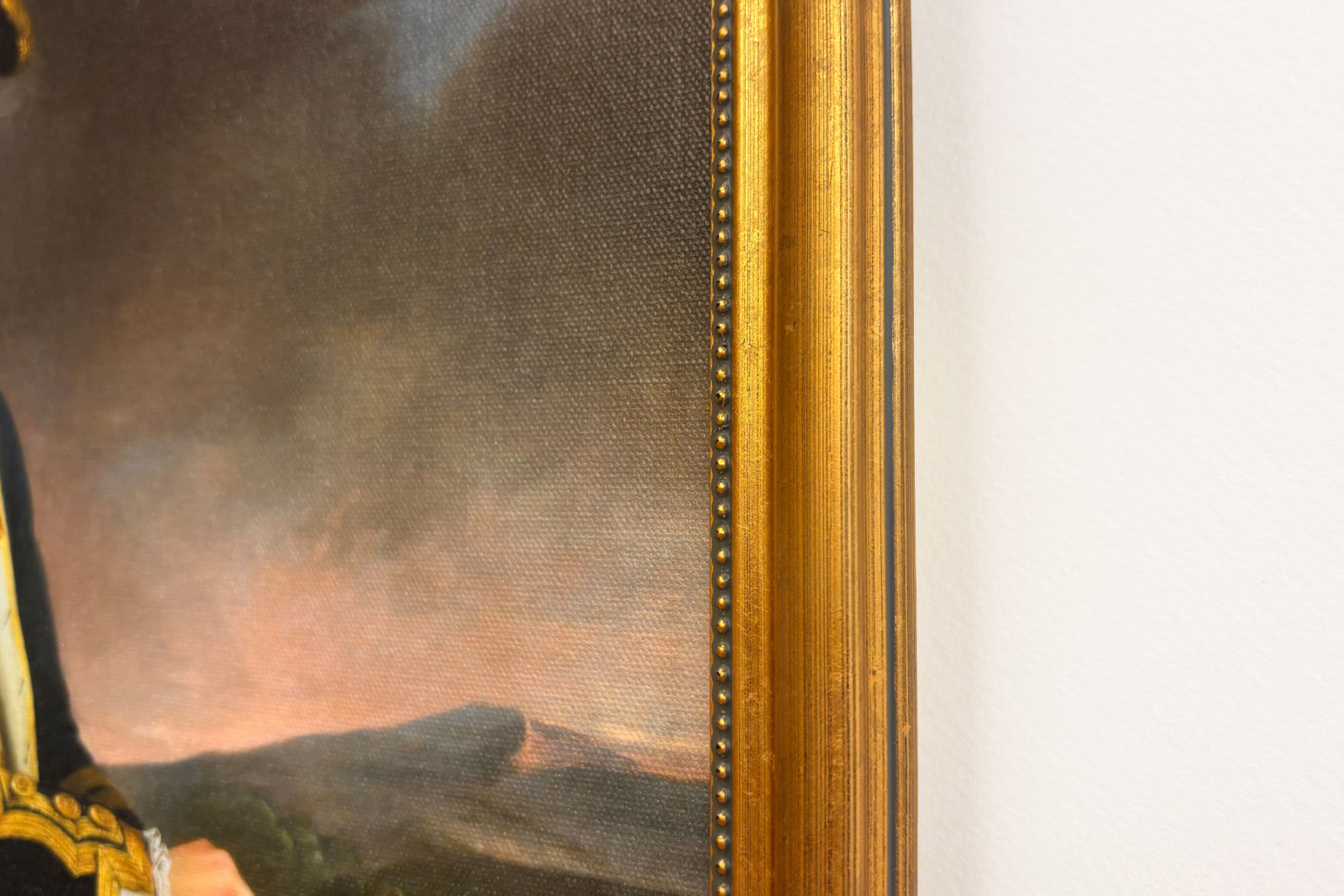
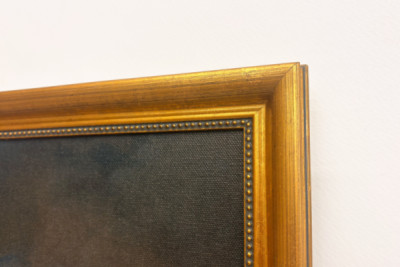
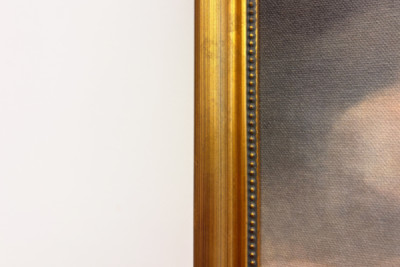
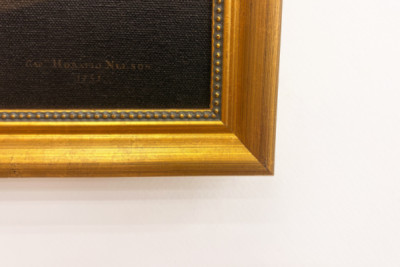
On the ‘Leonardo’ (satin) canvas, it is the face in particular that takes on a tactile surface. As one steps closer, one can make out the woven texture across the forehead, cheeks and neckerchief; raised threads run even through the soft contours of the skin. In the black areas of the hat and uniform, the printing inks lie thickly on the fabric, whilst finer sections reveal every tiny indentation. As a result, the surface does not appear to be a smooth reproduction, but rather has a tactile quality. Measuring 38 x 47 cm, the viewer’s gaze is drawn to the figure and her posture; without glass, this material effect remains immediate. On the outside, Noemi has added a narrow gold border with a sculpted beaded edge and a subtle patina. I find myself lingering longest on the areas where the eyebrows, the outline of the mouth and the fine hairline stand out with razor-sharp clarity despite the strong relief of the canvas - it is here that the reproduction demonstrates its true capabilities.
 ×
×





 +43 4257 29415
 support@meisterdrucke.com
 Mo-Do: 7:00 - 16:00 | Fr: 7:00 - 13:00