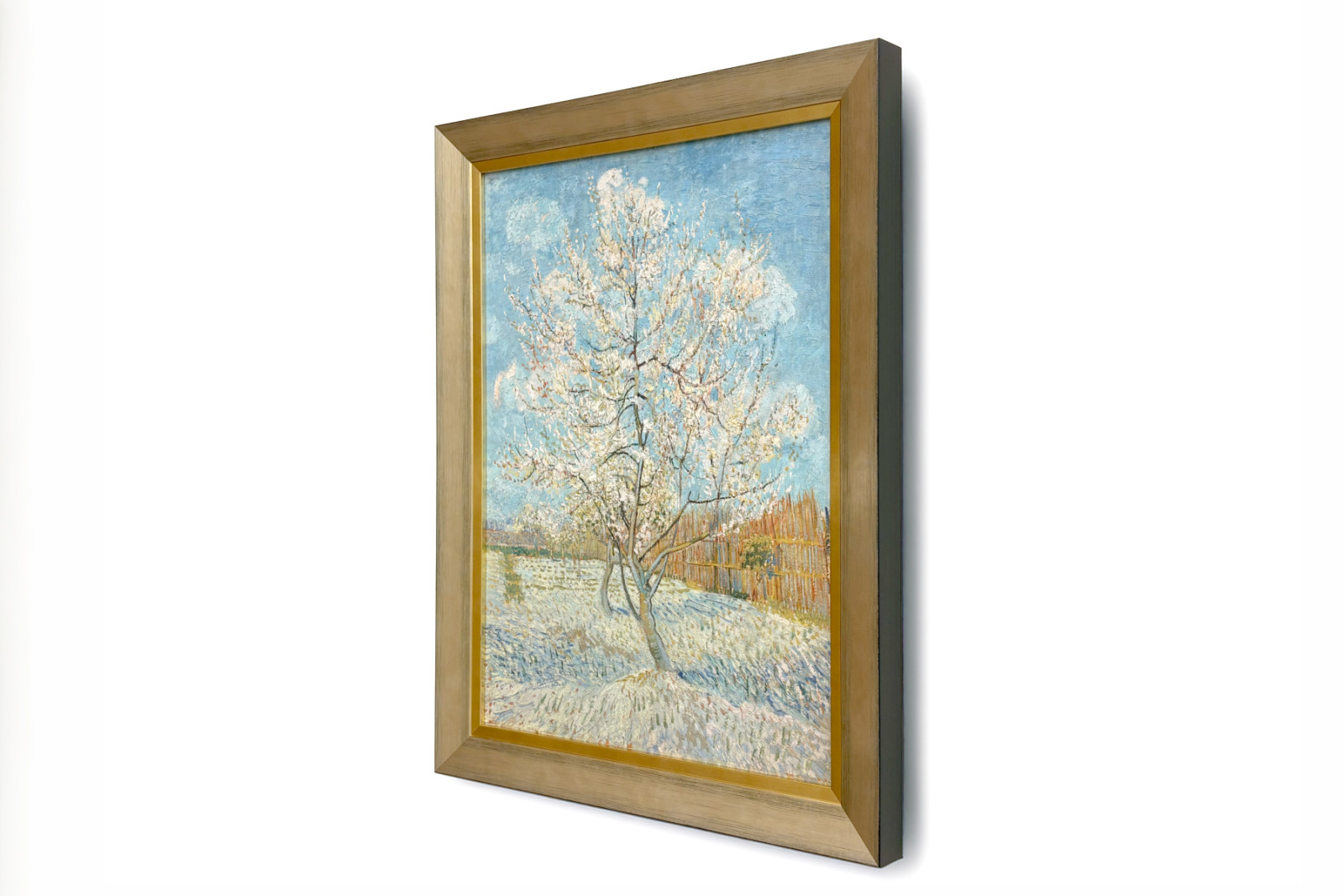
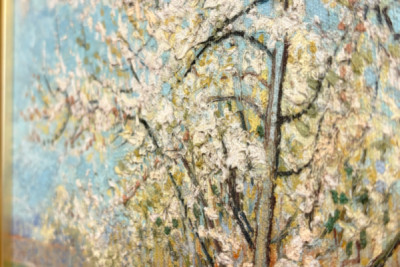
Almost the entire height of the picture is taken up by the peach tree: its trunk rises from the bright field, branches out several times and spreads its blossoming boughs against a blue sky. This central composition only appears fixed at first glance. Everywhere, short brushstrokes dissolve the contours, making the twigs shimmer and transforming the ground into a dynamic field of white, blue, green and delicate pink. On the right, an ochre-coloured fence sets a clear boundary; at the same time, its vanishing line leads into the depth, past further trees to the low horizon. In 1888, Vincent van Gogh painted the landscape not as a static still life of nature, but as something that is constantly changing before the viewer’s eyes. The blossoms are not meticulously counted details. They gather in bright clusters, dissolve into splashes of colour and reappear as a crown the very next moment. This is precisely what captures one’s attention: spring is not depicted here as gentle, but as almost impatient. Between the cool sky and the warm traces along the fence, the tree stands as a symbol of new growth, still slender and vulnerable, yet full of energy. Van Gogh is one of the defining Dutch artists of Post-Impressionism; here he combines direct observation of nature with that distinctive style which does not merely describe colour, but makes it the very essence of what is happening.
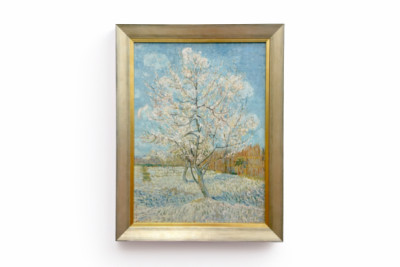
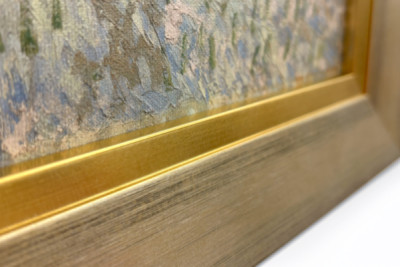
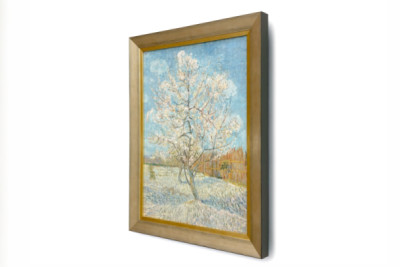
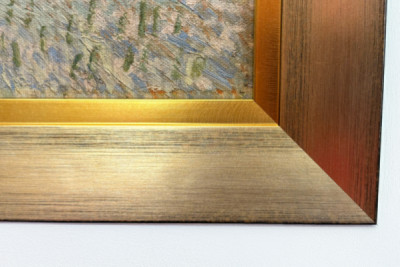
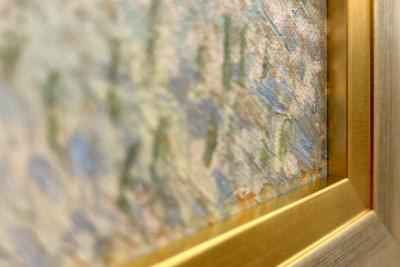
In this version, ‘Leonardo’, the satin-finished canvas, responds to the room’s light entirely without a glass pane. This is a wise decision: a reflective surface would obscure the painting’s restless rhythm too much. Instead, a soft glow drifts across the sky and refracts where the printed brushstrokes are particularly dense. Around the central branches, small reflections sit on the white and pink blossoms; they flash intermittently, whilst the dark lines of the trunk remain clearly visible. Further down, the light spreads across the diagonal strokes of the field, revealing their changes in direction without forming a uniform sheen. When the viewer’s gaze shifts to the side, the surface noticeably brightens; when viewed head-on, it settles down again. This gradation works well for the subject, as the tree appears denser or more airy depending on one’s vantage point. Mare frames the canvas with a champagne-coloured wooden strip; on the inside, a narrow gold edge creates a concentrated halo of light. Perhaps the most beautiful detail: at the lower corner, this clear golden sheen meets the softer glow of the canvas, whilst the blue-grey strokes of the field immediately beside it remain almost entirely free of reflection.
 ×
×






 +43 4257 29415
 support@meisterdrucke.com
 Mo-Do: 7:00 - 16:00 | Fr: 7:00 - 13:00