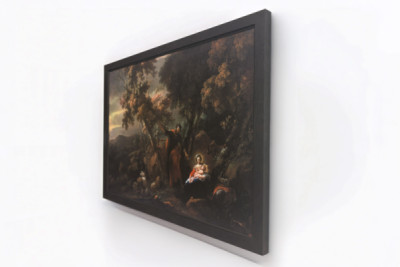
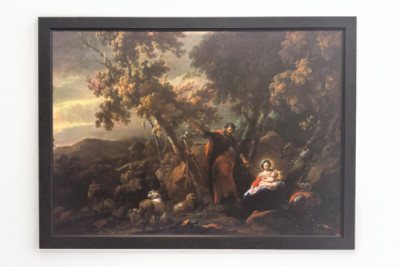
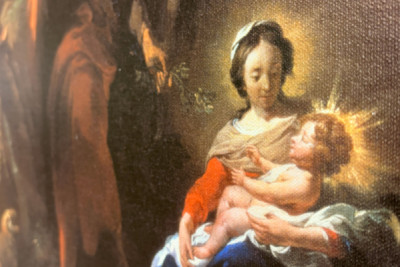
Beneath a spreading canopy of leaves, the Holy Family rests at the edge of a rocky path. Mary sits to the right of centre, holding the Child on her lap; a bright glow surrounds both figures and sets them apart from the dark forest floor. Joseph stands beside his mount, his arm raised towards the tree, whilst sheep and goats rest amongst stones and low bushes. To the left, the landscape opens out onto distant hills and a yellowish sky. This side light glances off tree trunks, foliage and individual animals, but quickly fades into shades of brown, olive green and black. Red appears only in isolated patches: in Joseph’s cloak, on Mary’s sleeve and on the discarded luggage. Nicolaes Pietersz. Berchem constructs the scene, painted in 1640, using multiple layers of depth. The open sky forms a contrast to the sheltered resting place, whilst the path and the waiting animal serve as a reminder of the flight that is not yet over. As a result, tranquillity and uncertainty coexist within the picture - it is precisely this tension that makes the scene so compelling.
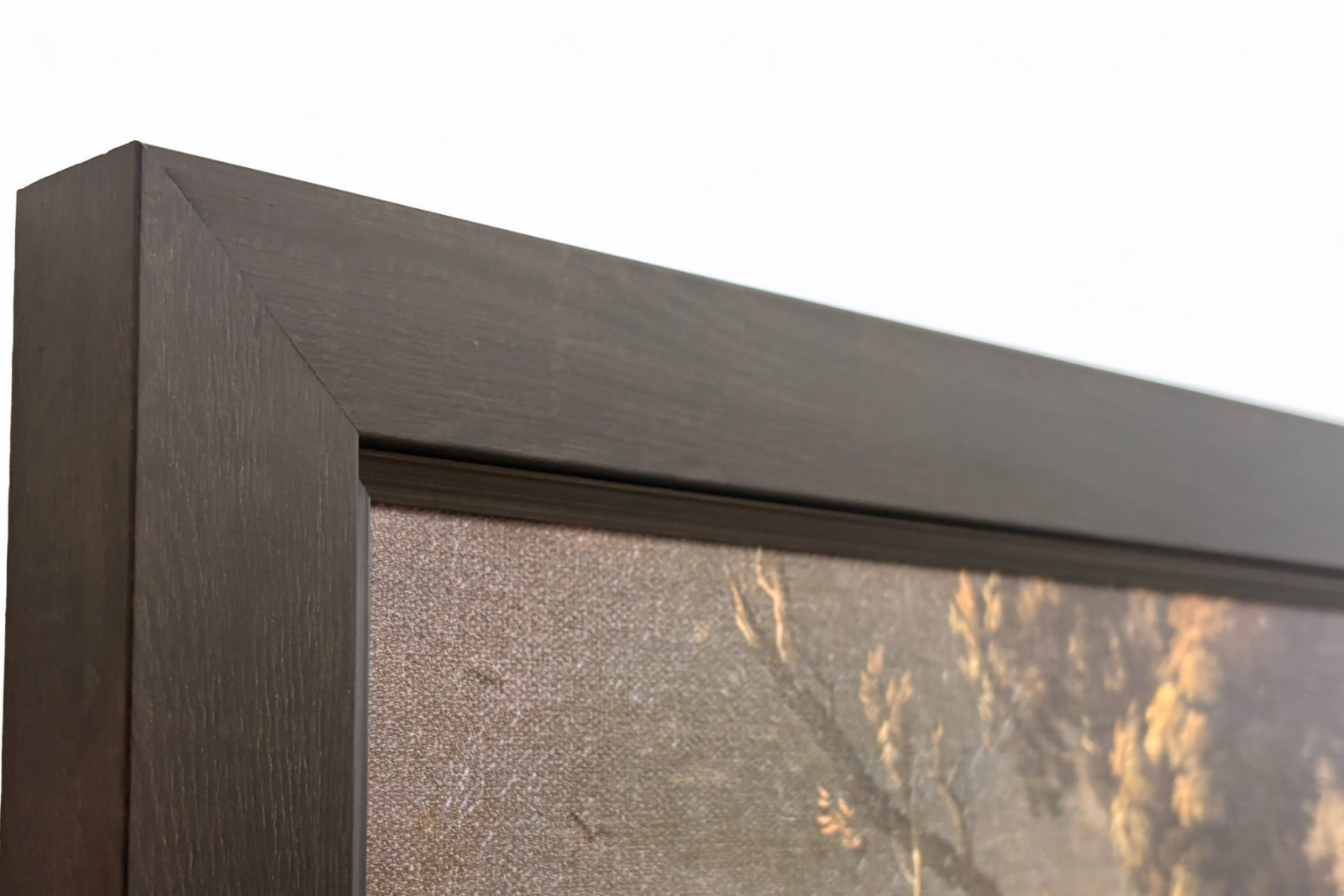
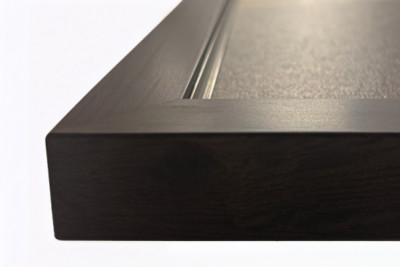
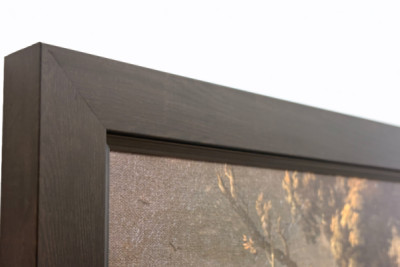
In this version, the canvas - with a satin finish - bears the motif without glass; Alia frames the 81 x 58 cm work in a wide wooden profile. The ebony veneer does not appear as an opaque black: Fine brown grain patterns run along the mouldings, becoming more pronounced at the lower edge. To examine the workmanship, look at the top corner - the mitre joint meets in a straight line, and the wood grain changes direction cleanly at that point. On the outside, the frame ends in a simple, slightly rounded edge. Towards the inside, there is a narrow step before Carlee appears as a dark fillet immediately adjacent to the picture surface. Its two fine grooves draw a clear border around the motif; at the corner, they meet without any misalignment, which is by no means a given with such narrow profiles. A narrow shadow gap remains visible between the outer profile and the fillet, the depth of which is clearly visible at the top left-hand corner.
 ×
×






 +43 4257 29415
 support@meisterdrucke.com
 Mo-Do: 7:00 - 16:00 | Fr: 7:00 - 13:00