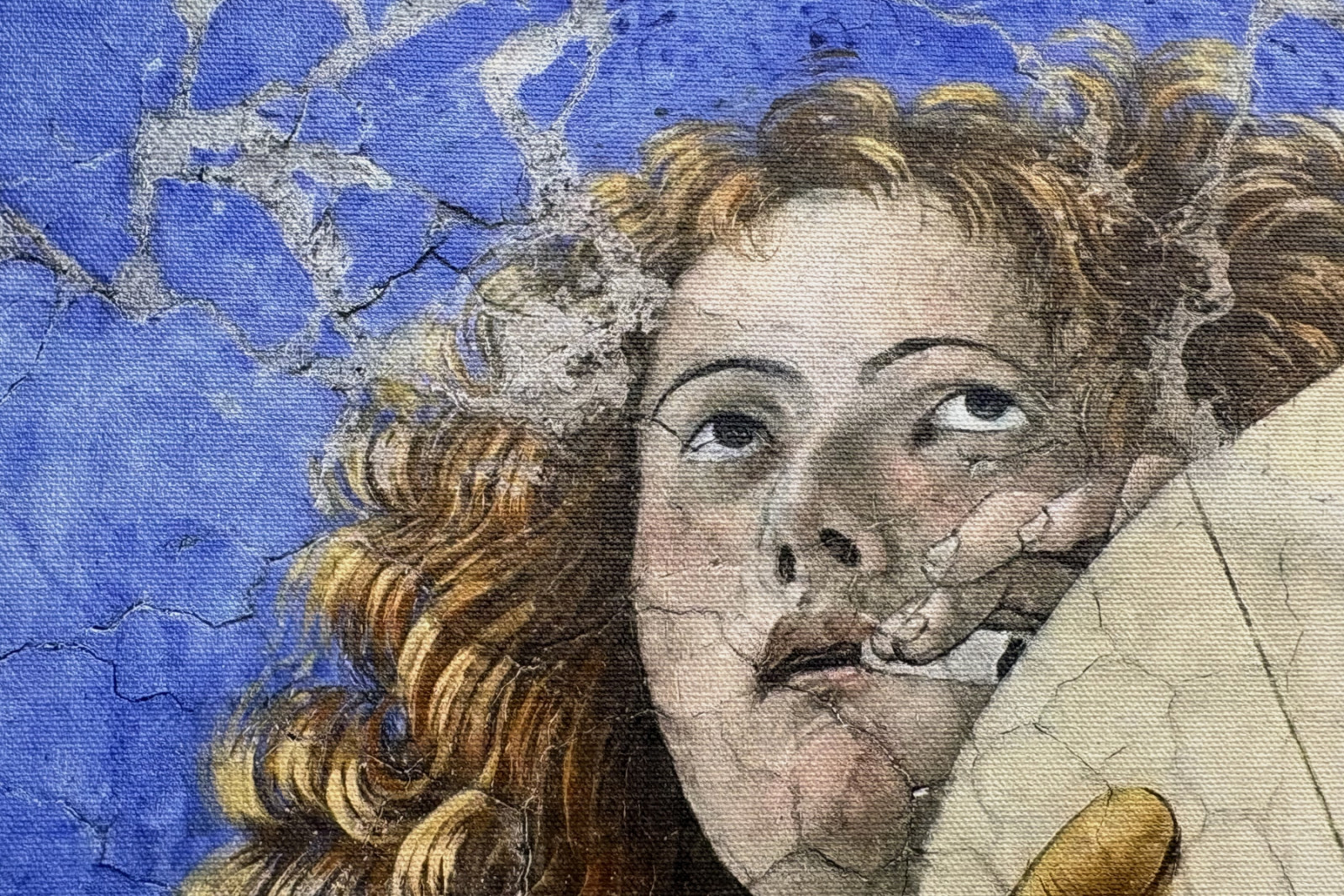
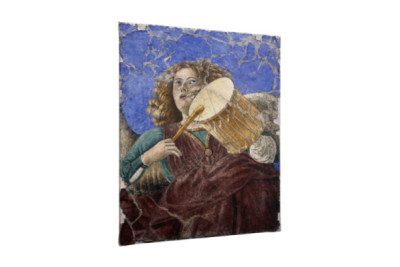
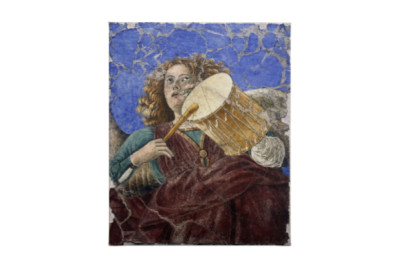
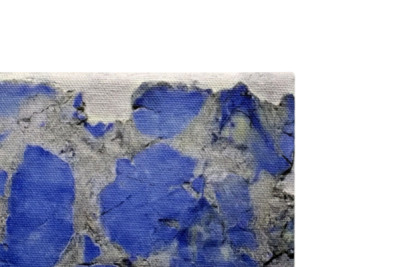
The drum stands diagonally in front of the face within the pictorial space; its light-coloured skin draws the eye to the angel’s eyes, which are directed upwards. This counter-movement defines the composition: The instrument moves forwards, whilst the gaze extends beyond what is visible. Golden-brown curls frame the face, whilst wings emerge from behind the shoulders. Above the turquoise sleeve, a wine-red cloak unfolds, its folds filling the lower half of the picture. This contrasts with the blue of the background, criss-crossed with cracks and areas where the paint has flaked away. In the ‘Musical Angel’, Melozzo da Forlì combines physical proximity with a focus that is directed elsewhere. The hand holds the mallet without any apparent effort. Despite the instrument, the impression conveyed is therefore less one of volume than of composure. At the same time, the damaged surface of the painting does not allow for unbroken rapture: its marks are part of the present-day appearance and lend the face a vulnerability that endures alongside the music.
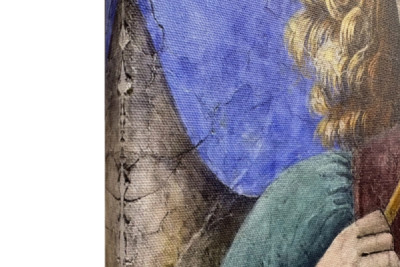
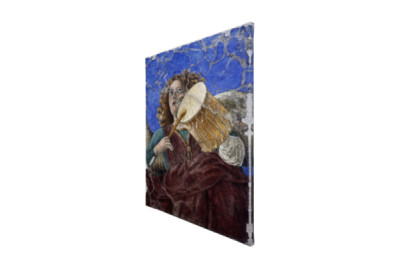
In this reproduction on ‘Leonardo’ satin canvas, the rendering of the cracks in the face is particularly striking. A line runs across the cheek, whilst further marks traverse the chin and forehead; the print clearly distinguishes them from the shadows cast by the nose and eye sockets. It is precisely this distinction that is important, and it is not achieved on every canvas. The damage does not obscure the expression, but allows it to persist amidst its distortions. Even beside the mouth, the fingers remain discernible despite the contours converging there - it takes a moment to distinguish them from the lips, but once you do, they are there. Thus, this version depicts not only a musician angel, but also the painting’s traditional state, without smoothing it over. When light falls on the satin surface, it slightly highlights the curve of the cheek, and the modelling remains discernible rather than becoming blurred.
 ×






 +43 4257 29415
 support@meisterdrucke.com
 Mo-Do: 7:00 - 16:00 | Fr: 7:00 - 13:00