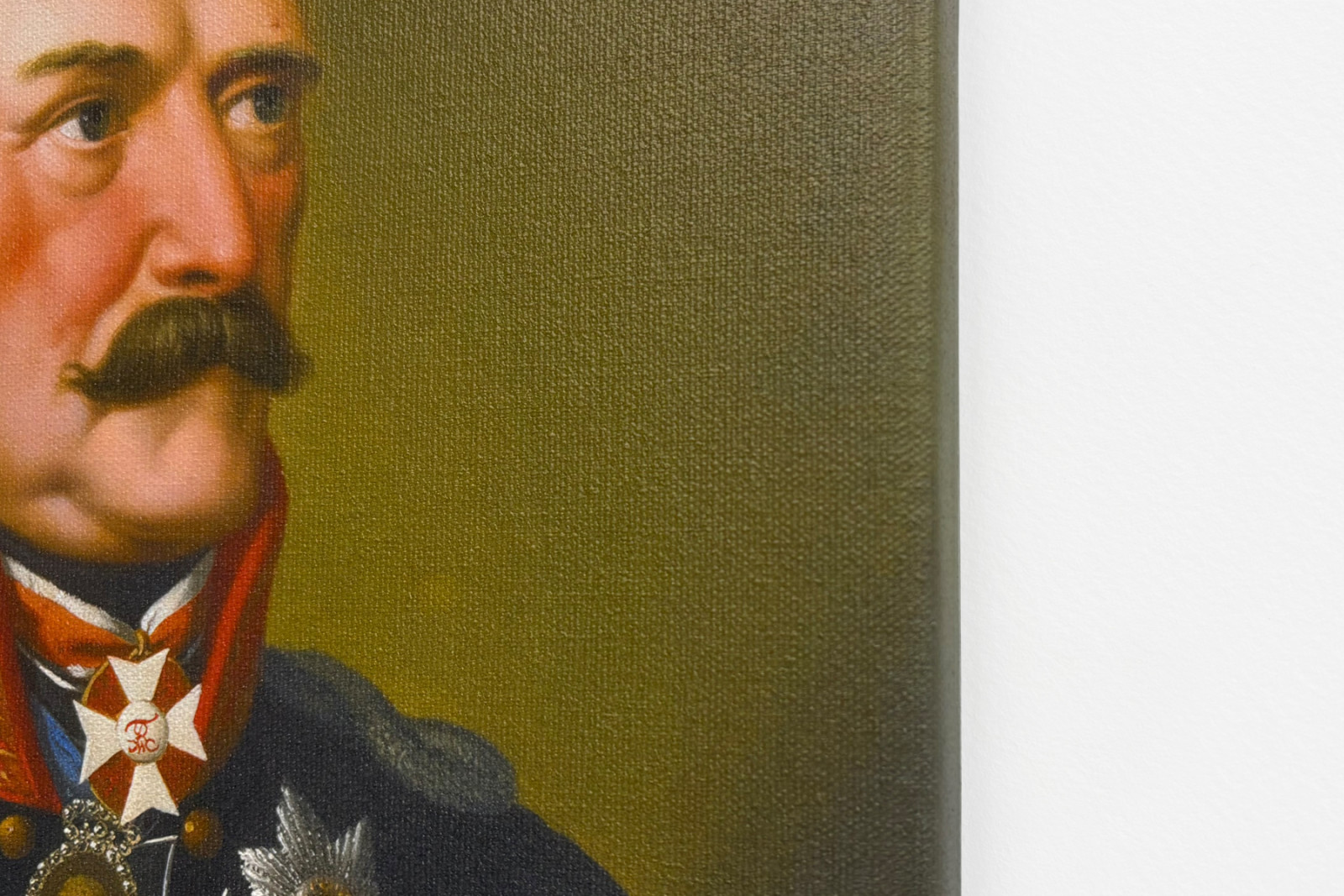
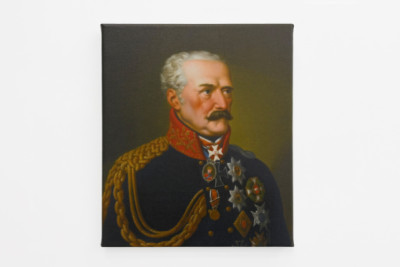
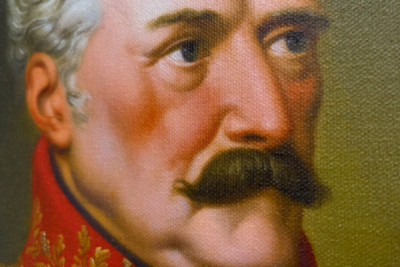
Blücher’s gaze is directed to the right, past the viewer; there is a tension beneath his brows that lends his face a certain unyielding quality. His white hair and moustache define his head just as distinctly as the flush on his cheeks. Eduard Ströhling depicts Gebhard Leberecht von Blücher, Prince of Wahlstatt, as a man whose public standing is reflected in his attire: Medals cover his chest, golden cords form arches across his uniform, and the red stand-up collar reaches right up to just below his chin. There is much here to catch the eye, yet the face remains the focal point. Light falls from the left onto his forehead, temples and cheek; behind his head, the otherwise dark background opens out into an olive-coloured field. This gives the turn of the head space, without the figure needing to be accompanied by a landscape or an interior. Ströhling constructs the portrait from this contrast: the insignia denote rank and honour, whilst the mouth, eyes and the wrinkles around the nose reveal a human being. This is not an approachable subject, and I am not sure whether one would wish to gaze at this face for long. Yet it is precisely this distance that defines the portrait’s impact; his demeanour speaks just as much as his regalia.
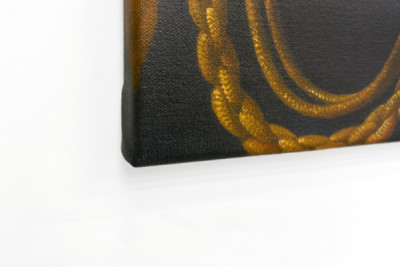
In this reproduction on Leonardo (satin) canvas, it is worth taking a look at the golden shoulder cords in the bottom left-hand corner. It is not merely their curves that remain legible in the print: within the thicker strands, points of light alternate with indentations, whilst individual coils stand out against the darkness of the uniform. At the bottom edge of the picture, a cord runs diagonally out of the neckline, with two arches intertwining above it. It is by no means a given that one can distinguish these elements; at 30 x 35 cm, such a trim can easily blend into a single golden-brown expanse. Here, the strands retain their direction and spacing. At the same time, it remains clear that they are painted: the variations in brightness convey a sense of volume without pretending to be metal. What makes this version so compellingis more than mere sharpness, because the drawing explains how the cords wrap round one another - this is precisely the point where I got stuck whilst examining it. Without a decorative frame or passe-partout, the intricacy of the uniform is immediately apparent at the edge of the picture; this concise finish gives the stately portrait a matter-of-fact boundary that suits it well.
 ×






 +43 4257 29415
 support@meisterdrucke.com
 Mo-Do: 7:00 - 16:00 | Fr: 7:00 - 13:00