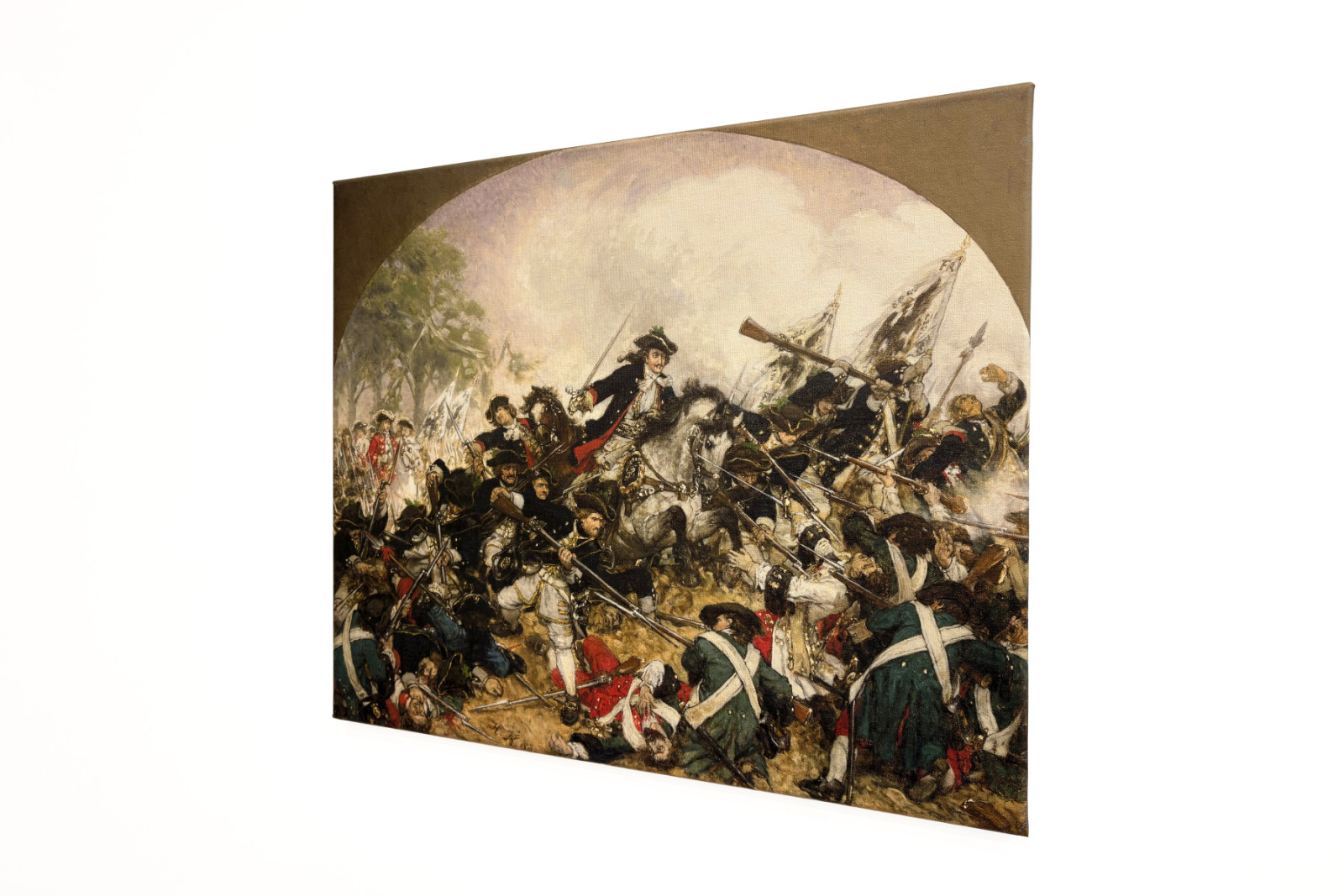
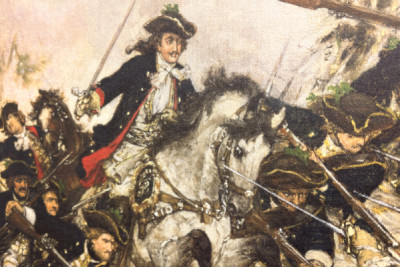
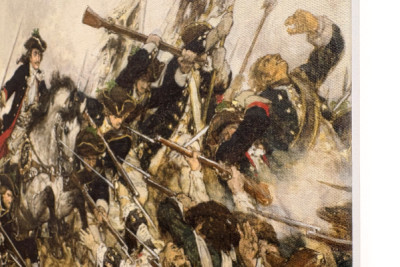
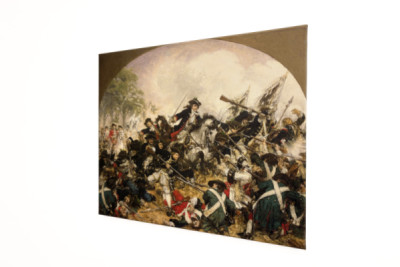
Rifle barrels cut across the throng, sabres and lances form sharp diagonal lines, whilst above the densely intertwined bodies of soldiers and horses, a vast, almost circularopen up, giving the battle at least some breathing space upwards. In the elevated centre, the Old Dessauer leads the charge on a white horse, his rapier raised, surrounded by banners, gunpowder smoke and men whose movements are barely distinguishable from one another; Black, off-white and earthy tones dominate the scene, whilst red uniform details provide sharp accents. Hermann Joseph Wilhelm Knackfuss painted the picture in 1883 and belongs to that generation of German history painters who recounted past events not as a sober chronicle, but as a vivid drama-and one can see how skilfully he manages the composition of the main figure: despite the turmoil, the commander remains clearly identifiable because his posture, his horse and his raised sword form a distinct line of sight. The Battle of Turin thus appears less as an orderly military operation than as an immediate clash - loud, close-quarters and physical - yet at the same time, the detachment of a historical commemorative image pervades the whole.
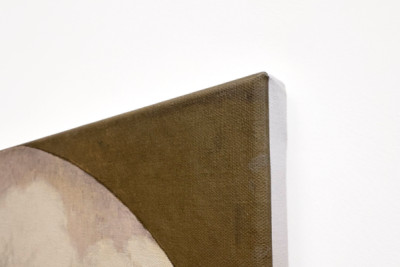
In this version, the canvas stretched over a stretcher frame-Leonardo-takes on the outer form all by itself, without a decorative frame, passe-partout or glass-and even a stretched canvas alone has its charm. If you look more closely, you can see that the clean edge replaces any additional moulding: At the top right-hand corner, the fabric is stretched taut over the wooden frame; the fold sits just behind the front, and a slight thickening at the corner reveals how the material is folded over there. No mitred joint distracts from this construction with ornamentation; instead, the straight outer line traces the compact form of the 57 x 48-centimetre work. A white border runs along the side, indicating where the printed front surface ends, whilst the upper folded edge continues in a dark shade and meets precisely at the corner. The satiny quality of ‘Leonardo’ remains perceptible only as a subtle surface texture. Viewed from an oblique angle, it becomes particularly clear that this piece does not pretend to be a framed panel painting: it stands out visibly from the wall as a stretched canvas, with firm edges and a delightfully straightforward finish.
It is precisely this combination of densely narrated historical painting and the openly displayed stretcher frame that lends the reproduction its authenticity, as nothing stands between the image and the viewer. Standing on its own against a bare wall, the canvas itself speaks for itself - the turmoil of the battle needs no heavy frame to make an impact.
 ×
×






 +43 4257 29415
 support@meisterdrucke.com
 Mo-Do: 7:00 - 16:00 | Fr: 7:00 - 13:00