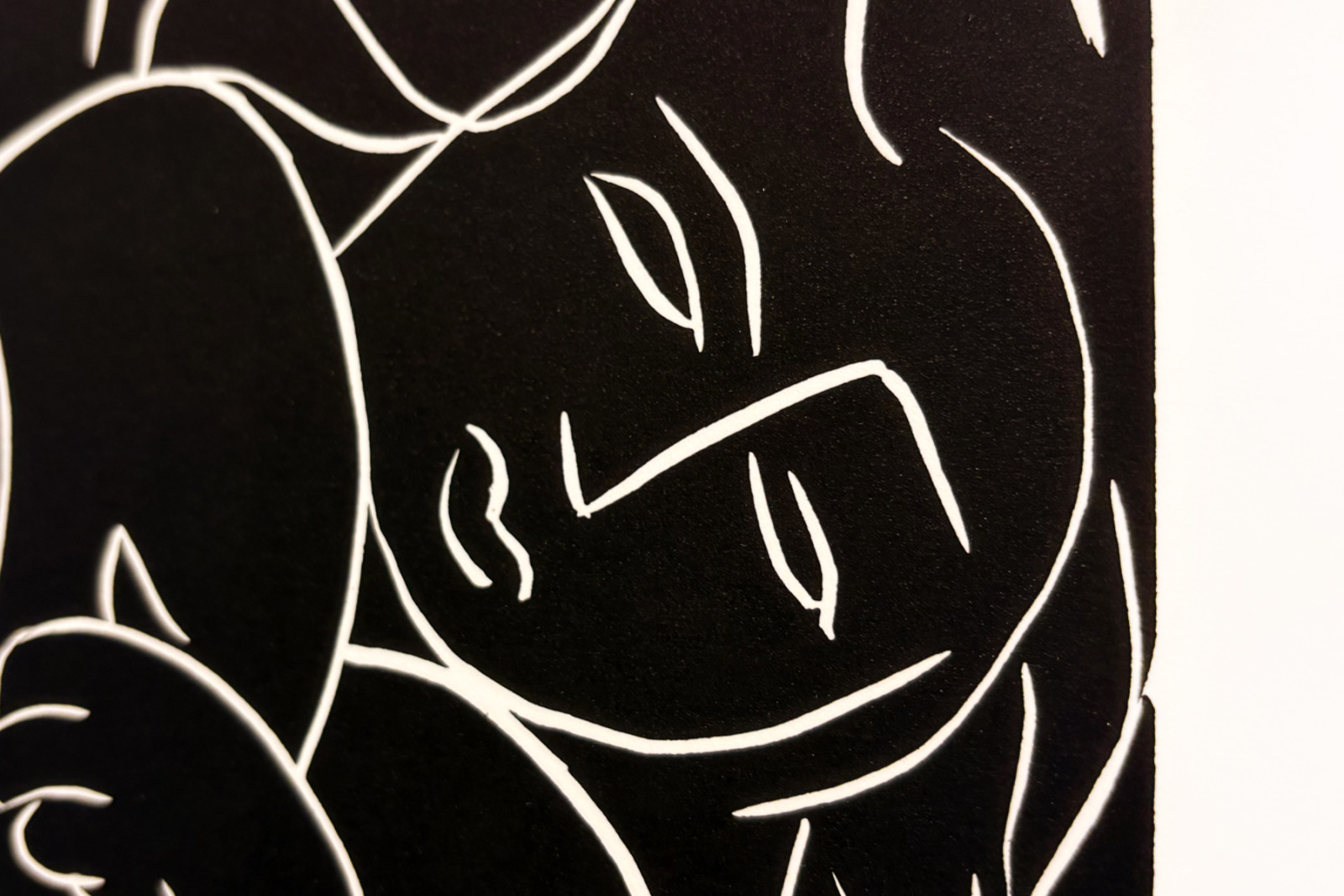
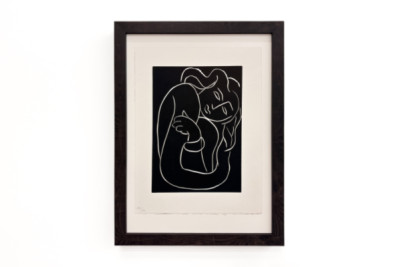
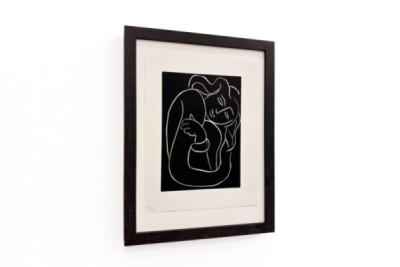
White lines run through a black surface, as if someone had carved light out of the darkness with a knife - which is exactly what Matisse did. *Pasiphaé* was created in 1944 as a linocut illustration for Henry de Montherlant’s play of the same name, and the technique turns drawing on its head: it is not the line that is applied, but rather its surroundings that remain. A female figure is curled up within herself, her head resting at an angle on her bent arm; her closed eyes are merely two narrow curves, a bangle a short double line. No shadow, no modelling - the outline alone conveys the body, the posture and an almost dreamlike tenderness. Matisse, already in his seventies at the time and in poor health, reduces the image here to the bare essentials, and it is precisely this reduction that makes the figure so vivid. There is plenty of drama in the mythological source material, yet the print itself radiates, above all, tranquillity: an introspective figure, enveloped in deep black as if by night.
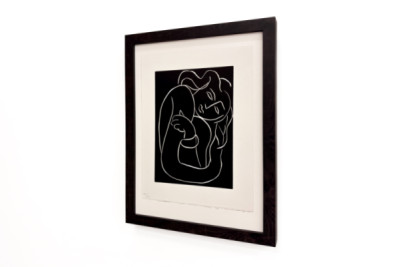
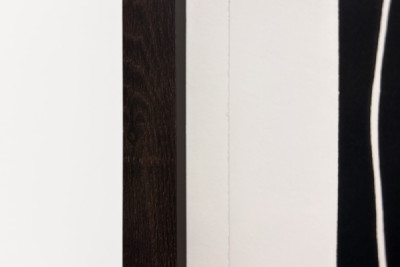
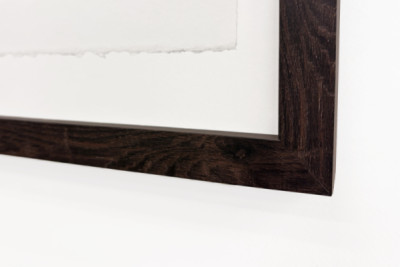
The print is produced as a matt FineArt photograph, and this paper suits the subject like few others: the black is velvety and completely glare-free, whilst the white lines stand out with crisp edges. If you look closely, you will discover a fine grain in the matt surface - it lends the print a graphic quality, almost the character of an original print, and it truly catches the eye. At the bottom edge, the sheet tapers into an irregularly torn handmade edge; to the left of this is a small number in a pencil-like style; without a passe-partout or glass, the paper hangs freely within the frame, with a visible edge and a slight shadow cast behind it. The frame is by Ernesta, an ebony-effect profile whose distinctive feature is only noticeable from the side: it is significantly taller than it is wide, so that the frame protrudes from the wall like a flat box, lending the sheet a tangible sense of depth. The mitre joints fit together precisely, the dark grain runs vividly across the sides, and the narrow inner edge slopes steeply down towards the paper. Against a light-coloured wall, the whole piece looks like a single, seamless object - understated enough for a bedroom, yet striking enough for a hallway where you pass it every day.
 ×
×






 +43 4257 29415
 support@meisterdrucke.com
 Mo-Do: 7:00 - 16:00 | Fr: 7:00 - 13:00