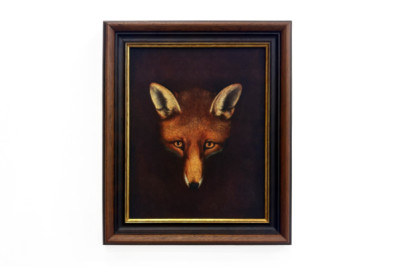
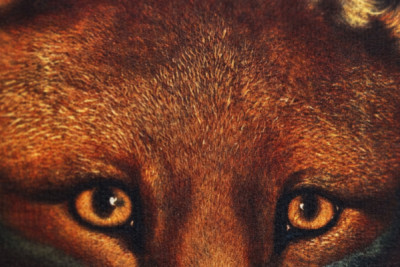
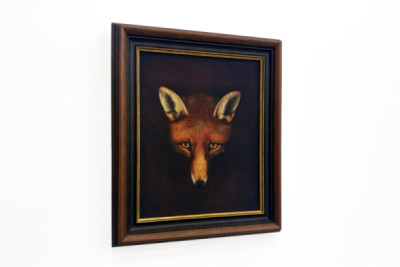
A fox’s head stares directly at the viewer from the darkness. No body, no landscape, no prey - just the pointed muzzle with its black nose, two pricked-up ears with light-coloured inner fur, and the amber-coloured eyes, each containing a small point of light. The background is a deep reddish-brown, which almost turns to black at the edges, making the head appear to float like a mask. The coat is rendered with thousands of short strokes: golden tips against a copper-red background on the forehead, darker streaks on the cheeks, a whitish sheen beneath the eyes. Philip Reinagle, born in 1749 and died in 1833, was one of the leading British animal painters of his time, and the close-up detail reveals just how closely he studied the animal. ‘Renard’, a name drawn from the medieval fable tradition, gives the picture its title - though here the cunning fox is not a storyteller, but a silent figure who simply observes.
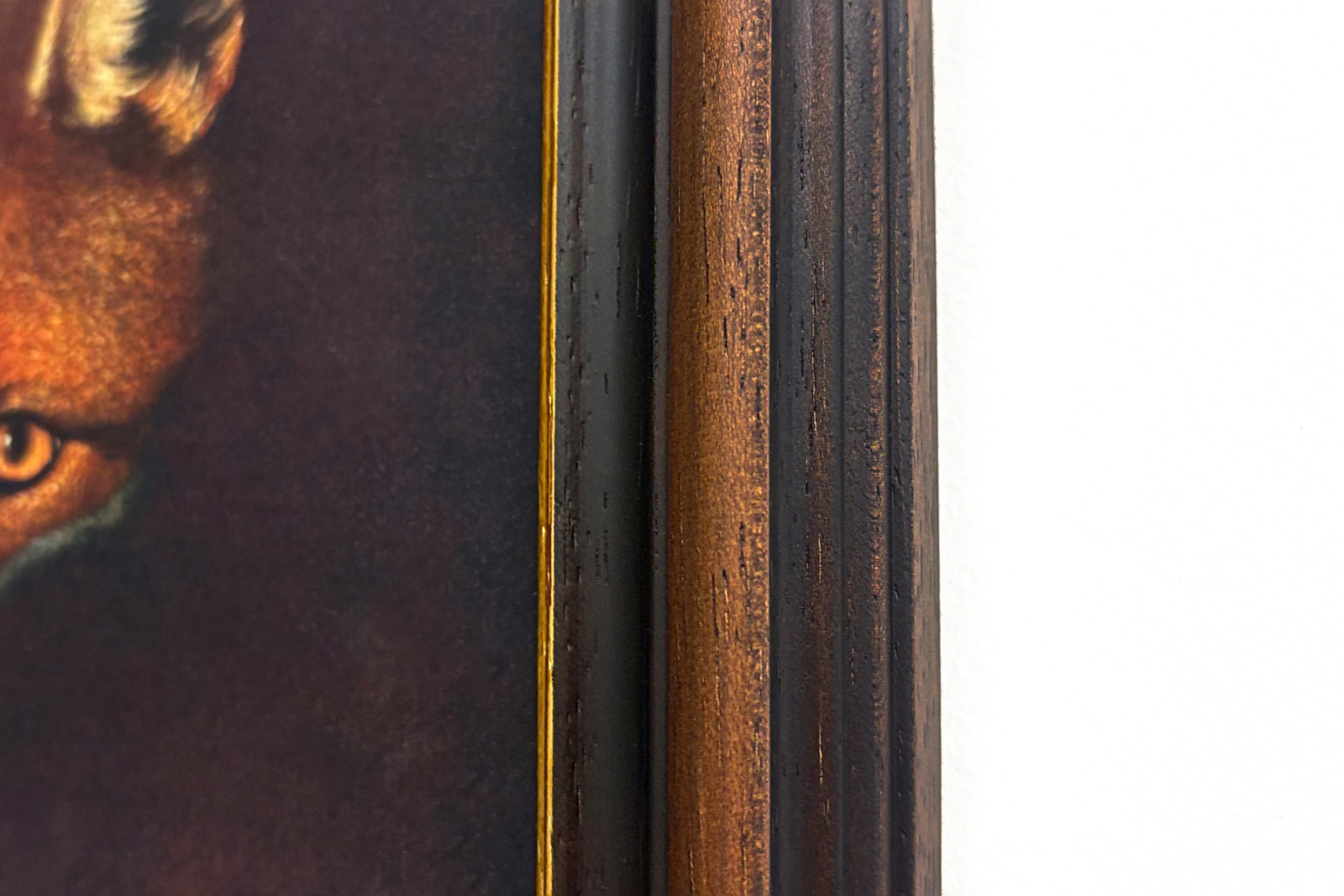
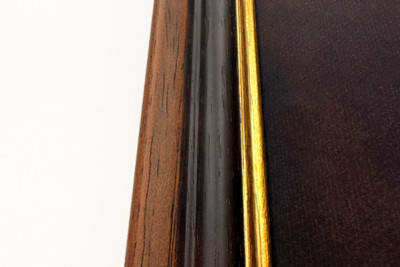
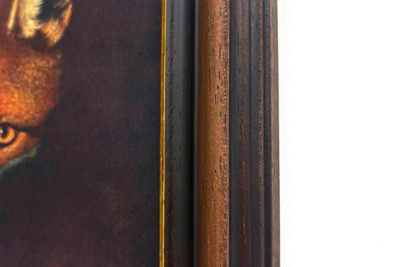
This head is painted on Dürer watercolour paper, and the fur in particular is worth taking a closer look at: The grain of the paper carries the strokes of the fur and lends them a slight roughness, so that the golden tips on the forehead do not lie flat, but appear as if drawn with a dry brush across a textured surface. Nor does the dark background remain a flat, lifeless area - a cloudy pattern emerges in the brown, inherent to the card itself, which enhances rather than detracts from the depth of the background. There is no glass in front of it; the matt surface stands exposed within the frame. I wouldn’t have thought such a sturdy frame suitable for a small 20 x 25 cm sheet, but Lana, at 37 mm, treats the motif like a painting, and the sheet stands up to it: on the outside, a strip of brown-glazed wood in which the pores remain visible as dark lines; then a grooved section in black; and on the inside, a narrow gold edge that meets the card directly. The brown of the wood is just a few shades different from the fox fur, the black echoes the background, and the gold border is the same shade as the highlights on the forehead and ears.
Viewed from the side, the stepped depth of the moulding becomes apparent, and the gold edge casts a bright line onto the edge of the dark card, where the background is at its blackest. This is where my attention is caught: the fox is indeed sitting in the dark, and the frame does not isolate this scene but rather creates a hollow.
 ×
×





 +43 4257 29415
 support@meisterdrucke.com
 Mo-Do: 7:00 - 16:00 | Fr: 7:00 - 13:00