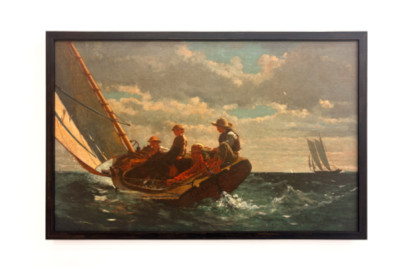
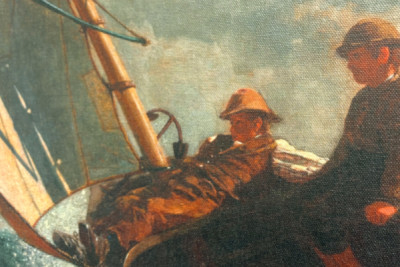
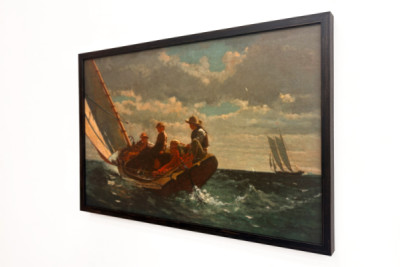
The boat heels sharply to starboard, the waves crashing dark green against the hull - and right in the middle of it all sit three boys and a man, as if nothing were amiss. Winslow Homer is not depicting a maritime emergency here, but quite the opposite: a calm confidence in the wind and weather. The boy at the stern holds the tiller, his gaze fixed on the horizon, where a schooner with full sails is passing by. Above it all is a sky of grey and pink cloud banks, through which a pale turquoise breaks here and there. Homer, one of the defining American painters of the 19th century, exhibited the work in 1876 at the Centennial Exhibition in Philadelphia - in the year of the hundredth anniversary of independence, many were quick to interpret this small sailing scene as a symbol of a young nation looking confidently to the future. The painting conveys this sense of confidence to this day: the spray, the boat’s tilt, the rolled-up sleeves - and yet a complete sense of calm on the faces.
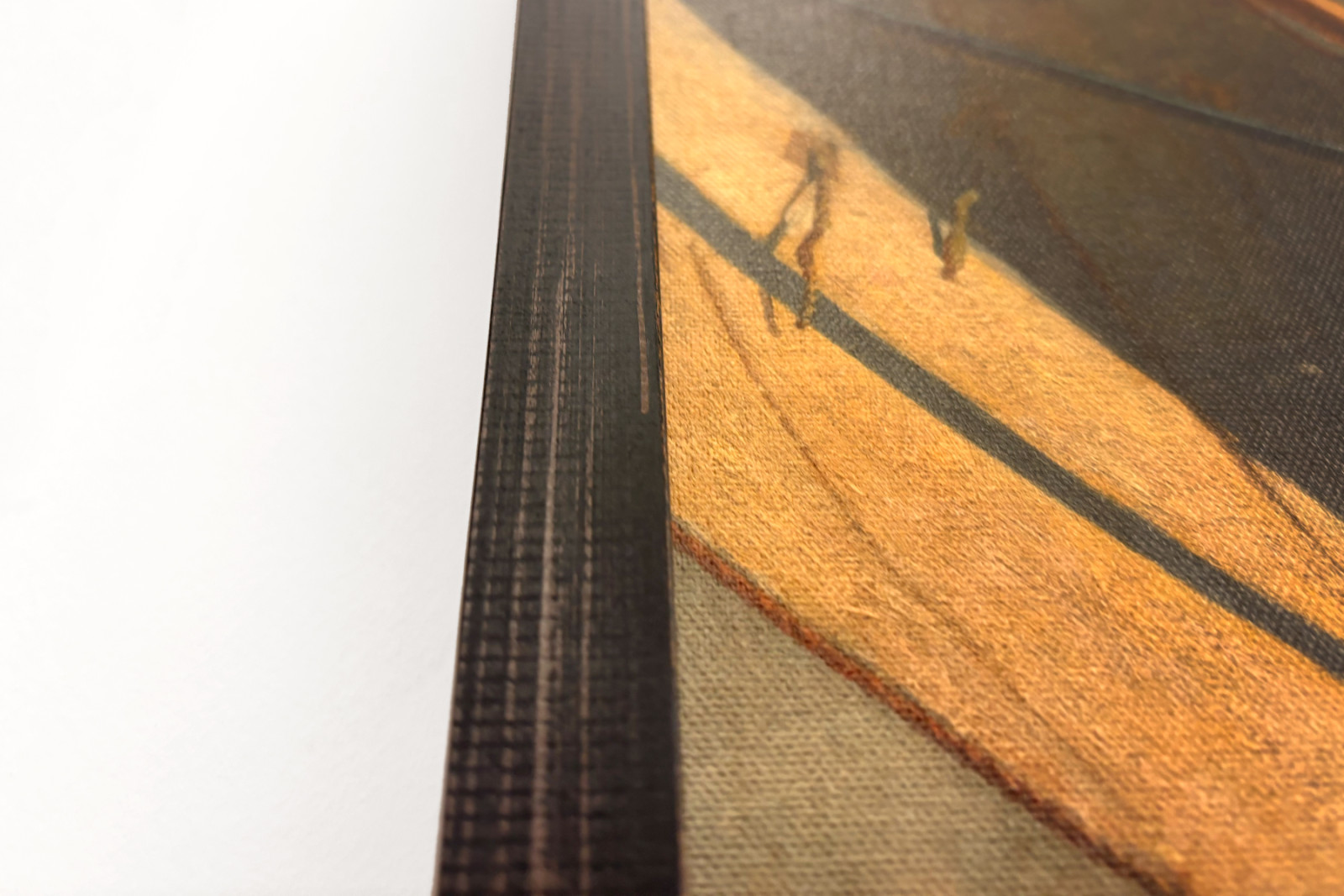
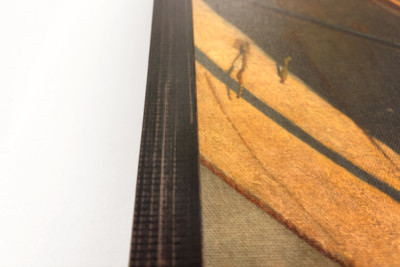
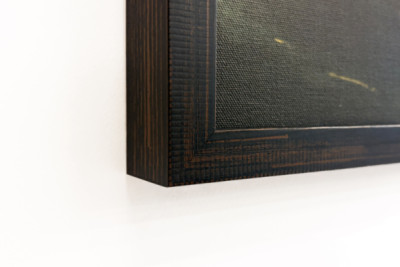
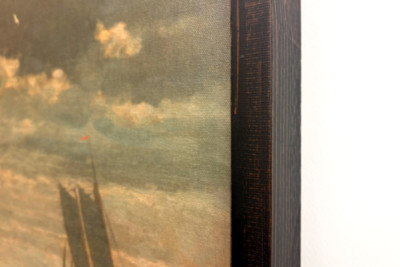
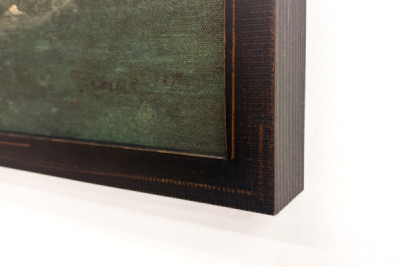
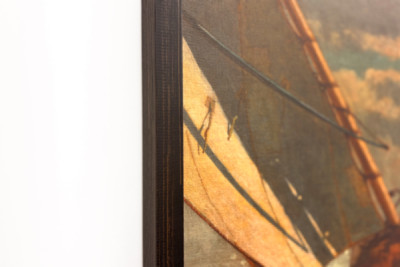
In this version, the eye is first drawn to the boy leaning into the boat at the bow - his hat pulled low over his face, his arm resting relaxed over the edge. It is precisely this detail that the print captures with astonishing nuance: the brown and rust-red tones of his clothing stand out clearly from one another, and the small anchor claw beside the mast stands out sharply against the bright sky. On the satin-finished canvas, a subtle shimmer lies over the cloud sections, whilst the dark expanses of water retain their depth - this could easily have looked flat on a smooth surface, but here it works. The whole piece is framed in ‘Lola’, a narrow, dark-brown real wood frame with a bark-like texture, through which the brown beneath the black top coat shines through. For a painting from 1876, it looks surprisingly natural.
 ×
×






 +43 4257 29415
 support@meisterdrucke.com
 Mo-Do: 7:00 - 16:00 | Fr: 7:00 - 13:00