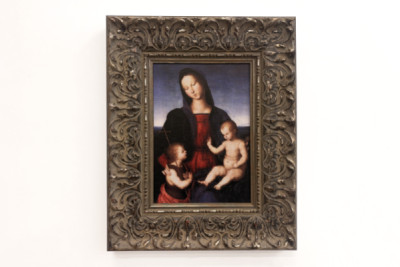
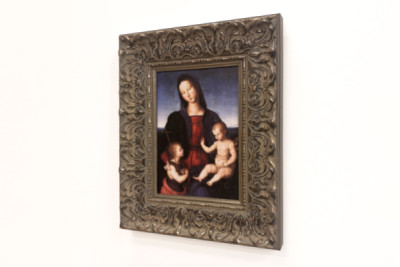
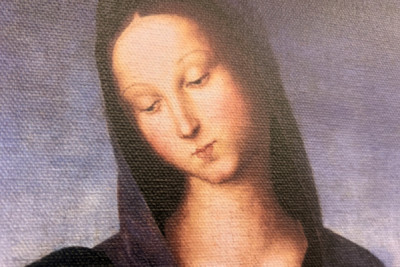
Fine threads of the fabric stretch across Mary’s forehead and remain visible as a tangible pattern even against her fair skin. From there, her gaze, with her eyelids closed, descends to the two children: On the left, the young John kneels with the cross-staff; on the right, the Christ Child sits on her lap and raises his hand towards him. Mary connects the two figures through her serene demeanour; her red dress forms the centre, whilst her dark cloak envelops her shoulders and the children. A blue sky opens out above the group, with a narrow strip of landscape on the horizon. This creates a clear triangular composition that establishes a sense of closeness without reducing the scene to the mundane. Raphael painted the ‘Diotalevi Madonna’ in 1503, thus at the very beginning of his career. Even here, one can see the order that would later characterise his Madonna paintings: gazes, hands and bodies communicate quietly with one another. One’s gaze lingers longest on the slight distance between the children. The movement of their hands almost bridges it, yet a trace remains, lending the encounter an air of anticipation.
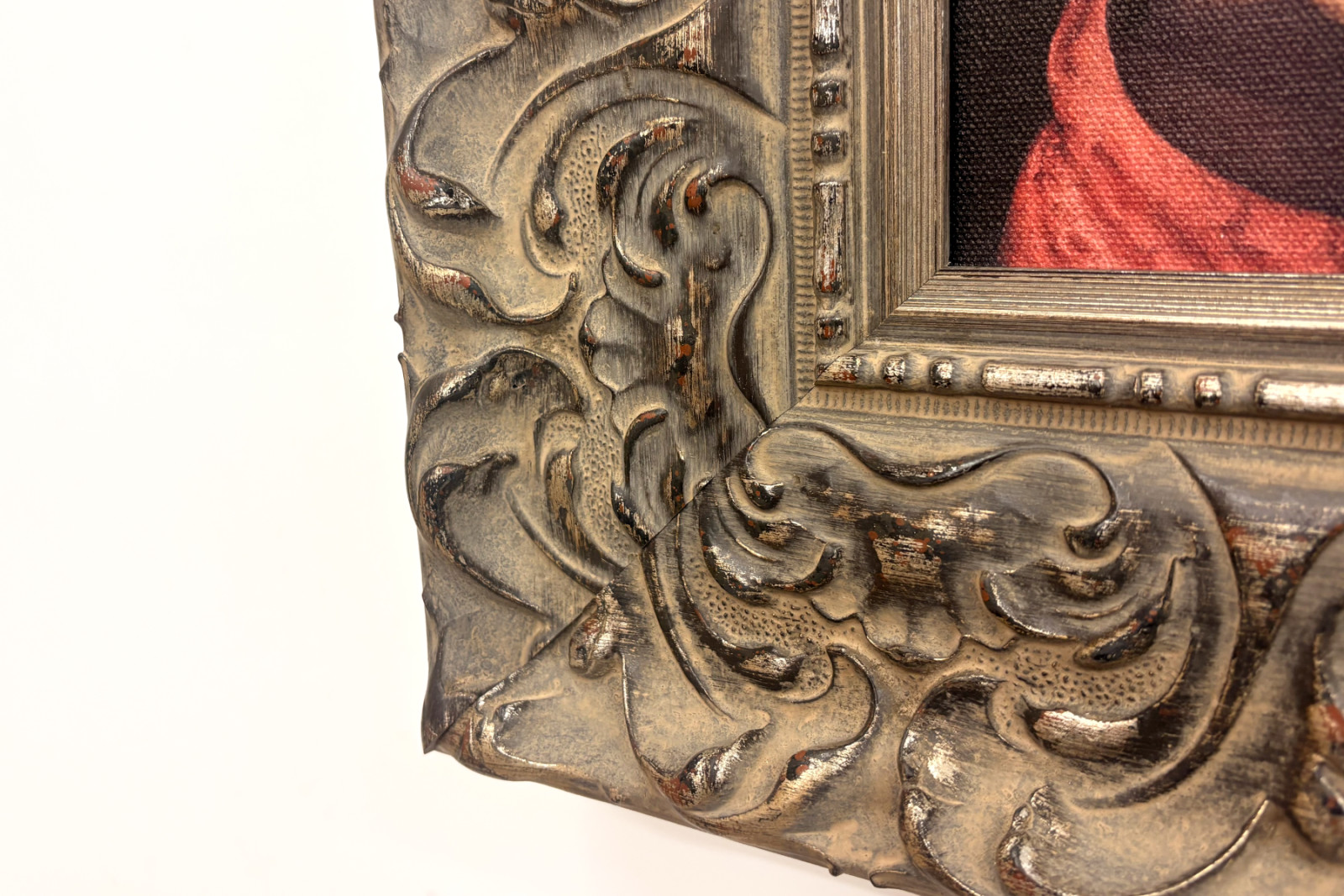
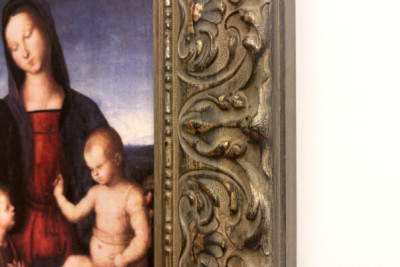
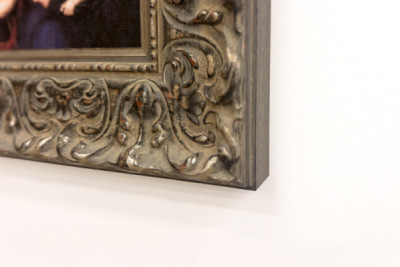
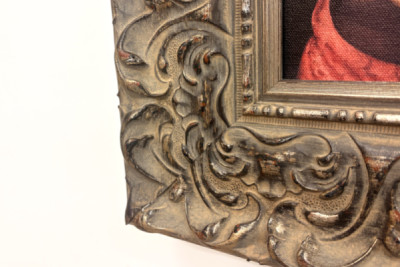
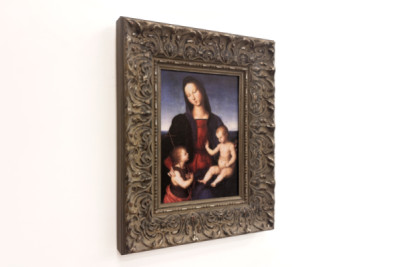
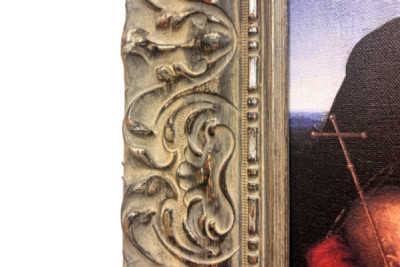
When hanging the painting, one notices how decisively this small canvas asserts its place. A wide frame surrounds it with deep foliage; mouldings, notches and dotted patterns are arranged in layers across the entire surface. In places, the relief protrudes significantly, allowing one’s fingers to trace the course of the tendrils. At the highest points, there are signs of wear and small indentations, beneath which darker and reddish-brown layers emerge. This patina does not appear smoothly staged, but rather worn - which suits the piece well. A narrow strip with bead-like raised elements acts as a bridge between the opulent outer edge and the canvas. One might fear that this frame would overwhelm the motif, yet it is precisely its physical weight that transforms the tranquil scene into a devotional image in the original sense. Without glass, the surface remains immediate: the texture of the fabric appears delicate across Mary’s face, stands out more strongly in the black areas, and in the sky the layers of print follow every small raised area. When you turn the picture, it is the texture rather than the colour that changes; at times individual threads stand out, then they merge back into the image. On Mary’s eyelids, her slender fingers and the cross-staff, the reproduction faithfully preserves Raphael’s lines - this precision holds up even at close quarters.
 ×
×






 +43 4257 29415
 support@meisterdrucke.com
 Mo-Do: 7:00 - 16:00 | Fr: 7:00 - 13:00