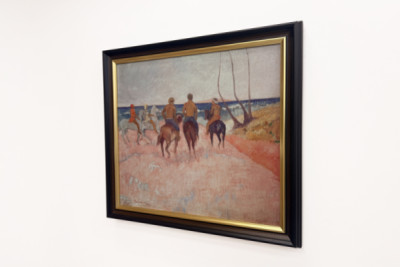
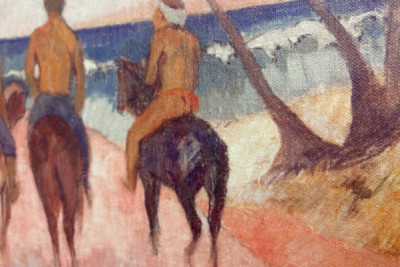
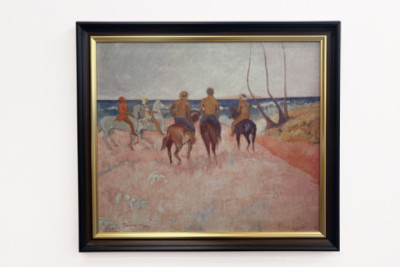
The hoofbeats are almost lost in the vast pink expanse of the beach, across which five horsemen ride towards the sea. Two light-coloured horses add a pale accent on the left, whilst the darker animals in the centre and on the right draw the eye deeper into the composition. Before the horsemen lies a narrow strip of blue and white; above it stretches a pale sky, whose tranquillity is broken only by the slender tree trunks on the right-hand bank. Gauguin constructs the landscape less through spatial depth than through large fields of colour: pink, ochre and a muted blue abut directly against one another; the figures appear simplified yet clearly distinguishable. This creates a peculiar tension. The group is in motion, yet the picture seems almost frozen, as if the beach had suspended the horsemen in time for a moment. Created in 1902, the work belongs to Gauguin’s late creative phase and displays that flat, Post-Impressionist visual language with which the French painter employs colour not merely descriptively, but as a force in its own right.
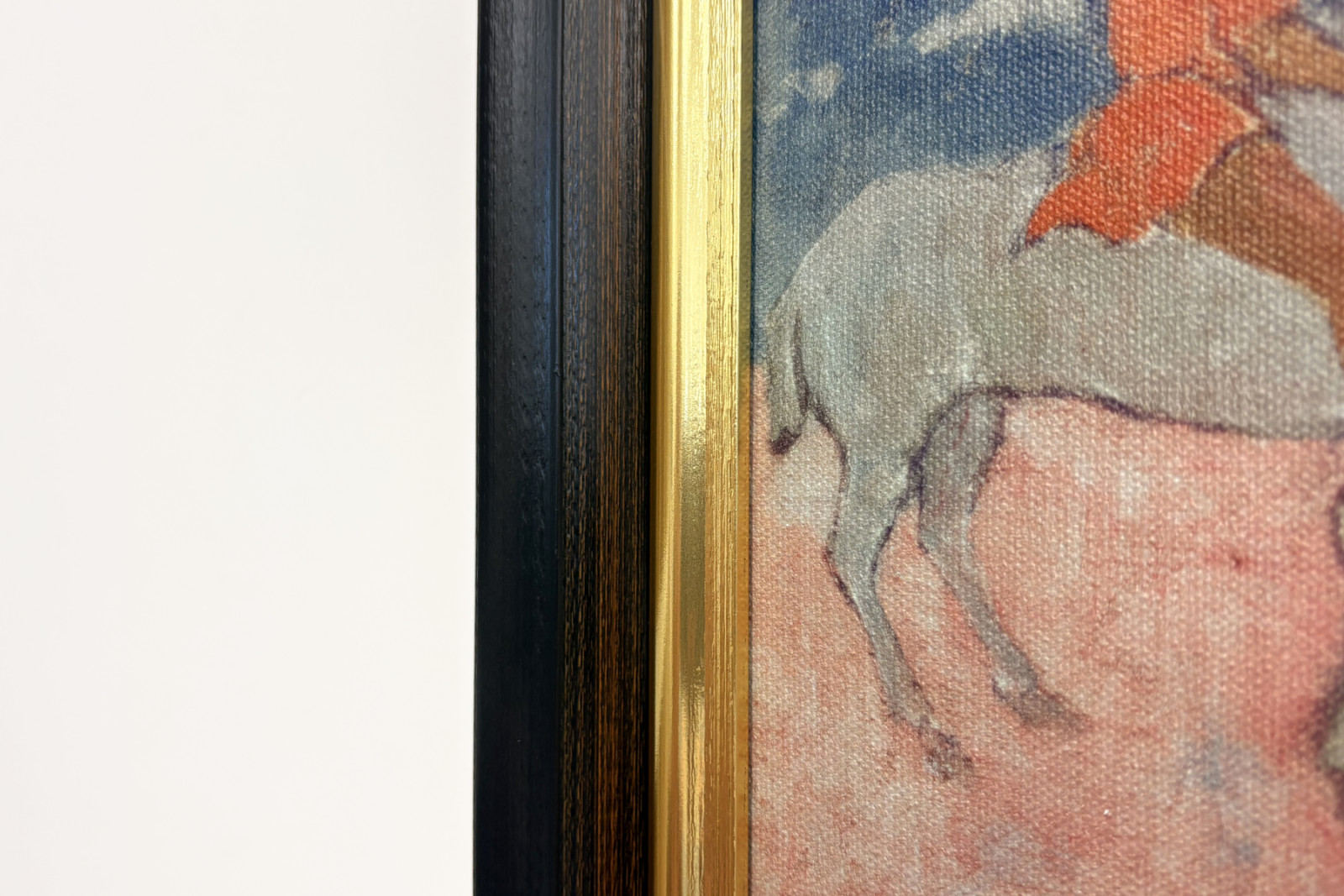
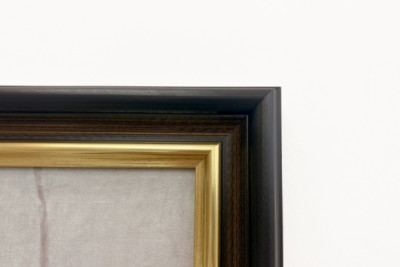
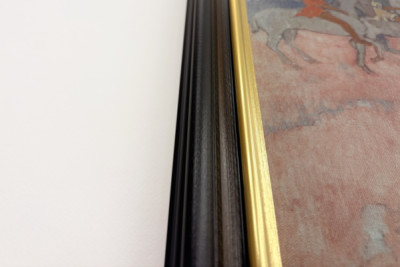
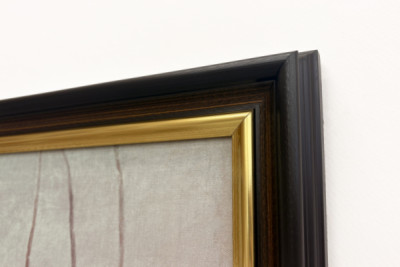
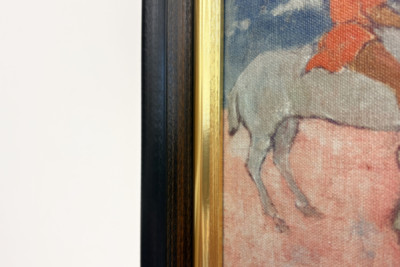
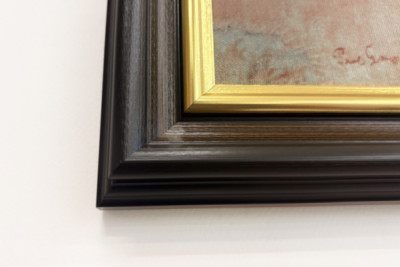
In this piece, it is above all the transition from the picture to the frame that determines its effect. Immediately adjacent to the pale sky and the powdery beach, the gold edge of the Lychorida frame draws a warm line; it makes the ochre tones of the horsemen and the right-hand bank stand out more clearly, without brightening the subdued colour scheme. Behind this, the frame deepens first to light brown, then to black - a gradation that makes perfect sense: The brown is close to the earthy tones of the horses’ bodies, whilst the outer black forms a counterpoint to the dark animal on the right and the strip of blue sea. The satin-finished surface of the Leonardo canvas preserves the subtle shifts between salmon pink, grey-blue and off-white; as one views the painting, one’s gaze is repeatedly drawn to these subtle transitions. Most compelling is the dialogue between the narrow gold border and Gauguin’s muted colour palette: a deliberate contrast that brings the painting into focus, rather than making it appear more solemn than it is.
 ×
×





 +43 4257 29415
 support@meisterdrucke.com
 Mo-Do: 7:00 - 16:00 | Fr: 7:00 - 13:00