1790 · Image ID: 1700171
Classicism
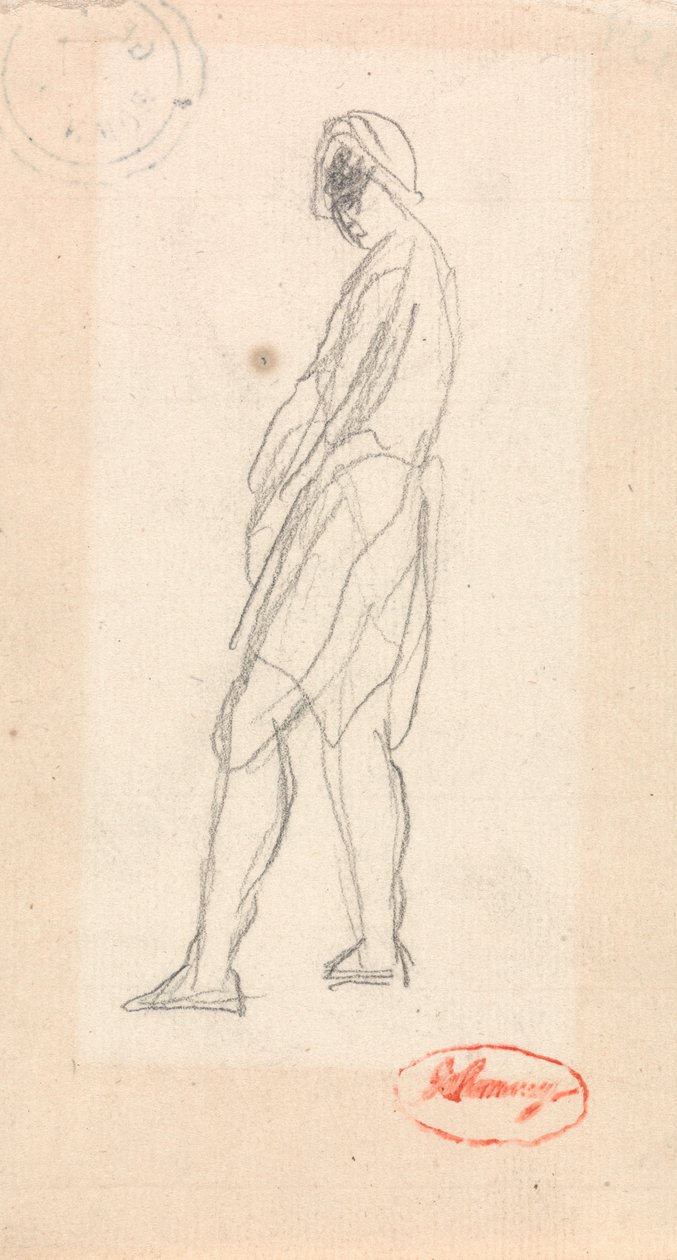
The figure’s bowed head is the subtle anchor of this small study. It draws the whole body inwards: the neck and shoulders slump, the face remains merely a dark, searching blur, and yet one immediately understands the posture. In ‘Standing Figure’, George Romney did not explain, but rather examined. The line feels its way along the outline of the head, starts again, adjusts the cap or the hair, then finds the angle of the upper body.
Look at the legs and the coat: there is no single, definitive outline. Several lines run side by side; some remain faint, others become briefly more decisive. This is precisely how one can show students how a figure takes shape. The pencil seeks weight, stance and direction. The front leg is drawn downwards almost like a pendulum, the foot merely faintly marked. With the back leg, the knee and calf shift in subtle variations. For a reproduction, these delicate graphite tones would benefit from a matt, untextured paper, as the uncertainty of the line should not be overshadowed by gloss.
The sheet itself also plays a part. In the top left-hand corner lies a pale, round stamp, like a distant shadow; in the bottom right-hand corner is a red, oval stamp, clearly set against the aged paper. Small spots, discolouration and the warm hue of the surface serve as a reminder that this drawing from the 1790s is not merely a motif, but also an object in its own right. Preserved at the Yale Centre for British Art, it does not depict the finished pose, but the moment just before it: a body that is only just becoming visible beneath the artist’s hand.
Our recommendation:
For these delicate graphite lines, I would definitely recommend a matt paper. Matt photo paper looks very harmonious behind glass: calm, low-glare and fine-textured enough for the multiple layers of contours. If you’d like a little more character from the paper, you could choose a fine watercolour card, also mounted behind glass. Glossy media, acrylic glass or heavily textured canvas would be too distracting for me here. A simple, light-coloured wooden frame or a subtle dark moulding would be suitable.
Standing Figure by George Romney. Available as an art print on canvas, photo paper, watercolor board, natural paper, or Japanese paper.
Yale Center for British Art, Yale Art Gallery Collection, Gift of Mr. and Mrs. J. Richardson Dilworth, B.A. 1938, to the Yale University Art Gallery
Other color versions of this image
Other color versions of this image
|
|
 ×
×





.jpg)
.jpg)
.jpg)
.jpg)
.jpg)
.jpg)
.jpg)
 View in 3D / AR
 Add to favorites
 Change wall color
 View picture in a room
.jpg "Major Pierson")
.jpg "Major Pierson")
.jpg "Composition of Two Figures")
.jpg "Standing Model")
.jpg "Standing Model, Boy, Seen from the Back")
.jpg "Two Standing Models")
.jpg "Draped Figure Standing")
.jpg "Figure of an Old Man")
.jpg "Composition of Two Figures")
.jpg "Composition of Two Figures")
.jpg "Study for the Figure of Major Thomas Pearson")
.jpg "The Cap")
.jpg "Walking Gentleman, Seen Half from the Back, Walking to the Left")
.jpg "Reclining Model")
.jpg "After Luca Signorelli: Study of Legs")
.jpg "Standing Model, Seen from Behind")
.jpg "Sketchbook, page 60: Nude Male Study")
.jpg "Standing Female Nude, Arms Raised")
.jpg "Sketchbook, Page 60: Nude Male Study")
.jpg "Study of a Male Figure, Page 129 from a book of studies, c. 1880-1890")
.jpg "Sketchbook, page 87: Figure Study")
.jpg "Figure")
.jpg "Standing Model")
.jpg "Miss Whitefoorde, c. 1754-1802, 1914")
.jpg "Mrs Johnstone and her Son, 1775-1780, c.1915")
.jpg "Portrait of James Dashwood, half length, wearing a blue jacket and white jabot")
.jpg "Emma, Lady Hamilton, c. 1785, 1909")
.jpg "Portrait of William Ralph Cartwright, MP")
.jpg "Portrait of Andrew Berkeley Drummond, 1781")
.jpg "Women Dancing")
.jpg "Lady Elizabeth Stanley 1753-1797, Countess of Derby, 1776-78")
.jpg "Lady Lemon 1747-1823, mid- to late 1780s.")
.jpg "Study of a Clouded Moonlit Sky")
.jpg "Miss Juliana Willoughby")
.jpg "Miss Juliana Willoughby, 1781-1783")
_-_(MeisterDrucke-1172527).jpg "The Stanhope Children")
.jpg "Lady Mary Drummond, 1781")
 - (MeisterDrucke-95217).jpg "Study of a Clouded Moonlit Sky")
.jpg "View under the Grand Portico, Philae, from Egypt and Nubia, Vol. 1")
.jpg "The Resurrection of Christ, from the right wing of the Isenheim Altarpiece, c.1512-16, detail of 17677")
_1913_-_(MeisterDrucke-804831).jpg "The White Woman and the Black Woman. 1913")
.jpg "The Terrace, Annecy")
.jpg "Water Serpents II")
.jpg "Atlantic Roll, 1895")
_-_Lensing_Galaxy_Cluster_(Webbs_First_Deep_Field)_-_(MeisterDrucke-1420924).jpg "Lensing Galaxy Cluster (Webb")
.jpg "Christ in the Wilderness")
.jpg "The beach at Saint-Clair, 1896.")
.jpg "The Four Horsemen of the Apocalypse, ca. 1498")
.jpg "Girl with a Pearl Earring")
.jpg "The Harvest")
.jpg "Malcesine on Lake Garda")
.jpg "Whirl of Love, c. 1917.")
_Amazon_Brazil_from_Le_Costume_Ancien_-_(MeisterDrucke-263271).jpg "Native birds, including the Toucan (centre), Amazon, Brazil, from")

 +43 4257 29415
 support@meisterdrucke.com
 Mo-Do: 7:00 - 16:00 | Fr: 7:00 - 13:00