-
 ×
×
- Home
- Art Prints ▸
- Artists ▸
- Categories ▸
- Art Styles ▸
-
Picture Frame ▸
- All decorative frames
- Baroque decorative frames
- Simple decorative frames
- Rustic decorative frames
- Floating frames
- Golden decorative frames
- Silver decorative frames
- White decorative frames
- Black decorative frames
- Wood-look decorative frames
- Shabby chic decorative frames
- Thin decorative frames
- Thick decorative frames
-
Print Media ▸
- All print media
- Canvas Leonardo (satin)
- Canvas Salvador (matte)
- Canvas Raphael (matte)
- FineArt Photo Matte
- FineArt Photo Satin
- FineArt Photo Baryte
- FineArt Photo Glossy
- Watercolor Paper Munch
- Watercolor Paper Renoir
- Watercolor Paper Turner
- Watercolor Paper Dürer
- Natural Line Hemp
- Natural Line Rice
- Kozo White, 110g
- Kozo Natural, 110g
- Inbe White, 125g
- Unryu, 55g
- Bamboo, 110g
- Premio Unryu, 165g
- Murakumo Natural, 42g
- Bizan Natural, 300g
- Bizan White, 300g
- Aluminum composite 3mm
- Acrylic glass 5mm
- Order Sample Set
- Which print medium is right for you?
Canvas
Photo Paper
Watercolor Board
Natural Line
Japanese Paper
Special Media
More information
-
Help & Service ▸
- Contact us
- Sell your art
- Frequently Asked Questions
- Job Openings
- Complaint
- Order Samples
- Order Vouchers
- Shipping costs
- Production time
- Sustainability
- Image research
- Special requests
- Who are we?
- Pricing policy
- Company policy
- Quality promise
- Stretcher frame
- Mats
- Decorative frames
- Glazing
- Fillets
- Mounting systems
- Print media
- Care tips
- Legal Notice
- Terms & Conditions
- Privacy Policy
- Right of Cancellation
Info & Service
More information
Good to know
Legal information
- Shop ▸
- Contact







 Passionate Customer Service
.jpg "The Scouts, 1902 by Charles Marion Russell")
.jpg)
.jpg "Crow Encampment, 1837 by Alfred Jacob Miller")
.jpg)
.jpg "Rendezvous, 1837 by Alfred Jacob Miller")
.jpg)
.jpg "Buffalo Hunt, plate 7 from Catlin")
.jpg)
.jpg "Comanche Feats of Horsemanship, 1834-35 by George Catlin")
.jpg)
.jpg "Buffalo Hunt, 1891 by Charles Marion Russell")
.jpg)
.jpg "Gathering Wild Rice, 1853 by Captain Seth Eastman")
.jpg)
.jpg "The Vale of Calaat, Ethiopia, c. 1800 by Henry Salt")
.jpg)
_183233_-_(MeisterDrucke-383062).jpg "Tooan Tuh (Cherokee), 1832-33 by Henry Inman")
_183233_-_(MeisterDrucke-383062).jpg)
.jpg "Indians Dancing at the San José Mission, from")
.jpg)
.jpg "Western Landscape with Indians by Leon Pomarede")
.jpg)
.jpg "Shin-ga-ba W")
.jpg)
.jpg "Mou-Ka-Ush-Ka or “The Trembling Earth”, a Yankton Sioux chief, illustration from The Indian Tribes of North America by Thomas L. McKenney and James Hall, published by John Grant by George Cooke")
.jpg)
.jpg "The Buffalo Hunt, c. 1832 by George Catlin")
.jpg)
 published in Frankfurt 1591 - (MeisterDrucke-100867).jpg "The Sacrifice of the First-Born Son, from")
 published in Frankfurt 1591 - (MeisterDrucke-100867).jpg)
.jpg "Chon-Mon-I-Case or “L")
.jpg)
_-_(MeisterDrucke-37218).jpg "Life on the Prairie - the Buffalo Hunt, 1862 by N. and Ives, J.M. Currier")
_-_(MeisterDrucke-37218).jpg)
.jpg "Hunting Buffalo Camouflaged with Wolf Skins, c.1832 by George Catlin")
.jpg)
.jpg "Notchimine or No Heart, an Iowa Chief, 1837, Illustration from")
.jpg)
.jpg "Nowaykesugga, an Otto, illustration from")
.jpg)
.jpg "The Imprisonment of Guatimocin by the Troops of Hernán Cortés, 1856 by Carlos Maria Esquivel")
.jpg)
.jpg "Hayne Hudjuhini or the")
.jpg)
_-_(MeisterDrucke-661363).jpg "Minnehaha, c. 1904 by Detroit Publishing Co.")
_-_(MeisterDrucke-661363).jpg)
.jpg "War Dance of the Sauks and Foxes, illustration from “The Indian Tribes of North America, Vol. 1”, by Thomas L. McKenney and James Hall, published by John Grant by American School")
.jpg)
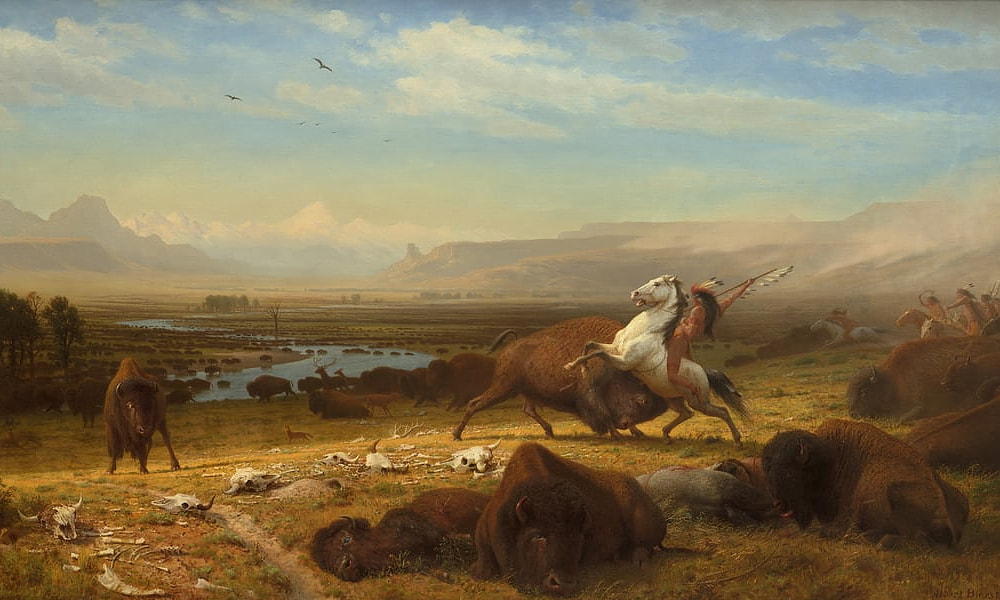
.jpg "The Last of the Buffalo, c. 1888 by Albert Bierstadt")
.jpg)
.jpg "Keesheswa or “the Sun”, a Fox Chief, c.1837, illustration from “The Indian Tribes of North America, Vol. 2”, by Thomas L. McKenney and James Hall, published by John Grant by Charles Bird King")
.jpg)
.jpg "Battle of Tolbiac in AD 496, 1837 by Ary Scheffer")
.jpg)
.jpg "Appanoose, a Sauk Chief, 1837, illustration from")
.jpg)
.jpg "Spearing Fish from a Canoe, 1853 by Captain Seth Eastman")
.jpg)
 Discovering the St Lawrence River in 1535 1847 - (MeisterDrucke-86526).jpg "Jacques Cartier (1491-1557) Discovering the St. Lawrence River in 1535, 1847 by Jean Antoine Theodore Gudin")
 Discovering the St Lawrence River in 1535 1847 - (MeisterDrucke-86526).jpg)
.jpg "Buffalo Dance, c.1832 by George Catlin")
.jpg)
.jpg "People of the Osagi Nation, from")
.jpg)
.jpg "Medicine Man, 1853 by Captain Seth Eastman")
.jpg)
.jpg "In the Cheyenne Country, 1896 by John Hauser")
.jpg)
.jpg "Botocudos family, Rio Grande, Brazil, from")
.jpg)
.jpg "Conquest of Algeria: surrender of the Beni Raten tribe from Kabylia to French Marshal Randon (1795-1871) in 1854 by Alfred Charles Ferdinand Decaen")
.jpg)
.jpg "Wa-Na-Ta or \"The Charger\", Grand Chief of the Sioux or Dakota Indians, painted 1926, illustration from \"The Indian Tribes of North America, Vol.1\", by Thomas L. McKenney and James Hall, published by John G by Charles Bird King")
.jpg)
_-_(MeisterDrucke-381369).jpg "Native Boutique or Shop, Ceylon, c.1900-20 by Ltd. Ceylon Plâté")
_-_(MeisterDrucke-381369).jpg)
.jpg "Breaking Up Camp at Sunrise, 1837 by Alfred Jacob Miller")
.jpg)
_183133_-_(MeisterDrucke-383065).jpg "Tai-O-Mah (Fox), 1831-33 by Henry Inman")
_183133_-_(MeisterDrucke-383065).jpg)
 and J Hurlimann 1843 (aquatint) - (MeisterDrucke-195091).jpg "A Skin Lodge of an Assiniboin Chief by Karl Bodmer")
 and J Hurlimann 1843 (aquatint) - (MeisterDrucke-195091).jpg)
.jpg "The Wagons by Charles Marion Russell")
.jpg)
.jpg "A Spaniard and an Indian Woman Produce a Mestizo, c. 1715 by Juan Rodríguez Juárez")
.jpg)
 - (MeisterDrucke-370846).jpg "Bull Boating, 1858-60 by Alfred Jacob Miller")
 - (MeisterDrucke-370846).jpg)
.jpg "Dance to the Giant by Captain Seth Eastman")
.jpg)
.jpg "Pocahontas saving the life of Captain John Smith, c. 1836-40 by John Gadsby Chapman")
.jpg)
.jpg "The Capture of Radisson, illustration from")
.jpg)
.jpg "Camp of Piekann Indians by George Catlin")
.jpg)
 - (MeisterDrucke-293626).jpg "Dance of Dog Soldiers by Monroe Tsatoke")
 - (MeisterDrucke-293626).jpg)
 - (MeisterDrucke-38398).jpg "Ki-On-Twog-Ky or")
 - (MeisterDrucke-38398).jpg)
.jpg "A Roman Battle, 1641 by Simon Peter Tilemann")
.jpg)
.jpg "Wakechai or “Crouching Eagle”, a Sauk Chief, illustration from “The Indian Tribes of North America, Vol. 2”, by Thomas L. McKenney and James Hall, published by John Grant by Charles Bird King")
.jpg)
.jpg "Wabeno Songs, from")
.jpg)
.jpg "On the Scent, 1846 by James Russell Ryott")
.jpg)
.jpg "Halpatter-Micco or Billy Bowlegs, a Seminole Chief, c.1825, illustration from")
.jpg)
.jpg "Se-quo-yah or George Guess, 1828, Illustration from")
.jpg)
.jpg "Conversing by Signs, 1837 by Alfred Jacob Miller")
.jpg)
.jpg "Red Jacket, Seneca War Chief, 1828, illustration from")
.jpg)
_c1831-33_-_(MeisterDrucke-383064).jpg "Julcee-Mathla (Seminole), c. 1831-33 by Henry Inman")
_c1831-33_-_(MeisterDrucke-383064).jpg)
.jpg "The Chiefs of Florida on Their Way to War by Gallo Gallina")
.jpg)
.jpg "Sunset, 1871 by Ernest Henry Griset")
.jpg)
 - (MeisterDrucke-589666).jpg "Love Call by Monroe Tsatoke")
 - (MeisterDrucke-589666).jpg)
.jpg "War Dance of the Sioux, from The History of Mankind by Prof. Friedrich Ratzel, published in 1904 by Rudolf Cronau")
.jpg)
.jpg "Indians Hunting the Bison, plate 31 from Volume 2 of “Travels in the Interior of North America”, engraved by Carl Vogel (1816-51), 1844 by Karl Bodmer")
.jpg)
.jpg "Tapuya men of North Eastern Brazil in war dance, 1641 by Albert van der Eeckhout")
.jpg)
.jpg "William Penn")
.jpg)
.jpg "Dancing Festival of the Camacani Indians, Brazil, from “Le Costume Ancien et Moderne”, Volume I, plate 46, by Jules Ferrario, published c. 1820s-30s by D.K. Bonatti")
.jpg)
.jpg "Dog Dance of the Dakotas, 1853 by Captain Seth Eastman")
.jpg)
 (see also 177058) - (MeisterDrucke-190704).jpg "Native American Puri tribesmen in their forest, from")
 (see also 177058) - (MeisterDrucke-190704).jpg)
.jpg "Cavalcade, c.1858 by Alfred Jacob Miller")
.jpg)
.jpg "Sioux Camp Scene by Alfred Jacob Miller")
.jpg)
.jpg "Hunting Buffalo, 1837 by Alfred Jacob Miller")
.jpg)
.jpg "Attack on Stocks Kraal in the Fish River Bush by Thomas Baines")
.jpg)
.jpg "Bourgeois Walker and his Squaw, 1837 by Alfred Jacob Miller")
.jpg)
.jpg "Near Them Was Standing an Indian, in Attitude Stern and Defiant by Newell Convers Wyeth")
.jpg)
.jpg "Trappers, 1858 by Alfred Jacob Miller")
.jpg)
 - (MeisterDrucke-253945).jpg "Woollen fabric by Paracas Culture")
 - (MeisterDrucke-253945).jpg)
.jpg "Snake Indians, 1837 by Alfred Jacob Miller")
.jpg)
.jpg "Chippeway Mother and Child, illustration from")
.jpg)
.jpg "Medicine Dance of the Winnebagoes by Captain Seth Eastman")
.jpg)
.jpg "The British Museum by Achille-Louis Martinet")
.jpg)
.jpg "Barbarian Indians, c. 1715 by Juan Rodríguez Juárez")
.jpg)
.jpg "Moa-Na-Hon-Ga or")
.jpg)
.jpg "Tshusik, a Chippeway Woman, 1827, illustration from")
.jpg)
_-_(MeisterDrucke-160017).jpg "Hunting the Buffalo, 1848 by Thomas Loraine McKenney")
_-_(MeisterDrucke-160017).jpg)
.jpg "Ball Playing Among the Sioux Indians, 1851 by Captain Seth Eastman")
.jpg)
.jpg "On the War Path, published 1871 by John Mix Stanley")
.jpg)
.jpg "Interior of a Cree Indian tent, 1824 by Lieutenant Hood")
.jpg)
.jpg "Habitations of the Papu Tribe, Rawak, plate 22 from")
.jpg)
_published_by_Edward_Orme_181_-_(MeisterDrucke-278052).jpg "The Trial, engraved by Matthew Dubourg, published by Edward Orme, 1813 by John Heaviside Clark")
_published_by_Edward_Orme_181_-_(MeisterDrucke-278052).jpg)
.jpg "North American Medicine Pipe Stem Dance by Paul Kane")
.jpg)
.jpg "Chinook Indian, Columbia River by Alfred Jacob Miller")
.jpg)
 - (MeisterDrucke-130490).jpg "Sioux Indian Girl by Alfred Jacob Miller")
 - (MeisterDrucke-130490).jpg)
.jpg "The Defender of Vercheres, Illustration from")
.jpg)
.jpg "David with the Head of Goliath before Saul, 1627 by Rembrandt van Rijn")
.jpg)
.jpg "Buffalo Bill Fighting the Indians by Louis Maurer")
.jpg)
.jpg "Camacani Tribesmen in Woodland in the Amazon jungle, Brazil, from")
.jpg)
.jpg "Yosemite Indian Village by Raymond Dabb Yelland")
.jpg)
.jpg "Indian Ball Game by George Catlin")
.jpg)
.jpg "The Lost Greenhorn by Alfred Jacob Miller")
.jpg)

 +43 4257 29415
 support@meisterdrucke.com
 Mo-Do: 7:00 - 16:00 | Fr: 7:00 - 13:00