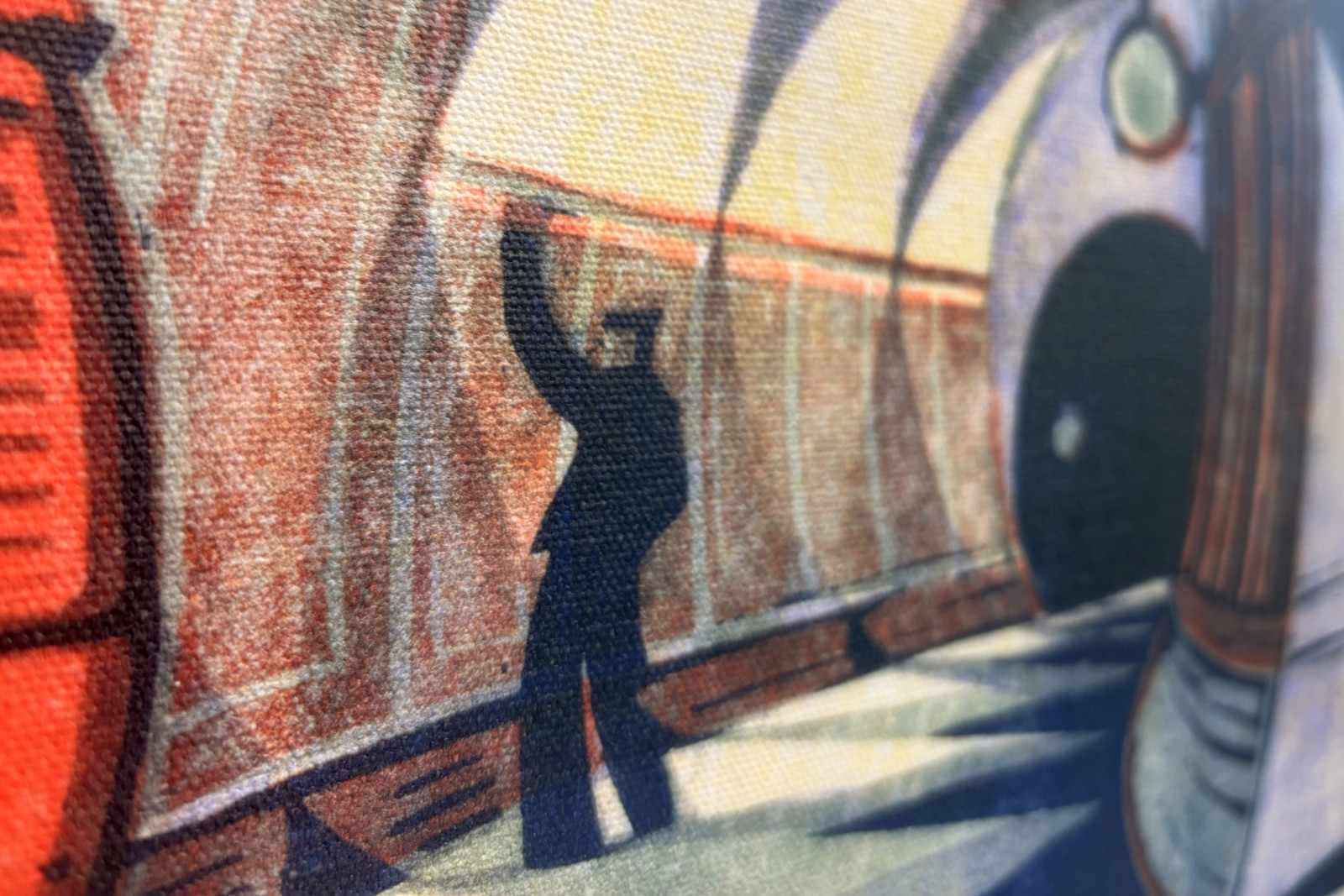
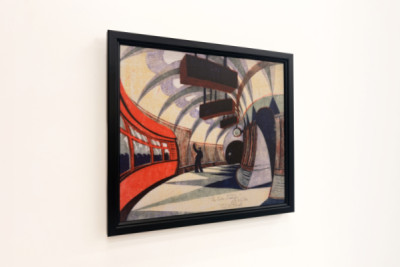
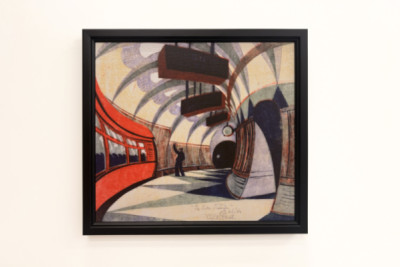
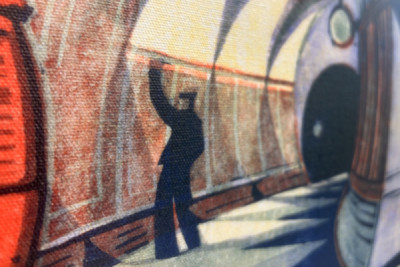
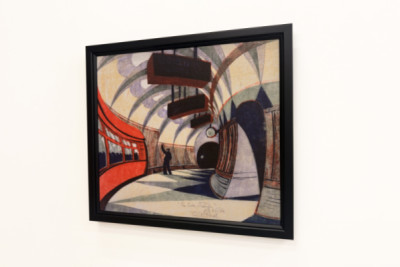
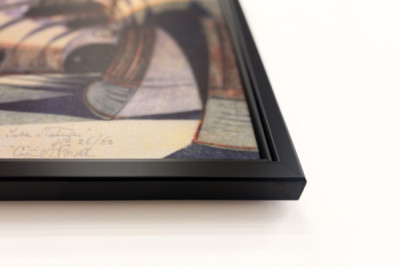
The red carriage glides into the picture in a single long curve, as if it were about to drive straight out of the frame. Opposite it, the tunnel entrance opens up as a black circle; above it, the ribs of the vault stretch like a fan across the entire width of the picture. Cyril Edward Power, born in London in 1872, created this Underground scene around 1932 as a colour linocut - he was one of the leading figures of the Grosvenor School, the London group of printmakers who translated the pace, traffic and the rhythm of the city into sweeping, almost musical forms. Here, the movement stands still, yet it is inherent in every line: in the hanging noticeboards, in the curved platform edges, in the solitary dark figure reaching for something with a raised arm, which provides a sense of scale to the deserted station. At the bottom right runs the handwritten title with numbering and signature - a piece of the work’s history that the reproduction has not retouched out.
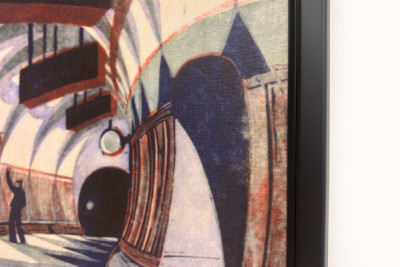
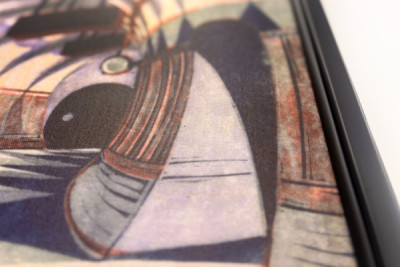
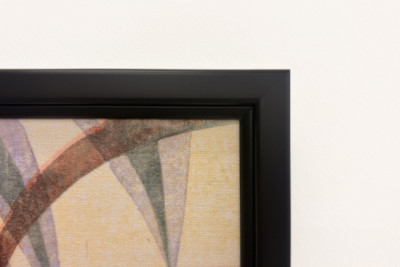
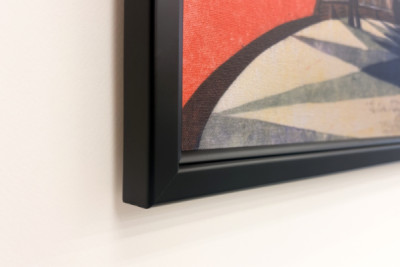
If you move your head in front of the canvas, something happens to the black: the tunnel entrance and the passenger’s silhouette swallow the light almost completely, whilst a soft glow washes over the light-coloured vaulted sections. The satin-finished Leonardo canvas is perfectly suited to this effect - the sheen never lies flat across the picture, but shifts, whilst the deep layers of colour in the linocut retain their matt, print-like density. The black ‘Dacey’ frame, with the ‘Wendy’ fillet forming a narrow inner step, frames the 41 x 36 cm work just perfectly; to be honest, this motif needs nothing more. In the end, the eye lingers anyway on the tunnel opening - that dark point towards which the entire composition of the picture converges.
 ×






 +43 4257 29415
 support@meisterdrucke.com
 Mo-Do: 7:00 - 16:00 | Fr: 7:00 - 13:00