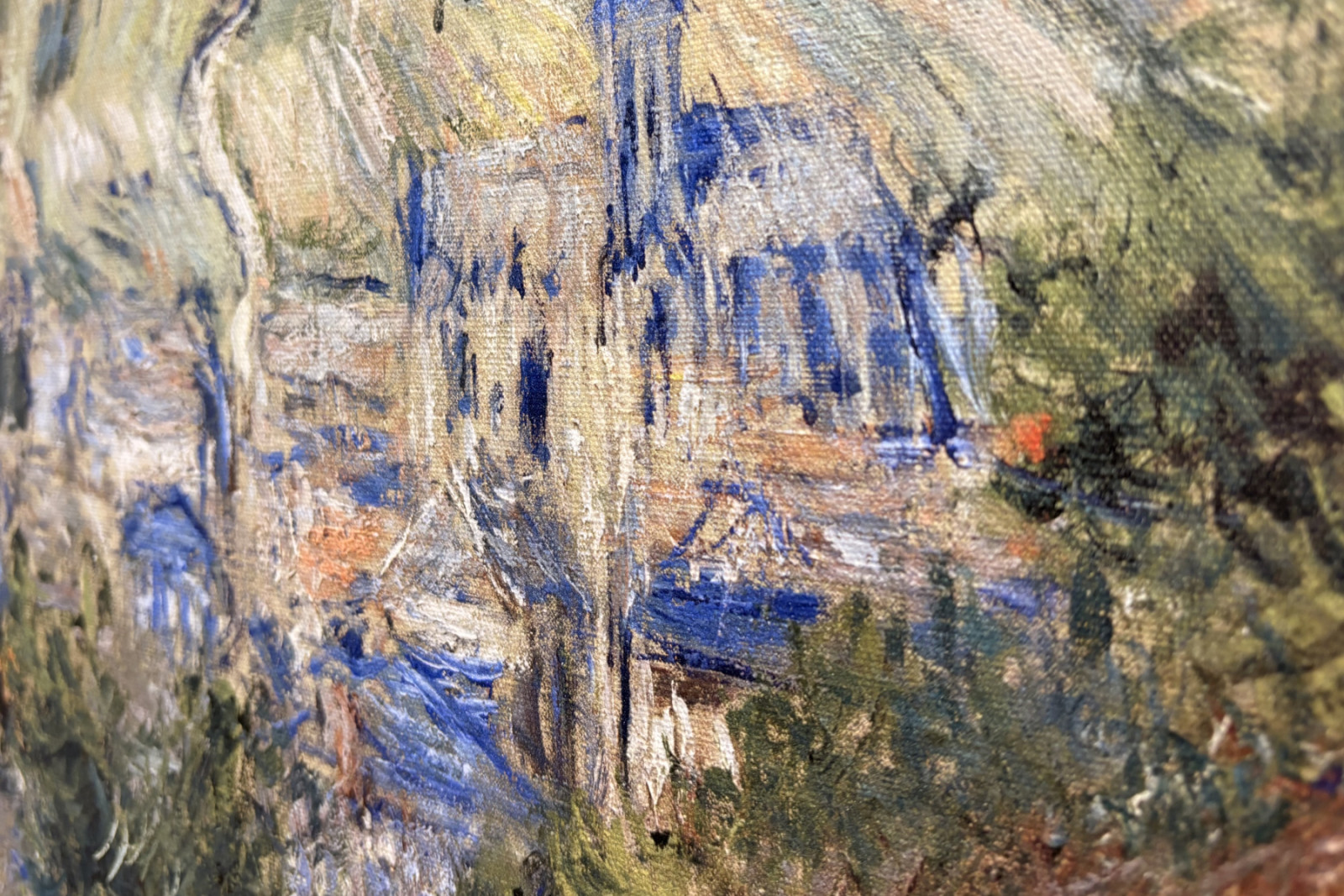
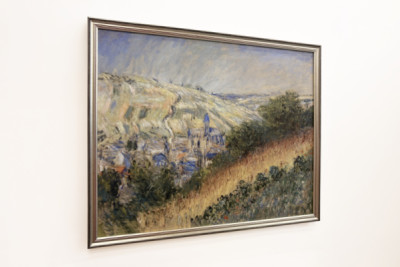
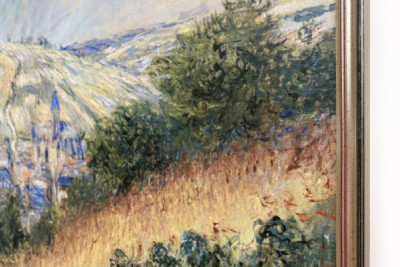
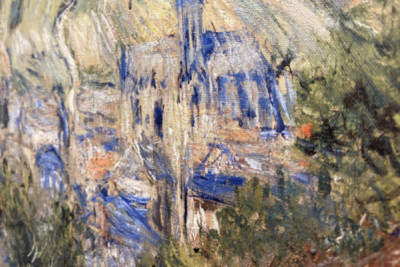
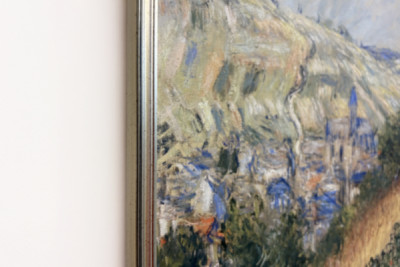
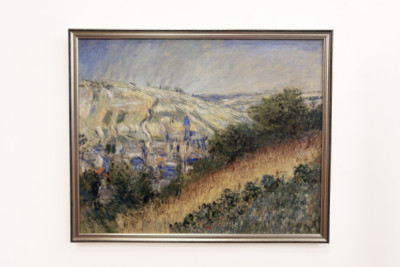
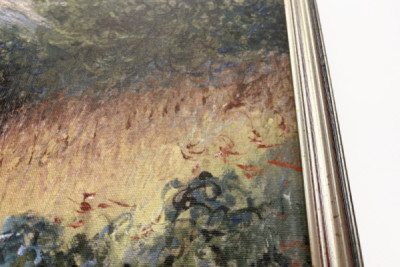
Above the wheat-covered slope at the bottom of the picture, small red dots flicker - poppies, rendered with two or three strokes, and in the print each of these strokes remains legible as a distinct mark. From here, the view descends the slope: nestled amongst bushes and undulating grass lies Vétheuil, the little town on the Seine where Claude Monet lived from 1878 onwards and which he painted time and again during those years - from the river, from the opposite bank, and here from an elevated vantage point. The church emerges as a blue-and-white silhouette from the jumble of houses; behind it rises the pale chalk slope, where ochre, green and violet strokes interweave to form rock and vegetation. Painted in 1881, the picture dates from a time when Monet was regaining his footing after difficult years - the death of his wife Camille and financial hardship; yet none of this is apparent in the painting, which exudes the shimmering air of summer. No fixed outline defines the objects; everything is in motion: the sky, rendered in slanting strokes of blue and cream; the village, a vibration of blue, white and scattered orange roofs.
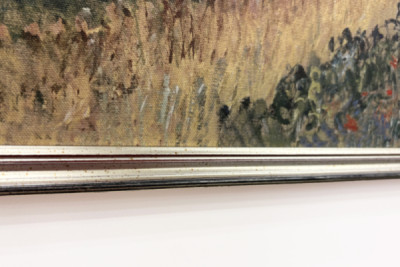
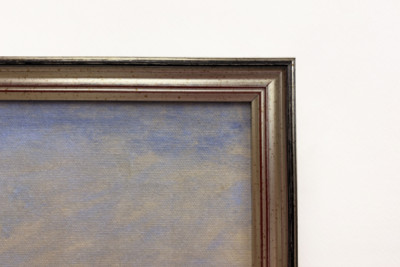
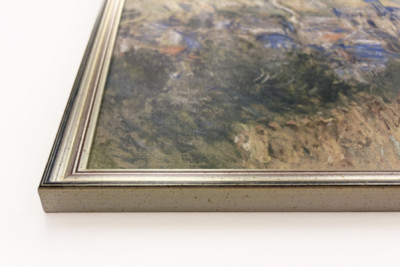
What makes the frame so perfectly suited to this piece is its colour scheme: matt antique silver, interspersed with a red line that runs round the profile. It is precisely these two shades that are also present in the picture - the cool silvery-blue of the sky and the church roofs, and the red of the poppy dots in the foreground. In the upper corner, where the cloudy sky meets the frame directly, the blue and silver almost merge into one another; at the bottom, the red line echoes the blossoms in the grass without overpowering them. Added to this is the speckled patina on the surface - small brownish dots that give the metal an aged appearance - one might mistake them for chance, but they noticeably bring the frame closer to the era of the work. Without glass or a passe-partout, the satin-finished canvas lies exposed and immediate; its fine weave shimmers faintly through the bright sky. Measuring 60 by 48 centimetres, the narrow frame supports the picture without weighing it down; if you look closely, you can see along the bevelled edge how the dark red shines through beneath the silver - the same interplay of warm and cool tones that Monet explores in the painting. It is this detail that holds my attention the longest.
 ×
× 





 +43 4257 29415
 support@meisterdrucke.com
 Mo-Do: 7:00 - 16:00 | Fr: 7:00 - 13:00