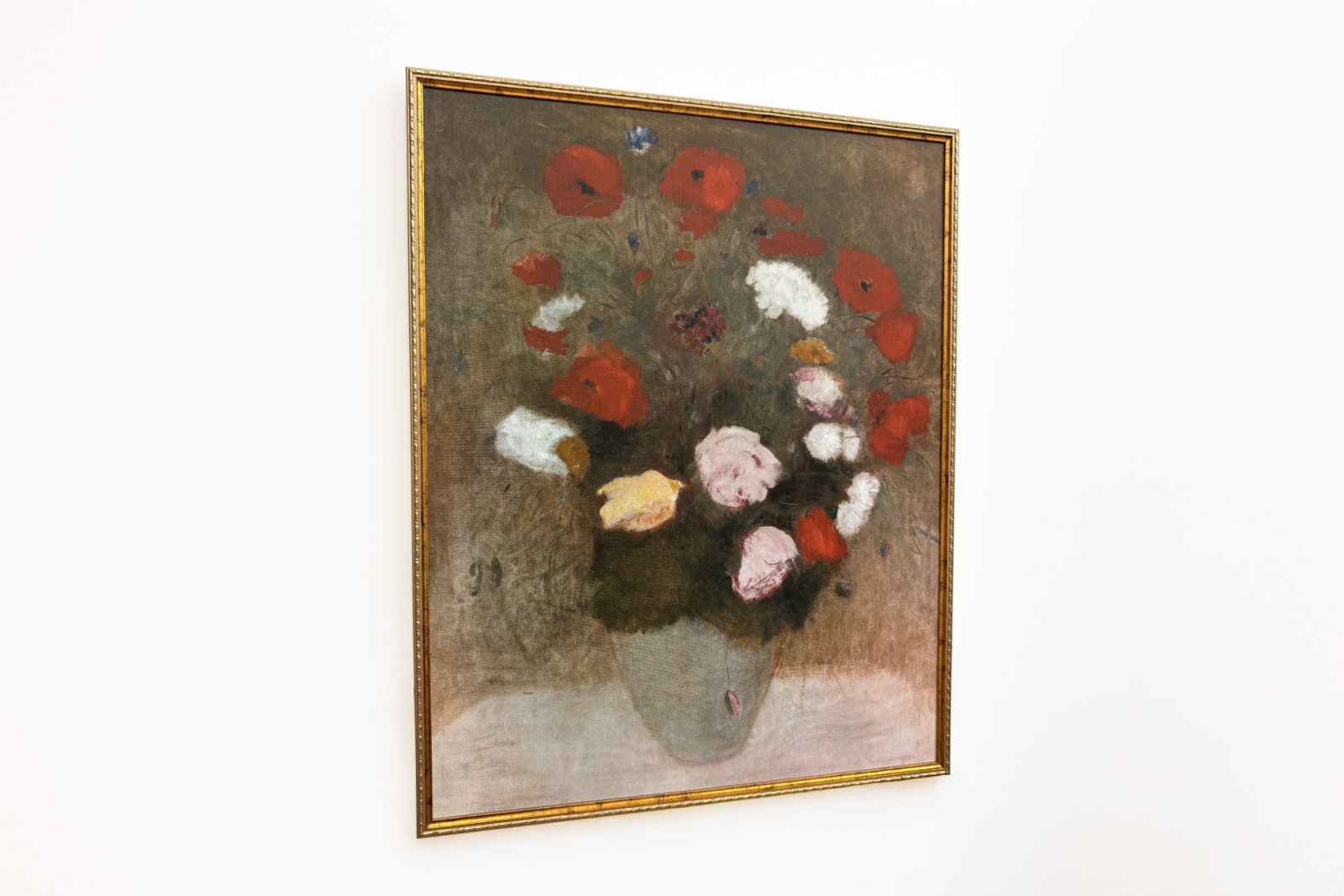
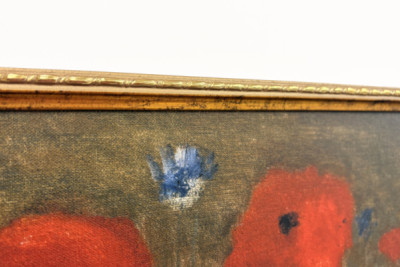
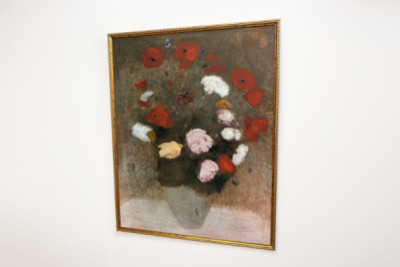
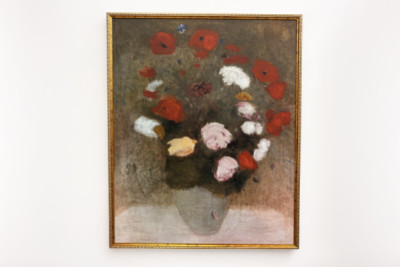
From the low-set vase, the bouquet rises in a loose, almost circular motion; individual stems are lost against the brownish-green background, whilst the flowers emerge from it like scattered islands of colour. Red poppies dominate the upper arc and, with their dark centres, provide distinct focal points. In between stand white, pink and yellow blooms, some wide open, others still closed. Their forms remain soft, at times merely hinted at, as if they were only coming into being as one looks at them. At the bottom, a light-coloured strip on the table frames the grey-blue vase, yet here too there are no hard boundaries. Redon does not arrange the still life with botanical precision: colour, memory and appearance intertwine. It is precisely the small blue splashes between the poppy heads that catch the eye - they cool the subdued red and lend the lush bouquet a contemplative quality, without detracting from its physical presence.
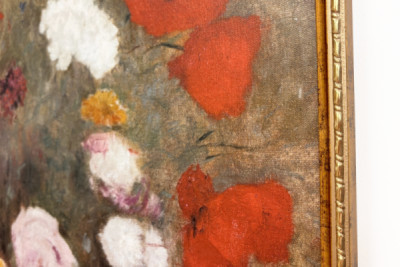
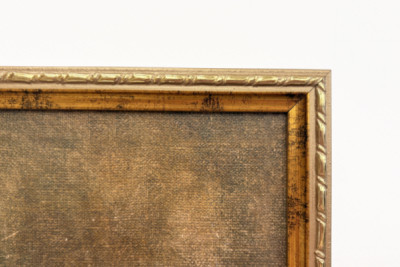
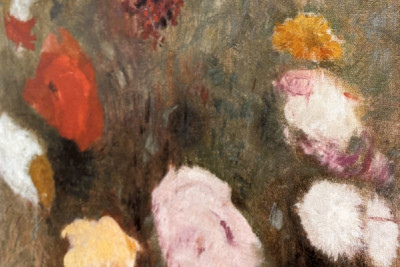
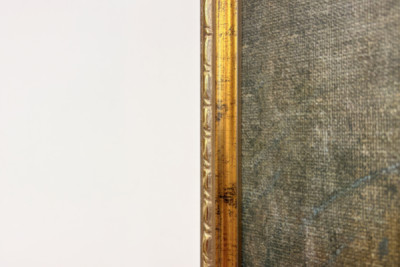
In this version on canvas, ‘Salvador’, the matt fabric surface plays a key role in determining how close the image appears. The fabric stands out even through the red poppy petals and the grey-brown background; particularly in the top right-hand corner, its fine grid breaks up the seemingly solid areas of colour into many small raised areas. Even the white and pink blossoms do not appear to be smoothly printed: light layers seem to sit visually atop darker traces, whilst individual violet strokes remain as if they were brushstrokes added afterwards. One is tempted to run a finger over them, although the visible grain already reveals enough about the texture. Without glass, this surface remains unobstructed; the ‘Noemi’ therefore merely draws a narrow golden border around the whole. The print does not actually have a coloured relief, yet the material and the layers of ink create a depth at close range that even surprised me when I looked at the photos. In this way, the design preserves, above all, that tentative juxtaposition of placement and correction which makes the bouquet appear alive at the very moment of its creation.
 ×
× 





 +43 4257 29415
 support@meisterdrucke.com
 Mo-Do: 7:00 - 16:00 | Fr: 7:00 - 13:00