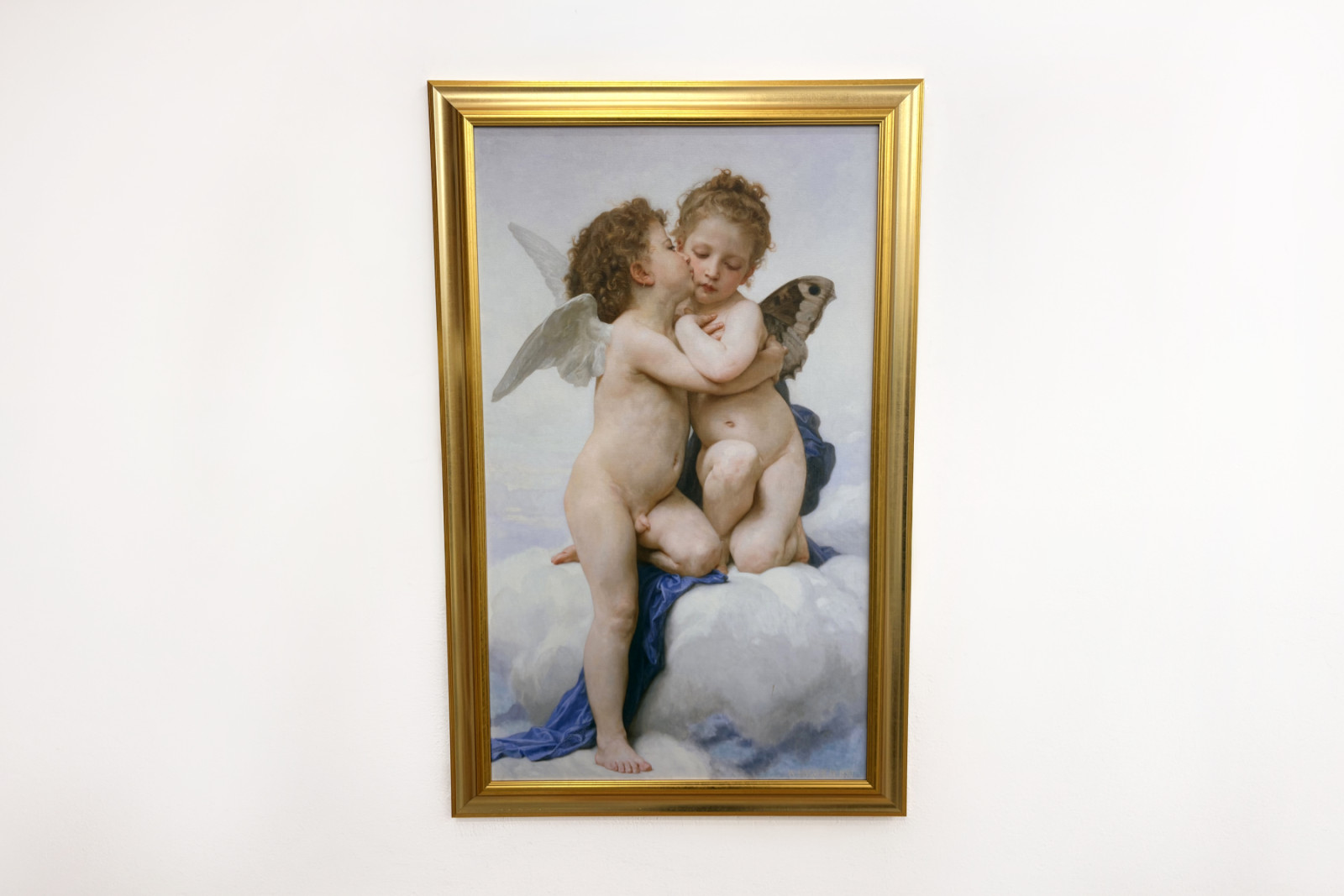
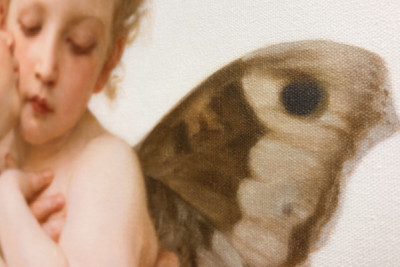
The narrow portrait format gives the two childlike figures plenty of height and leaves them with hardly any room to move sideways. This makes their embrace seem all the more intimate. Cupid stands on a cloud and leans towards Psyche; his kiss touches her cheek. She lowers her eyelids and folds her arms across her chest, whilst he holds her tightly. Behind their bodies, two very different pairs of wings unfold: on the left, light feathered wings; on the right, a large butterfly wing with a dark eye-spot. The deep blue of the cloth provides the only bold splash of colour in an otherwise light scene. The clouds and the background almost merge into one another, so that the children seem to be floating rather than sitting. Light skin tones and soft shadows dominate the picture. Nothing is forced; even the kiss remains gentle. Bouguereau painted the scene in 1890. As a French representative of 19th-century academic painting, he is known for his precise figure drawing, idealised bodies and smooth transitions. Here, he does not treat the myth as a dramatic love story, but instead depicts Cupid and Psyche as two children. The first kiss becomes a moment that seems almost shy.
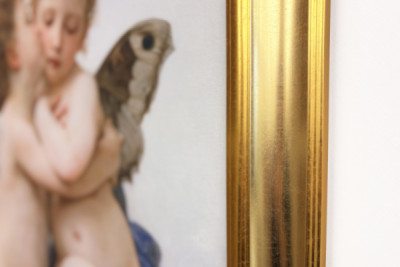
In this version, the tall format of 58 × 97 cm is very clearly evident. The Leonardo canvas, with its satin-finished surface, renders the subtle gradations of the skin and the blurring clouds without any harsh breaks. There is no passe-partout, nor is there any glass in front of the painting - the canvas remains directly visible. On the outside, Ava adds a bold border. The gold frame has a noticeable weight and provides a firm boundary for the narrow picture area. From the front, the gold appears bright and uniform; in the wide moulding, it gives way to brownish shadows. Fine dark speckles and slight irregularities rob the surface of any sterile uniformity; along the narrow edges, a clearer yellow gold reappears. My gaze lingers on the corners: this is where the different zones of gold meet cleanly. What I like about this setting is that it does not trivialise the delicate motif, but treats it as a classical figurative image. The frame makes a noticeably stronger statement than the scene itself - a deliberate choice, not a casual border. In the end, however, the painting’s unusual concept lingers in the mind: two famous figures of love appear as children, and the myth begins with a tentative kiss on the cheek.
 ×
× 








 +43 4257 29415
 support@meisterdrucke.com
 Mo-Do: 7:00 - 16:00 | Fr: 7:00 - 13:00