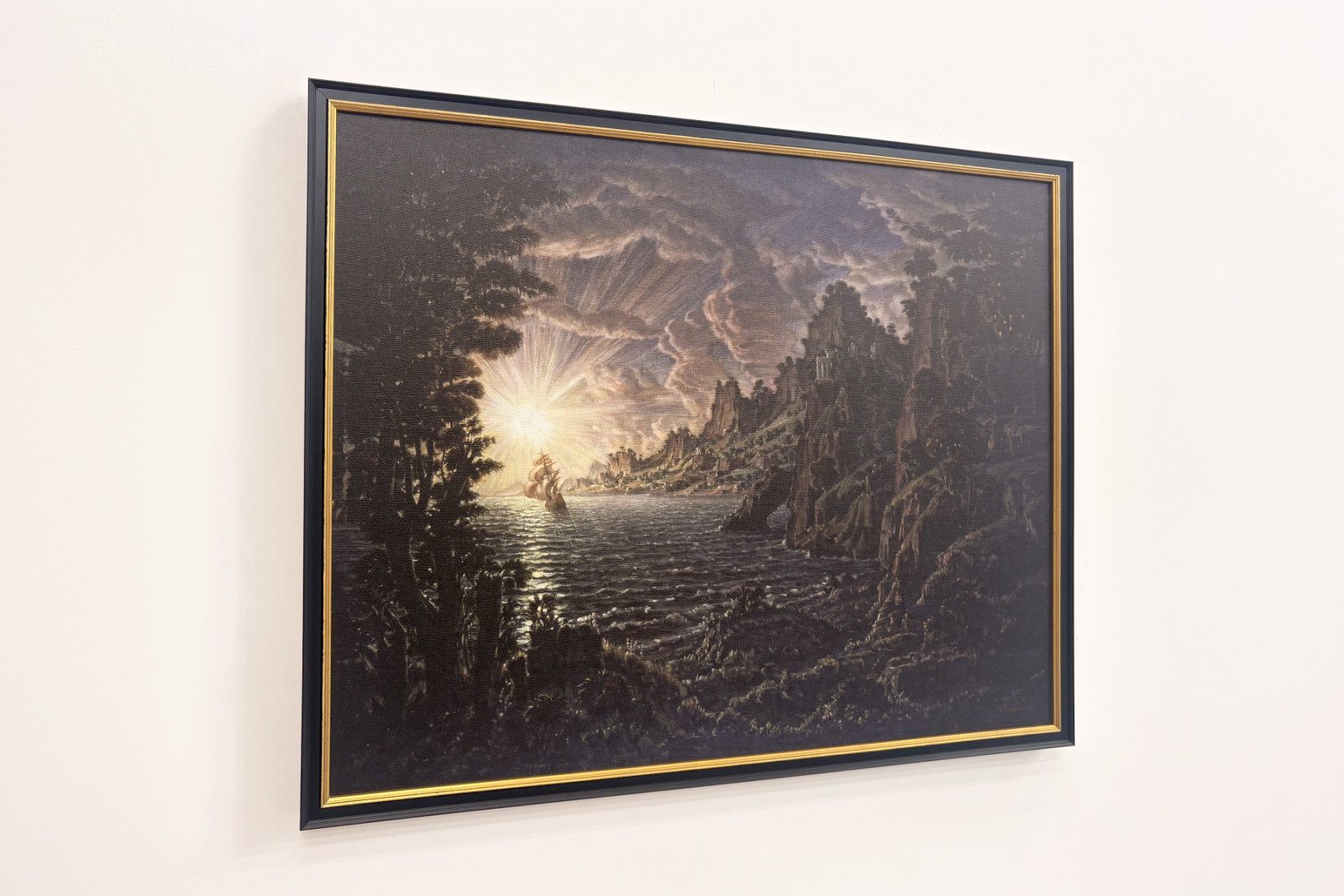
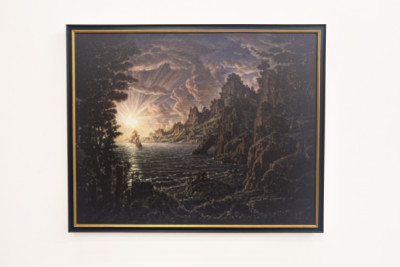
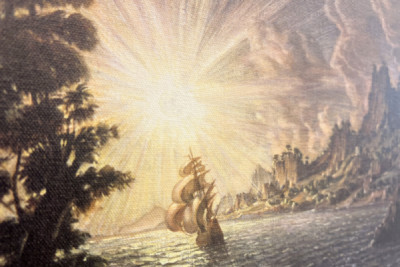
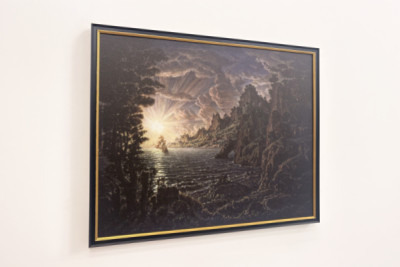
Where the sun breaks through in the picture, the surface of the print also brightens noticeably - the halo of light above the water stands out so brightly against the otherwise almost black background that, when viewed from the side, it appears to be a light source in its own right. From this dazzling centre, the entire scene unfolds: A sailing ship is cruising against the low-hanging evening sun, whose rays fan out through the banks of clouds, whilst on the left dark treetops and on the right a rugged rocky coastline with small temple structures on the heights rise up against the sky. Konstantin Bogayevsky, the painter of the Crimea, created this work in 1912, at a time when he was elevating his coastal landscapes to the realm of the visionary - not a real bay, but a dreamt-of one, in which antiquity and the forces of nature converge. The painting carries a curious dual atmosphere, at once solemn and menacing, for the sky above the light remains heavy, and the water in the foreground is almost black.
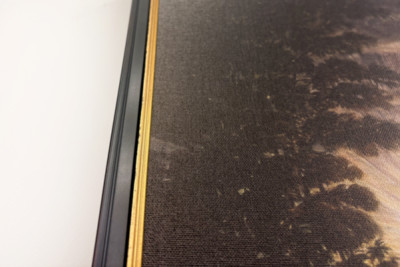
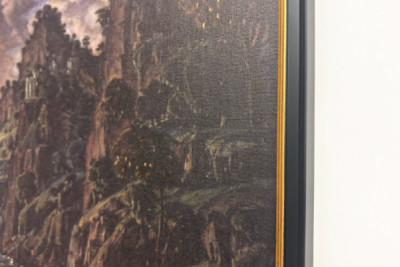
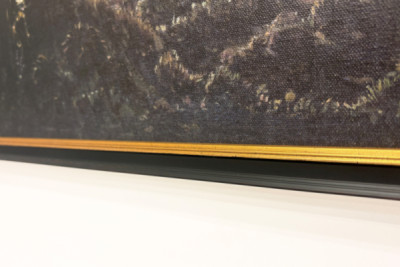
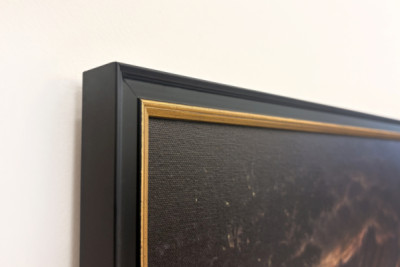
It is precisely this contrast between glare and darkness that makes the satin-finished canvas its own here: Leonardo actually makes the centre of the sun shimmer, a soft glow that shifts with the viewer’s vantage point, whilst the dark rocky sections swallow the light and remain dull - the contrast therefore lies not only in the colour, but in the surface itself. When room light falls obliquely across the 60 x 48 cm canvas, narrow reflections run across the crests of the waves in the foreground, and the small golden dots in the cliffs flash briefly before sinking back into the brownish-black - the eye keeps returning to this detail. Amelie, a black wooden frame with an internal gold edge, sets a calm boundary to this interplay; in places, the reddish patina shows through the ribbed gold strip, a warm tone that harmonises well with the evening light in the picture.
 ×
× 





 +43 4257 29415
 support@meisterdrucke.com
 Mo-Do: 7:00 - 16:00 | Fr: 7:00 - 13:00