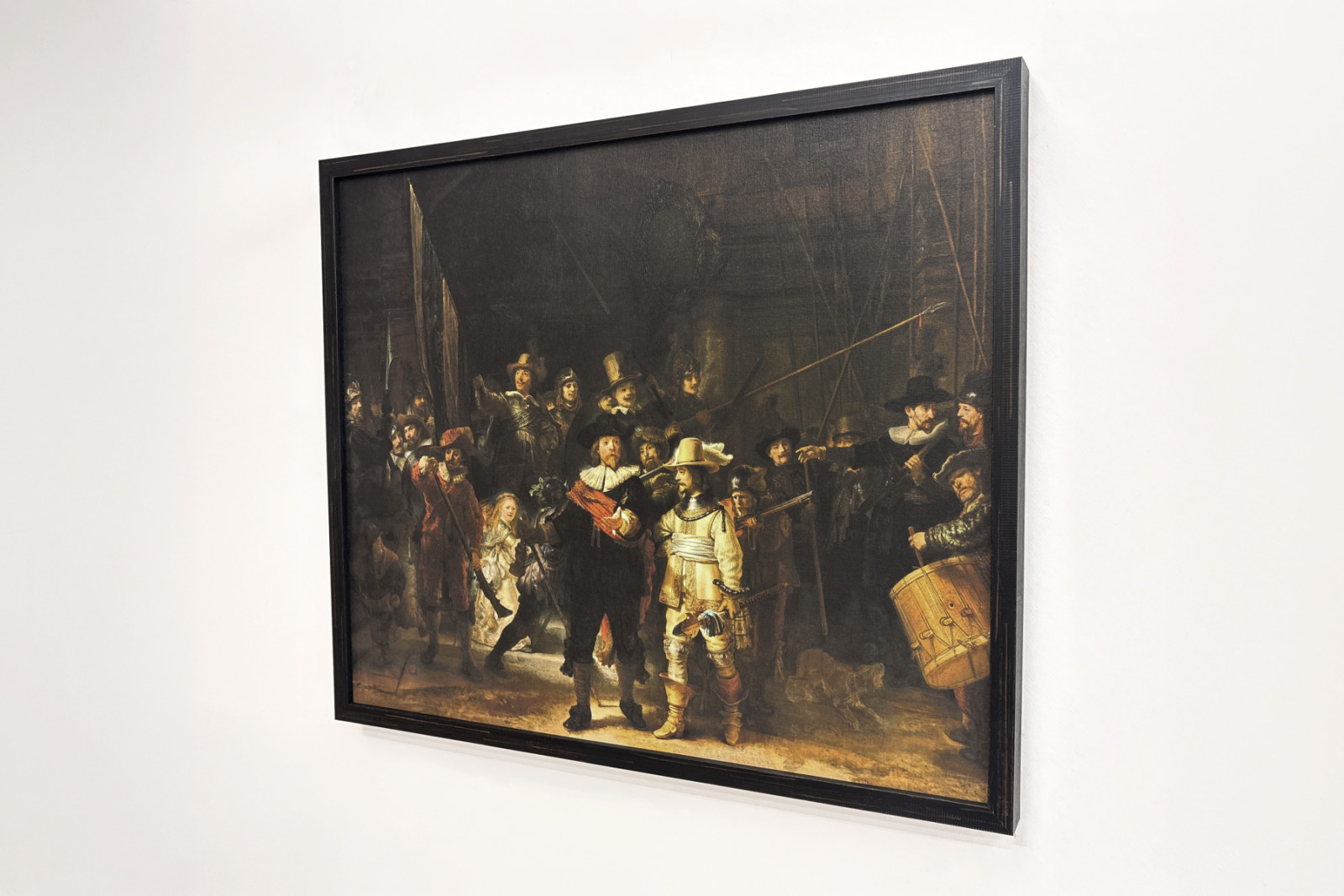
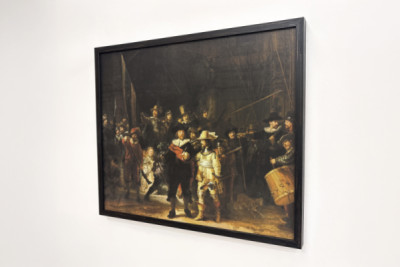
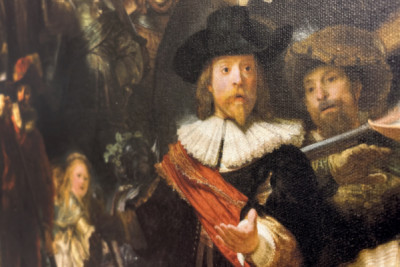
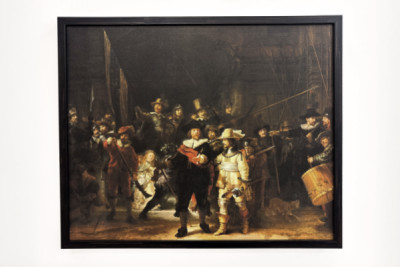
In the midst of the darkness, a little girl glows. She stands to the left of the centre of the picture, dressed entirely in gold, with a dead chicken on her belt, and to this day no one knows exactly what she is doing there. Surrounding the child is the militia company of Captain Frans Banninck Cocq, who leads the way dressed in black with a red sash, flanked by his lieutenant in bright yellow. Lances cross, a drummer strikes up a beat, a dog recoils. In 1642, Rembrandt did not paint a stiff group portrait, but rather a scene of departure. This did not earn him only praise at the time - some of the paying marksmen disappear into the semi-darkness, whilst light and movement dominate the picture. It is precisely this unequal treatment that keeps the work alive to this day. Incidentally, the name ‘The Night Watch’ is a misunderstanding arising in later centuries: it was only after the varnish had darkened that the daytime scene became a night scene.
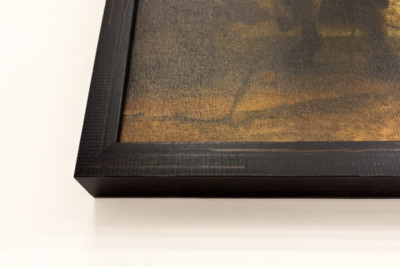
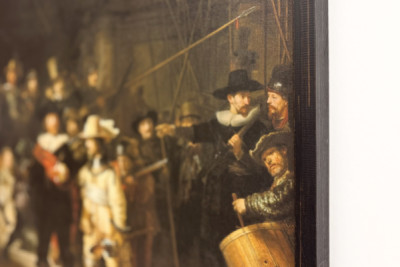
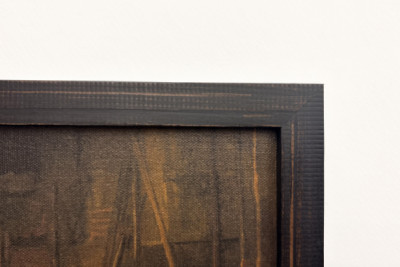
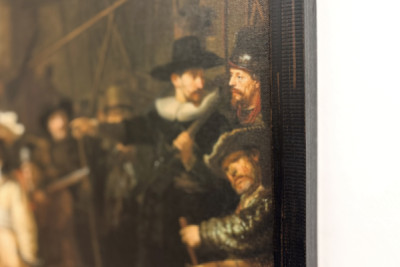
This version takes the half-light seriously and responds to it with a suitable frame. Lola is a slender, dark brown real-wood moulding whose surface is reminiscent of tree bark, and this brown is closer to the painting than any pure black. Where the stain thins at the edges, warm wood shimmers through - the same ochre tone that colours the floor and the drum in the painting. The frame and the painting thus share a colour family without blending into one another; the profile remains visibly darker than the lightest parts of the painting, allowing the lieutenant’s yellow to stand out all the more. Measuring 70 x 58 cm, the whole work is mounted on satin-finished canvas, without glass or a passe-partout - a decision that does the painting a favour, as nothing stands between the eye and the layer of paint. It is astonishing how much emerges from the shadows: even the crossed lances in the upper part of the picture retain their contours, and one’s gaze lingers on the drummer’s flushed head at the right-hand edge, as it still bears the subtle highlights of the original.
 ×
× 





 +43 4257 29415
 support@meisterdrucke.com
 Mo-Do: 7:00 - 16:00 | Fr: 7:00 - 13:00