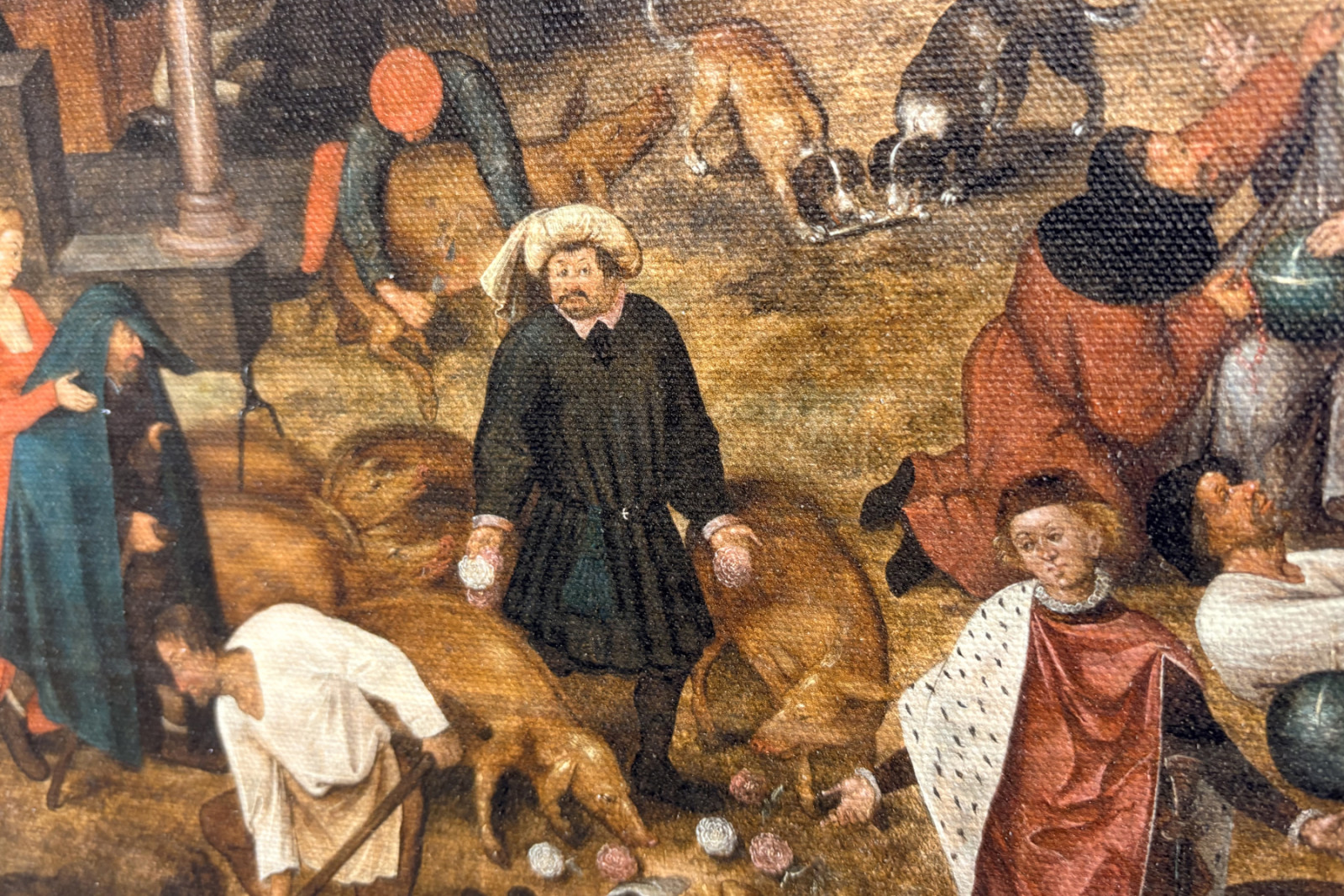
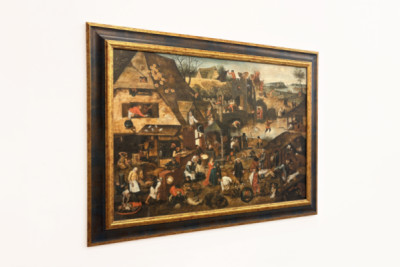
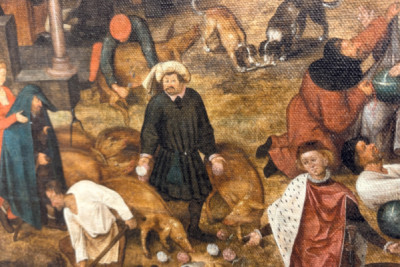
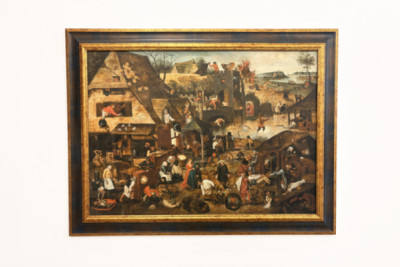
Set amongst dark huts and bright paths, the village stretches all the way to the distant water. There’s action everywhere. People are climbing onto roofs. One leans out of a window. Others are lugging things about, arguing or half-disappearing into the buildings. Every little action translates a proverb into visible humour, whilst at the same time exploring human quirks and follies. The picture does not pass judgement loudly; it observes dispassionately. Ochre, brown and muted green dominate the scene, whilst red and white garments provide small points of colour amidst the bustle. The light is distributed evenly, leaving hardly a single quiet spot. With such densely populated depictions, Pieter Brueghel the Younger follows in the pictorial tradition of his father, Pieter Brueghel the Elder. It is astonishing how legible the figures remain at 65 × 47 centimetres - and yet they cannot be taken in at a single glance. Constantly, another scene slips from the background into the foreground.
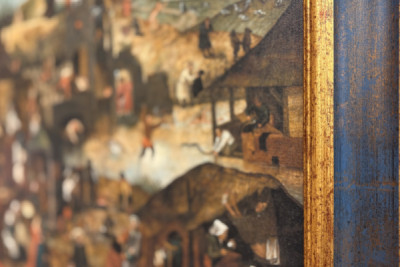
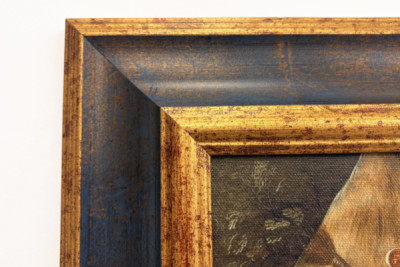
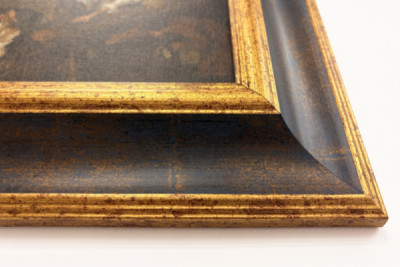
Annelie frames this abundance with a broad border of deep blue and gold. Given that this is a historical motif, this comes as something of a surprise at first. A conventional gold frame would probably have merely emphasised the earthy colours; here, however, there is more contrast: the blue stands out coolly against the brown roofs and black clothes. Golden veining runs through the 66-millimetre-wide frame and is echoed in the ochre-yellow walls and fields. Inside, a gold edge draws a clear boundary; on the outside, there is another narrow gold border; in between, the blue appears almost black in places. The ‘Leonardo’ canvas, with its satin-finish surface, sits in the frame without glass or a passe-partout; on the sides, the mirrored motif runs around the stretcher frame. My gaze lingers on the right-hand edge of the picture: there, the dark blue comes so close to the shaded huts that small figures initially disappear between the brown and black - only to reappear at a second glance. It is precisely this process of rediscovery that never ceases in this painting.
 ×
× 





 +43 4257 29415
 support@meisterdrucke.com
 Mo-Do: 7:00 - 16:00 | Fr: 7:00 - 13:00