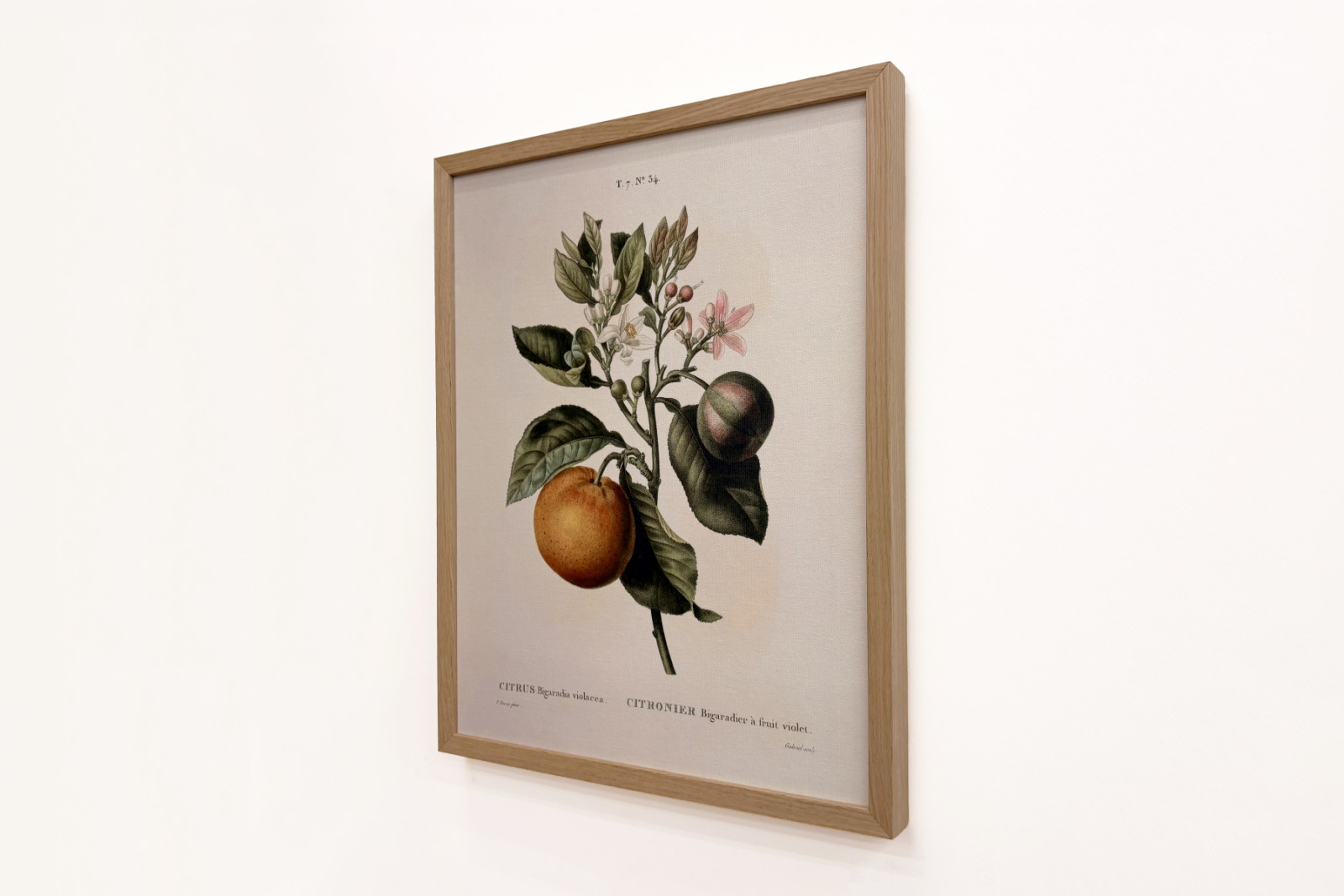
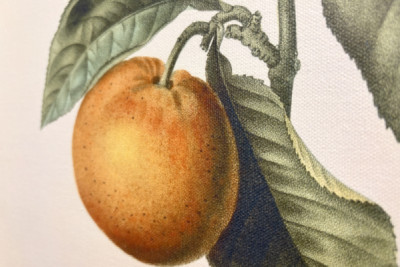
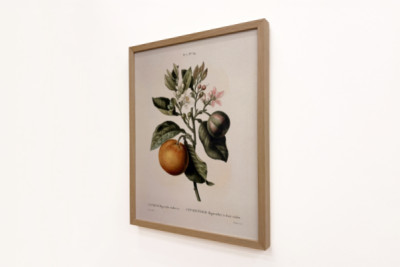
Two fruits hang from a slender twig, and they could scarcely appear more contrasting: on the left, a ripe bitter orange in a warm ochre; on the right, a dark fruit banded with purple and green. Between them, leaves, buds and blossoms reach upwards. White star-shaped blossoms open alongside delicate pink flowers, whilst small fruit buds already herald the plant’s next stage of development. Redouté arranges all this against a light background so clearly that the twig appears to stand almost freely in space. Nevertheless, the depiction does not appear rigid: leaves tilt forwards, stems branch out, and the heavy orange noticeably pulls the composition downwards to the left. Subtle shadows define its curve; the violet fruit responds with cooler transitions and an almost velvety darkness. Pierre-Joseph Redouté, originally from Belgium and renowned as a botanical illustrator around 1800, combines botanical precision with a highly accessible visual language. At the same time, the painting tells a story of growth: a closed bud, an open flower and a ripe fruit appear side by side. It is precisely this calm order that captures the viewer’s attention; at some point, one actually finds oneself counting the dots on the skin.
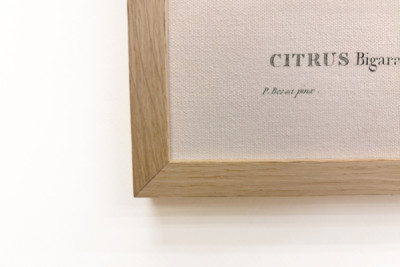
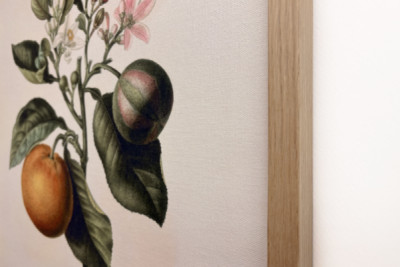
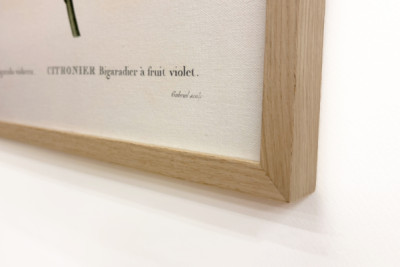
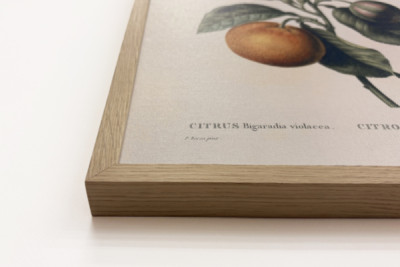
Once hung, it becomes clear why the satin-finished surface of the canvas suits Leonardo’s botanical depiction. Viewed from the front, the light background remains uniform; even around the labels at the bottom edge, there are no harsh patches of light. Only when the piece is turned towards the light source does a soft glow wash over the surface. On the orange-coloured fruit, it settles over the centre without obscuring the speckled skin or the dark rim. The purple fruit reacts differently: its dark areas absorb more light, whilst the rosy bands glow briefly. It is precisely this interplay that makes both objects appear rounded. Without glass, the light falls directly on the print; this prevents any reflective double images from forming in front of the flowers or leaves. The motif therefore remains legible even when viewed from the side; only the focus of the sheen shifts. On the outside, the ‘Sinead’ decorative frame made of oak veneer provides a clean edge - and, to be honest, the 35 x 45 cm print needs nothing more than that. As you step back, the shimmer subsides and the twig regains its silhouette. In the end, it is the peculiar pair of fruits that makes the difference: the familiar orange next to its violet-striped counterpart transforms a botanical study into a small discovery.
 ×
× 





 +43 4257 29415
 support@meisterdrucke.com
 Mo-Do: 7:00 - 16:00 | Fr: 7:00 - 13:00