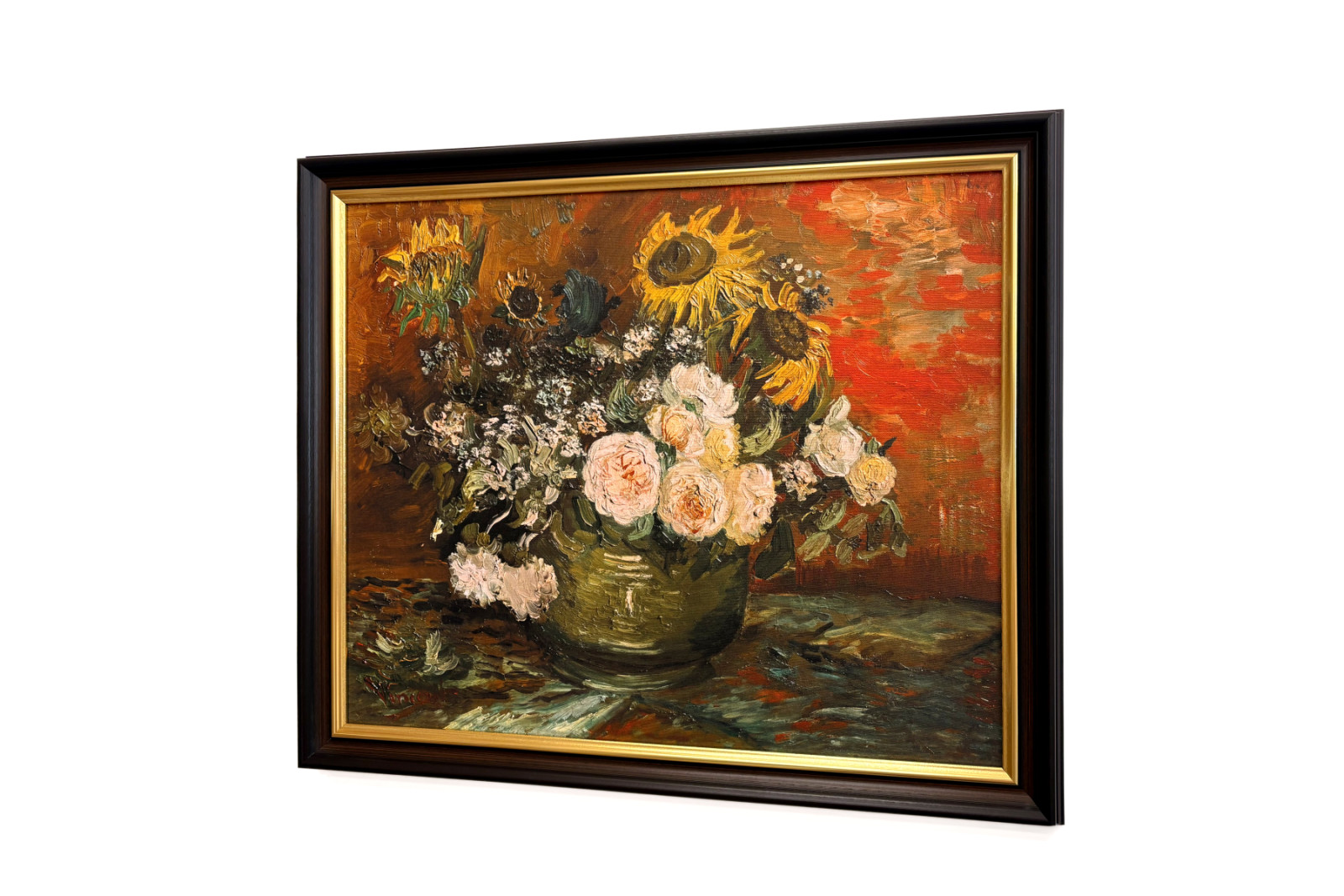
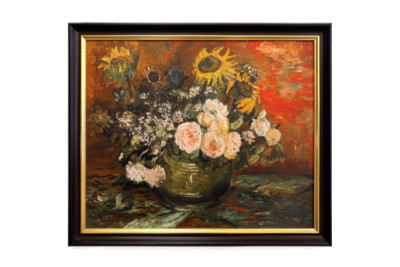
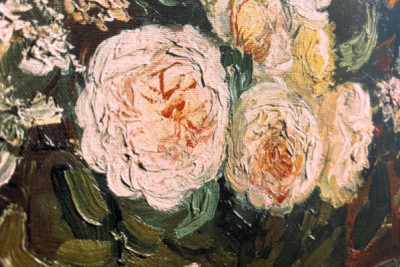
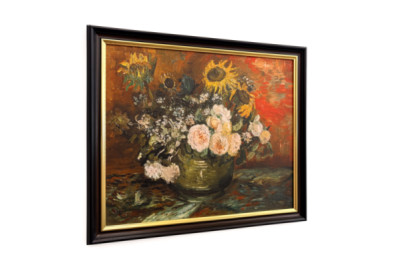
Dark red lines run across the pale pink of the roses, as if the colour had only just found its way through the blossoms. Behind them, sunflowers, small white flowers and lush greenery jostle together to form a dense bouquet. Vincent van Gogh painted this still life in 1886. The vase sits low on the table, the flowers spreading upwards and out to the sides. Nobody has arranged anything here. Some heads are opening, others are already drooping. That is precisely where the tension lies. Van Gogh depicts blossoming and decay in the same vessel. For him, yellow symbolises warmth, joy and friendship; it glows in the sunflowers, yet conceals neither the dark centres nor the wilting edges. On the right, the background blazes with red and orange. On the left, brown, green and black lend the scene a sense of depth. This is no mere bouquet of flowers; rather, it is a vivid portrayal of vitality and transience.
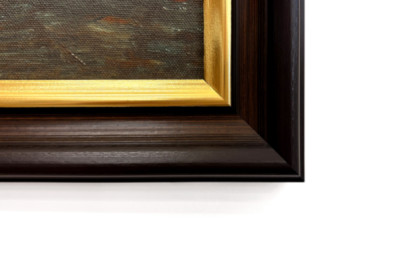
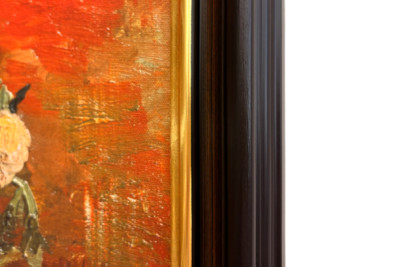
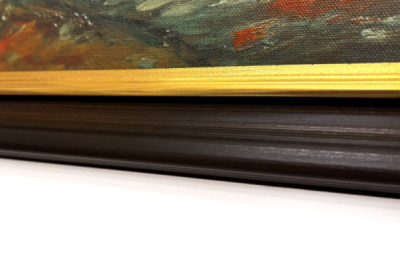
We have printed the work on Leonardo Satin. The satin finish makes every single brushstroke visible, even the short strokes in the roses. When framing it, I align the gold edge of Lychorida with the bottom corner, step back and pause for a moment. That’s the best vantage point from which to appreciate the frame. Inside, the gold draws a line. Behind it, a light brown hollow opens up, before the broad black edge provides the finishing touch. This sequence has a decisive, almost slightly austere effect. For some floral paintings, this would be too harsh for my taste, but this one does not call for a delicate border. Without a passe-partout or glass, the image remains immediate. Measuring 58 by 48 centimetres, it retains an intimate quality, almost table-sized. Ultimately, the slightly drooping sunflowers set the tone: their yellow petals still shine, whilst their posture already speaks of transience.
 ×





 +43 4257 29415
 support@meisterdrucke.com
 Mo-Do: 7:00 - 16:00 | Fr: 7:00 - 13:00