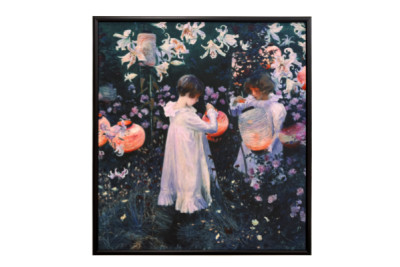
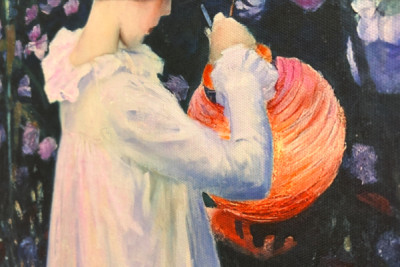
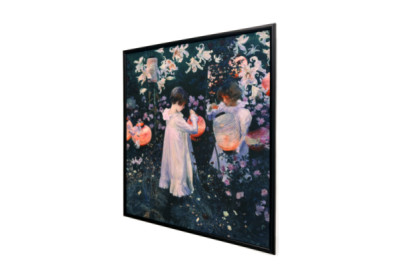
In the garden near Broadway in the Cotswolds, two girls stand amongst lilies and roses, lighting paper lanterns. The orange glow of the lanterns falls on their hands and faces; their white dresses appear almost transparent in the mauve evening light. Behind them, the foliage deepens to a rich blue-green, whilst scattered blossoms dot the scene with touches of pink and violet. The bowed heads, the careful movements - there is something solemn about the scene, and yet it remains a familiar moment of childlike concentration, one that instinctively makes one fall silent oneself. John Singer Sargent, best known as an American portrait painter of his time, began the painting in 1885 and worked on it over two painting seasons. Each evening, he had only a few minutes in precisely that twilight light in which colours and contours blend into one another. Time and again, he would lay out his brushes and palette, have the models take their positions, and then, the following day, rework whatever he felt was not quite right. He even trims the canvas to frame the composition more closely around the two figures. The fact that this test of patience has resulted in such a light-hearted painting is, to me, one of the most astonishing aspects of it.
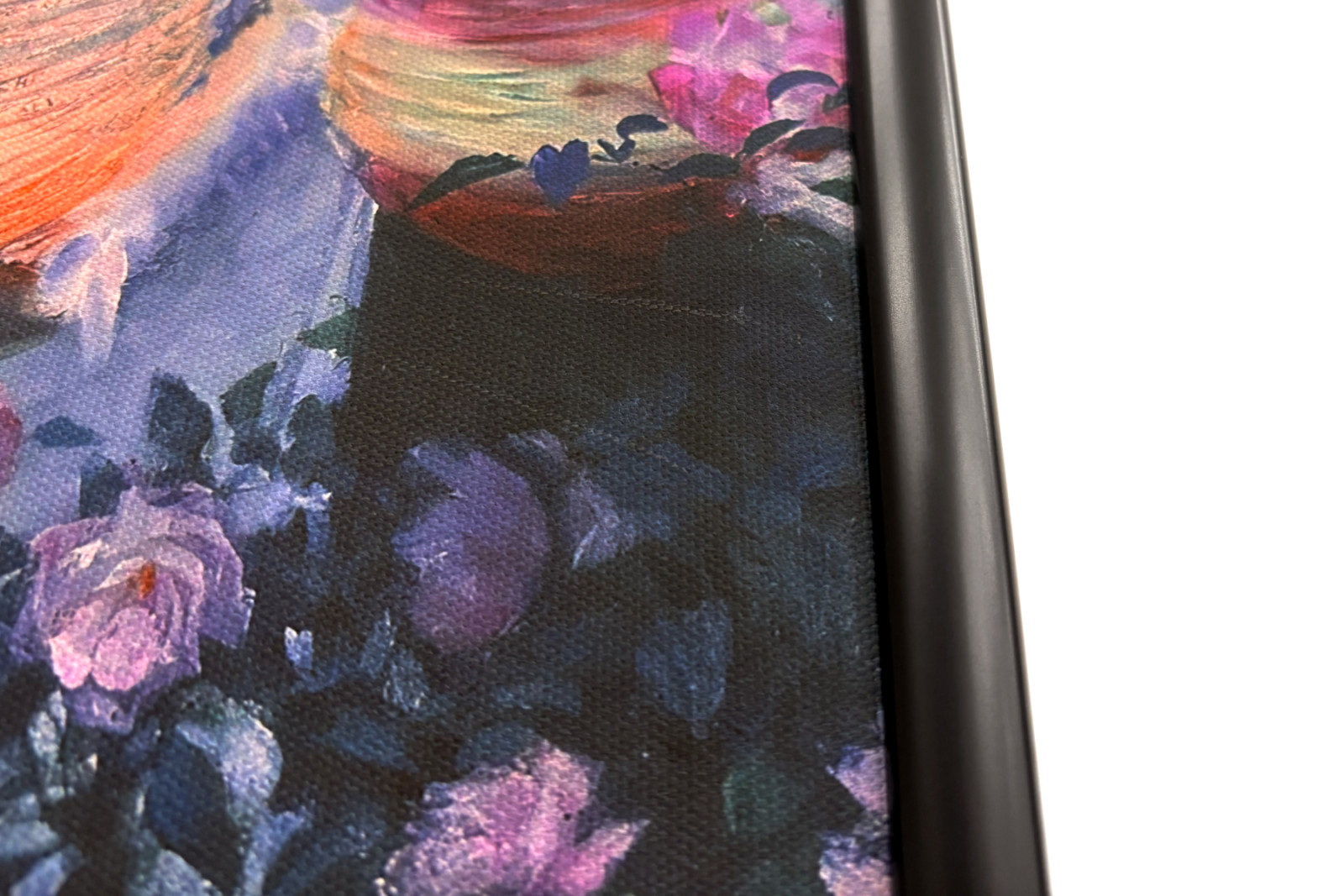
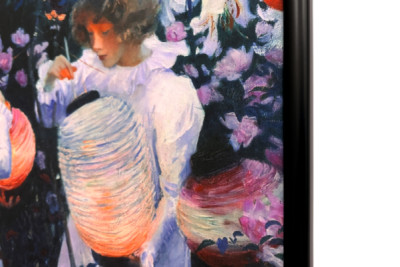
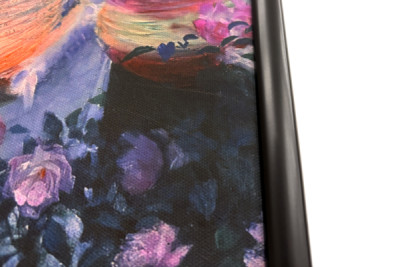
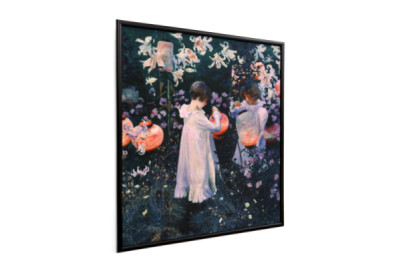
When hung, it becomes clear just how fitting black is for this work. *Friedegarde* flows seamlessly into the midnight-blue garden; no passe-partout interrupts the transition. In the bottom right-hand corner, where violet roses emerge from dark foliage, the frame almost merges into the background of the picture. One briefly searches for the boundary. This makes the coral-red lanterns and the light-coloured robes stand out all the more clearly from the depths. The same relationship applies along the upper edge: the white lilies meet the black outline there and gain in clarity without becoming harsh. The Salvador canvas, with its matt surface, calmly carries Sargent’s loose brushstrokes and avoids any sheen that would brighten the twilight colours. Admittedly, in an already dark room, so much black calls for a lamp nearby - but then the combination really works.
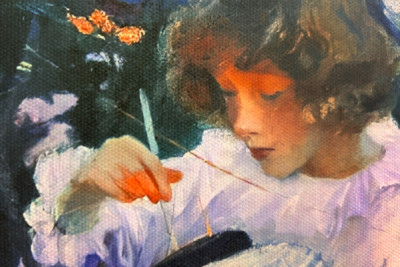
From a distance, the scene appears like a fleeting evening still captured by the streetlamps. Up close, the visible colourgive the picture a depth that makes you want to trace it with your fingers, whilst Friedegarde’s black binds the picture and frame into a single unit - a choice that only becomes apparent at second glance.
 ×
×






 +43 4257 29415
 support@meisterdrucke.com
 Mo-Do: 7:00 - 16:00 | Fr: 7:00 - 13:00