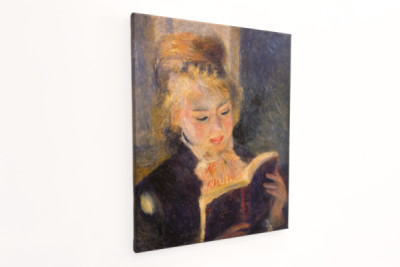
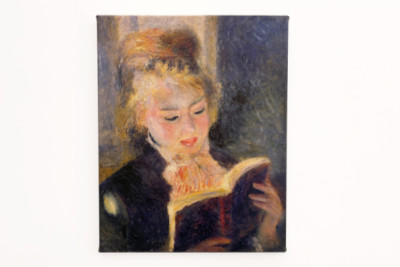
A young woman is reading, completely absorbed in her book - so deeply, in fact, that she does not even notice the viewer. Pierre-Auguste Renoir painted “The Reader” (also known as “La liseuse”) in 1874, the year Impressionism was founded, and the painting captures precisely what this movement stands for: an everyday moment, captured in swift, loose brushstrokes. The light here does not come from outside, but appears to emanate from the book itself - the bright pages cast a warm glow upwards onto the lowered face, the orange-red jabot at the collar and the blonde, pinned-up hair. The cheeks appear in shades of pink and peach, the lips slightly parted, the eyes almost closed beneath dark eyelashes. Against this, Renoir sets the deep blue-black of the clothing and a sketchy background in blue-grey, in which a bright strip of light from a window is hinted at on the left. The original, an oil on canvas, now hangs in the Muséed’Orsay in Paris and is regarded as one of the painter’s most intimate portraits - no pose, no staging, just concentration and warmth.
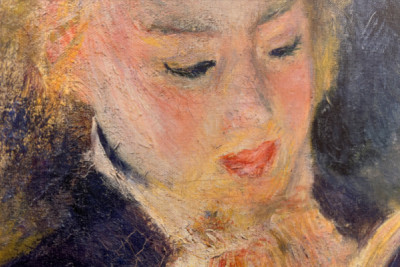
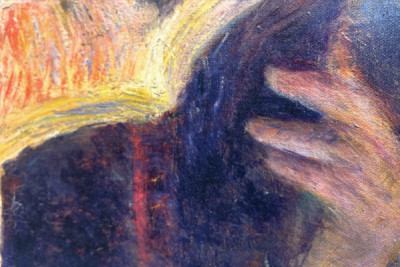
This version measures 40 x 50 cm and is painted on ‘Leonardo’, a satin-finished canvas that comes remarkably close to the oil-painting quality of the original. This is most evident where the light from the book meets the jabot: orange-red and yellow brushstrokes are visibly layered upon one another; one can trace Renoir’s brushwork as he built up the glow in short, almost flickering strokes. Even on the face, the print conveys more than one might expect from a distance - fine cracks in the aged paint film run across the forehead and cheek, the craquelure of the original remains recognisable as a delicate web, without detracting from the soft skin tones. On the hand holding the book, the fingers blur with precisely the sort of soft focus that Renoir intended. The print does not create a hard edge here, but leaves the transition between the skin and the dark cover open. It is here that one’s gaze truly lingers. Even the signature at the left-hand edge of the image, half-submerged in the blue-grey of the background, is legible. The mat and glass have been deliberately omitted - nothing stands between the viewer and the surface.
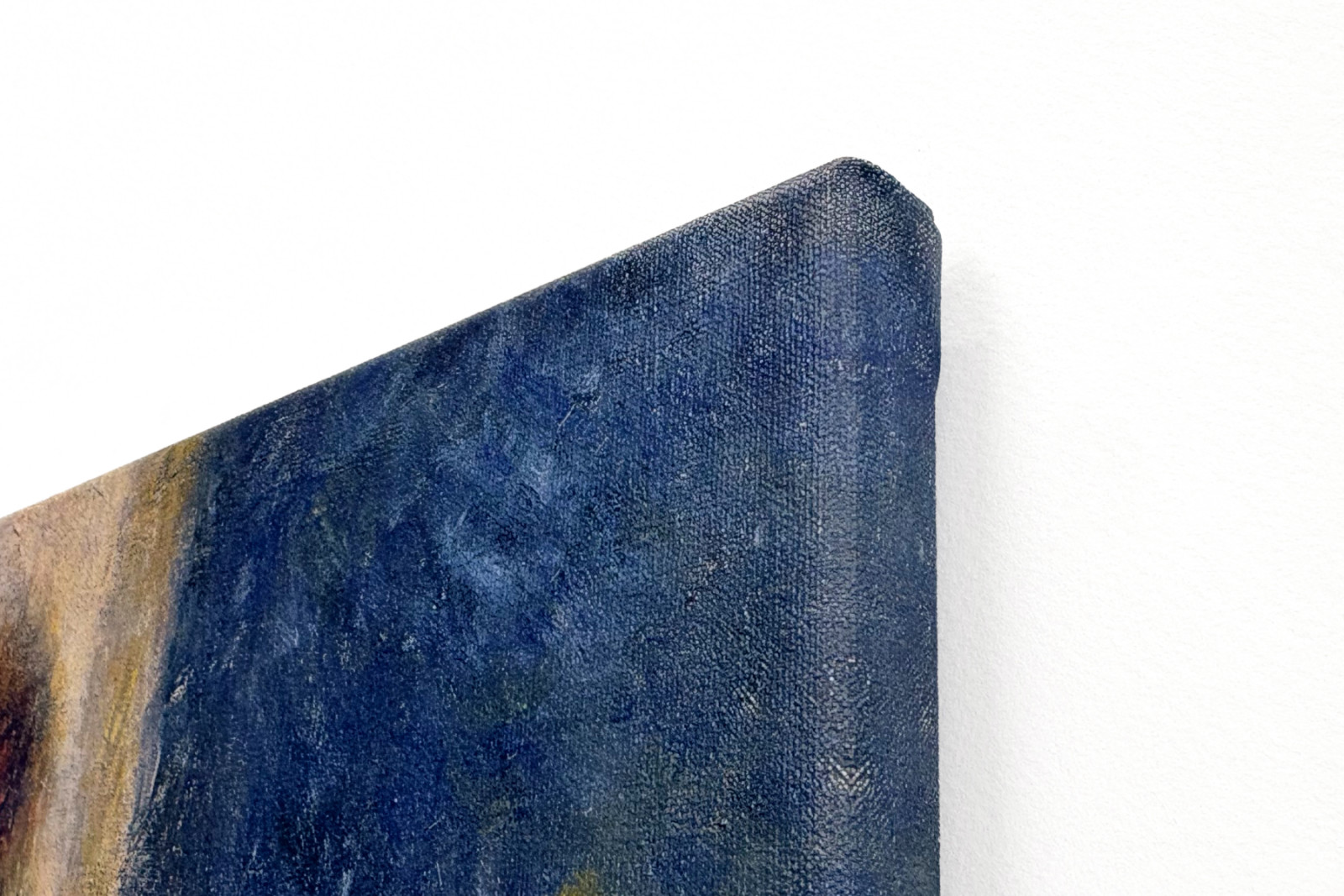
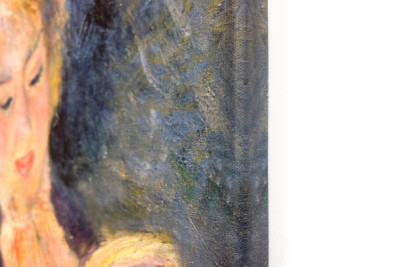
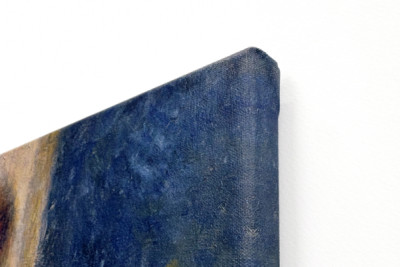
The stretcher frame extends the motif, mirrored around the edges: On the side, the dark blue of the background, with its yellowish flecks, flows over the edge, whilst at the top the dynamic brushstrokes continue. Thus, the piece hangs frameless on the wall, and the picture surface does not end abruptly anywhere - at the top corner, the canvas fits neatly around the edge, with the fold sitting precisely in the corner. A simple solution that suits the understated motif well.
 ×
× 





 +43 4257 29415
 support@meisterdrucke.com
 Mo-Do: 7:00 - 16:00 | Fr: 7:00 - 13:00