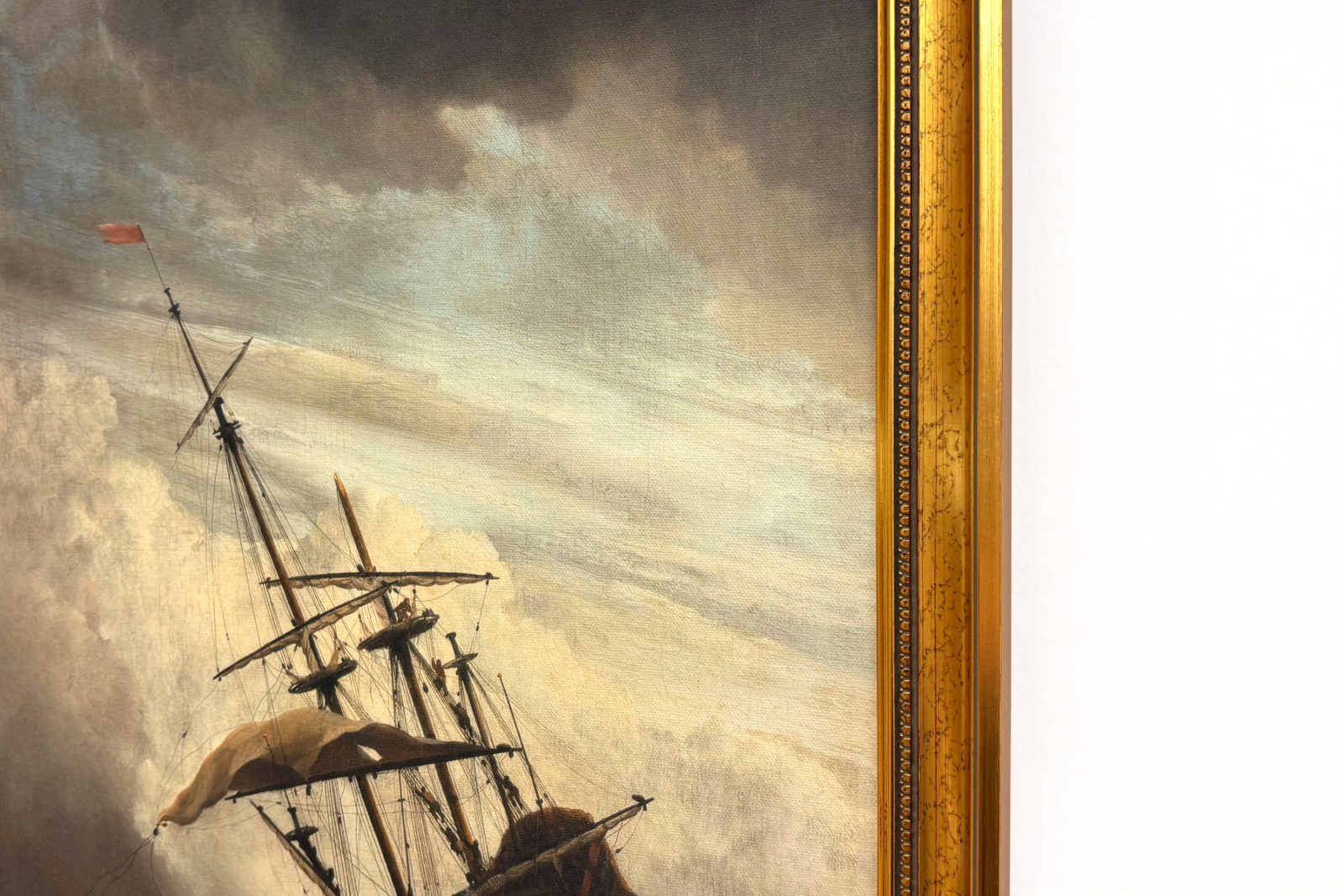
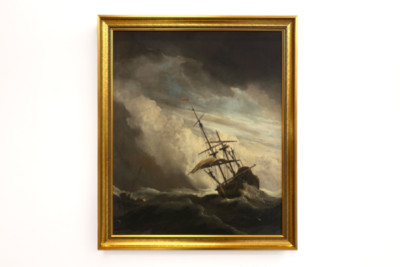
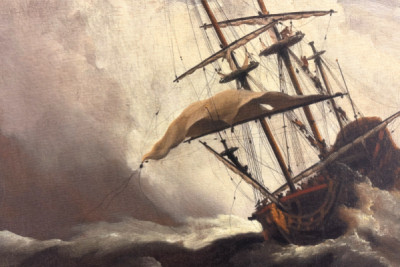
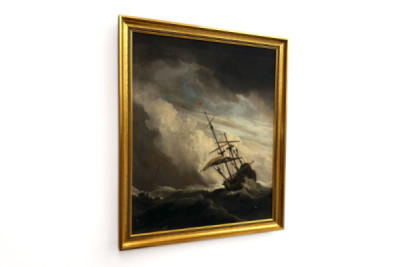
A tiny red pennant flutters from the foremast, barely bigger than a fingernail, and yet it is the brightest spot amidst this whole turmoil of clouds and spray. Beneath it, a three-masted ship battles the gale that gave the painting its nickname: ‘The Wind Gust’. The ship is listing heavily; a torn sail billows like a sack in the storm, whilst to the left, in the darkness, a smaller boat is almost swallowed up by the waves. Willem van de Velde the Younger, the great marine painter of the Dutch Golden Age, knew exactly what the weather at sea looked like - he used to sail with his father in dinghies amongst war fleets to sketch battles at close quarters. This experience is evident in every detail: in the rigging, which remains logical even under pressure; in the sailors, who hang minuscule against the shrouds; and in the light that breaks through the wall of clouds, staging the scene rather than merely illuminating it. It is a picture about being at the mercy of circumstances - and, at the same time, about order amidst chaos.
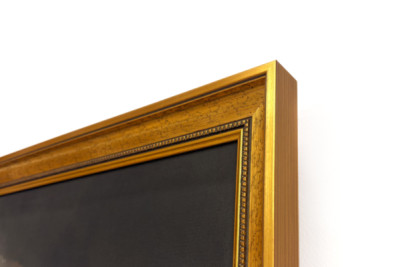
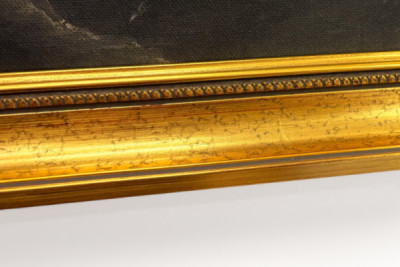
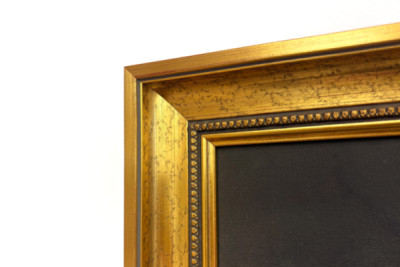
Framed, the whole piece hangs in ‘Janine’, a real wood profile which, not without reason, is one of our most popular. It’s worth taking a closer look: between the wide, grained golden-throat moulding and the inner round moulding runs a string of pearls made up of tiny, individually shaped links, which meet cleanly at the mitred corners - it is precisely at these corners that you get briefly caught up every time you unpack it. The gilding is not smoothly polished, but bears a fine, almost marbled pattern; at the edges, the red-worn bolus base shimmers through, as is typical of historical mountings. So it is not a dainty frame, but neither is it one that imposes itself - at 48 x 59 cm, the profile thickness remains pleasantly moderate. The motif itself is painted on Raphael canvas, whose matt surface absorbs any glare; thus even the darkest areas of cloud remain visible from every angle, which is no small feat in a picture so rich in shadows. And this is precisely where the appeal of this composition lies: Inside, the storm rages, whilst outside, a precisely crafted ornament provides a counterpoint - the frame gives the turbulent motif a solid railing to which the eye can cling.
 ×
× 





 +43 4257 29415
 support@meisterdrucke.com
 Mo-Do: 7:00 - 16:00 | Fr: 7:00 - 13:00