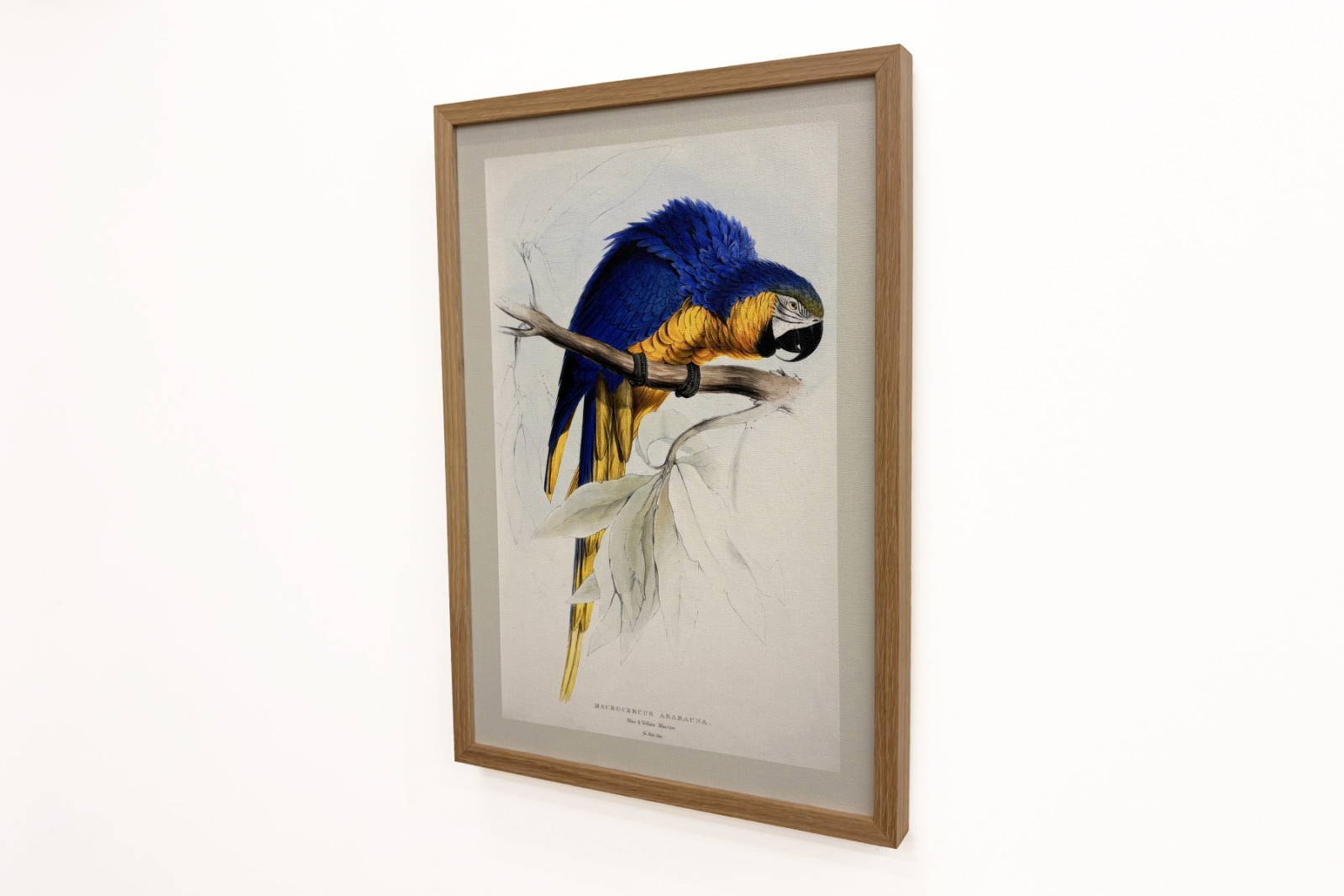
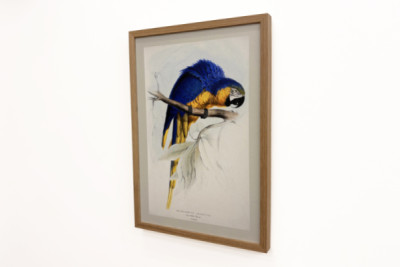
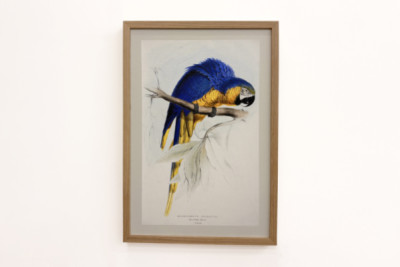
A macaw leans down from a branch, as if to scrutinise the viewer. Its back shimmers deep blue, its breast glows yellow, and its black beak hangs heavily above its pale facial markings. The background around it remains almost empty. Only the branch bears colour; the leaves beneath are merely hinted at, sketched in pale shades of grey. This contrast in detail is typical of Edward Lear. Before he became famous for his nonsense verses, the young Englishman drew parrots from live animals, not from taxidermy specimens, as was customary at the time. He sat in the menagerie of the Zoological Society of London and observed. You can tell this from the bird. The plumage does not appear contrived, but rather as if observed in real life: every feather on the yellow neck is individually rendered, the eye alert, the claws clamped firmly around the branch. Beneath the illustration is the old label bearing the Latin name, as on the historical display boards. The blue-breasted macaw is now classified as an endangered species. In retrospect, this too lends the print a different significance.
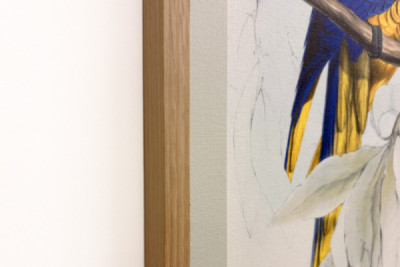
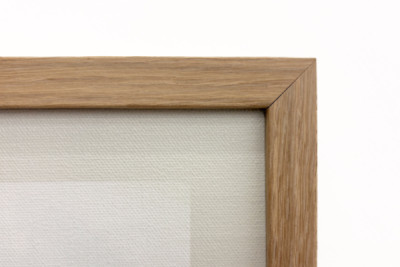
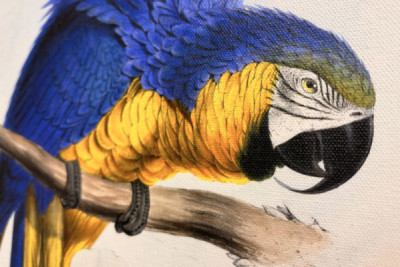
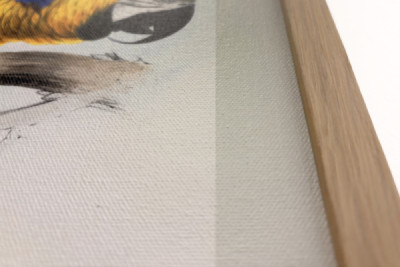
For this piece, Lear’s print is mounted on canvas - specifically, on ‘Leonardo’ with a satin finish. The client opted not to use a passe-partout or glass - and rightly so, as this allows the canvas to remain clearly visible. As your gaze travels over the light-coloured areas, the fine weave of the fabric emerges - an even texture that lends the blank paper background of the sheet a sense of substance. This is most pronounced at the bird’s head: On the black beak area, the ink layer sits firmly on the raised parts of the fabric, leaving the recesses darker. This makes the blue feathers appear almost three-dimensional, even though the surface is flat - it’s a detail you really do pause over whilst working on it. ‘Sinead’, a simple profile with oak veneer, frames it with a narrow border. The wood’s grain runs smoothly along the edges, mitred and without ornamentation. A grey margin remains between the frame and the motif, allowing the sheet to ‘breathe’. This motif needs nothing more.
A natural history illustration from the 1830s, transferred onto fabric and set in light-coloured wood: the two complement each other perfectly because both remain understated, allowing the bird to take centre stage. As you move in front of the picture, a soft shimmer wanders across the satin-finished surface, never glaring, more like a streak of matt, silky light - and particularly against the deep blue of the plumage, this effect complements the print remarkably well.
 ×
× 





 +43 4257 29415
 support@meisterdrucke.com
 Mo-Do: 7:00 - 16:00 | Fr: 7:00 - 13:00