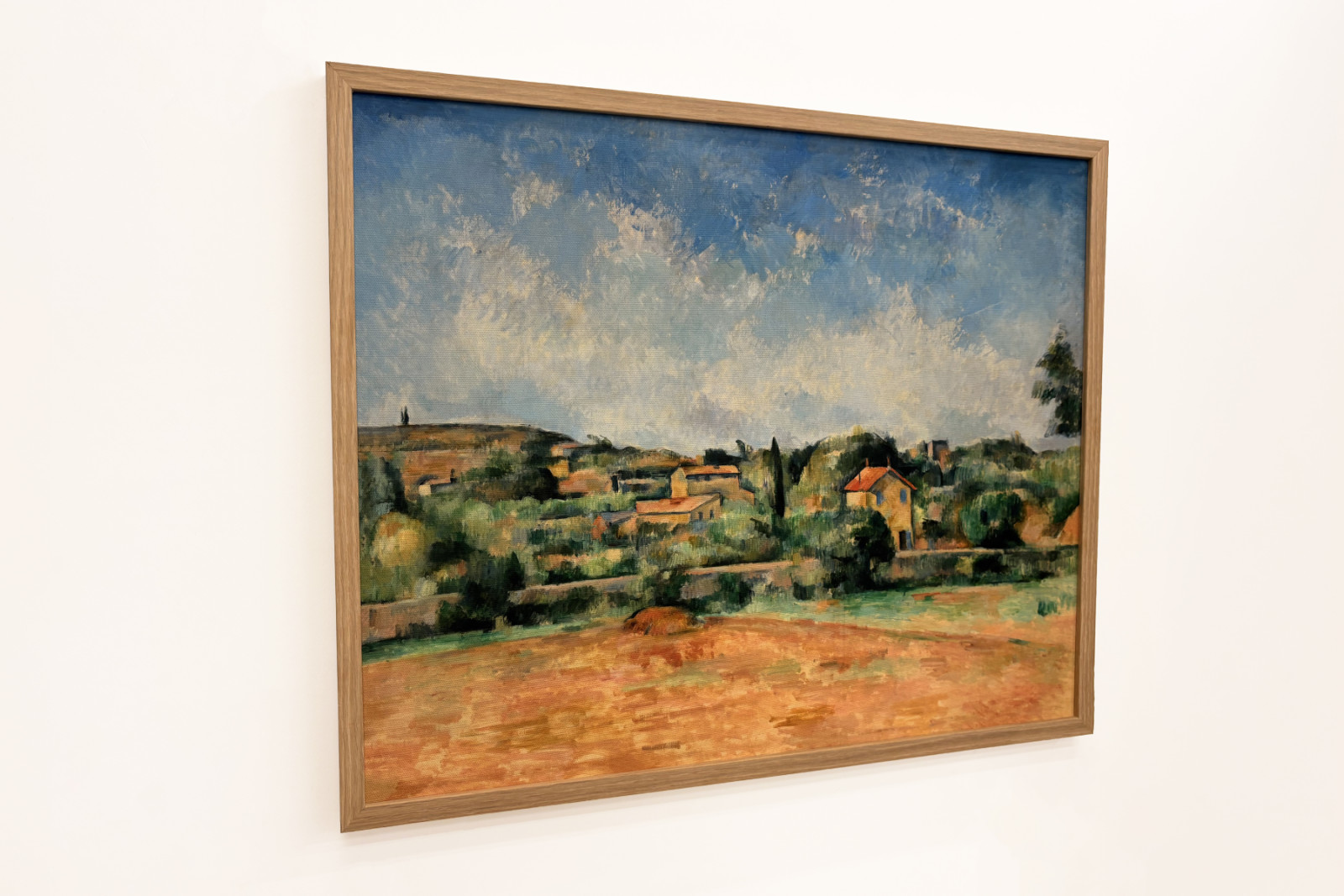
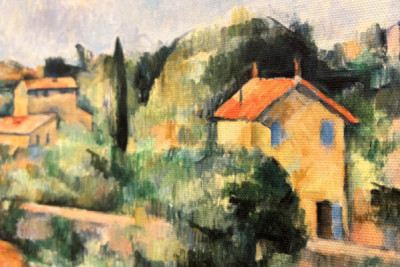
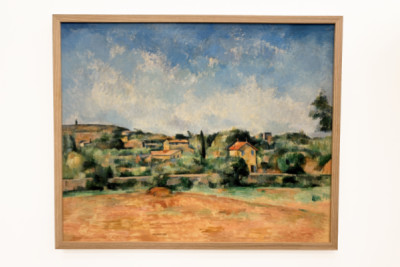
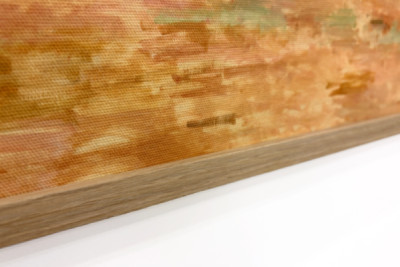
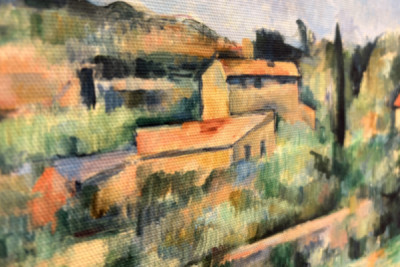
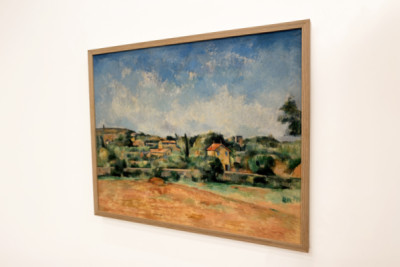
Just above the lower edge of the frame, there is a short, dark line in the red earth, almost casual; yet on the clearly visible fabric, this small mark takes on the weight of a brushstroke. From there, the view rises across the rust-coloured field to a green slope, behind which houses, walls and slender cypresses are scattered amongst clumps of trees, whilst a single building with a brick-red roof to the right of centre stands out more clearly, lending the landscape a firm, almost physical anchor. Above it, the sky occupies a surprising amount of space: blue, grey and off-white are layered in small patches without suggesting any particular weather conditions. Between 1890 and 1892, Paul Cézanne painted the Bellevue plain not as an pleasing panorama, but as a composition of colour fields, the directions of which together form the terrain, vegetation and architecture; it is precisely here that we see the first signs of that constructive view of nature through which the French painter’s influence extends far beyond Post-Impressionism. The red earth in the foreground appears warm, yet not with the carefree lightness of summer, for dark bands of greenery and heavy shadows hold the landscape together. It appears inhabited and yet deserted, familiar, yet somewhat austere.
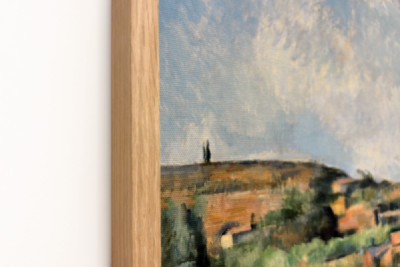
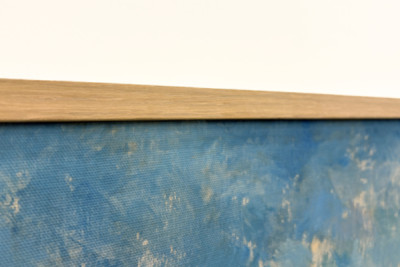
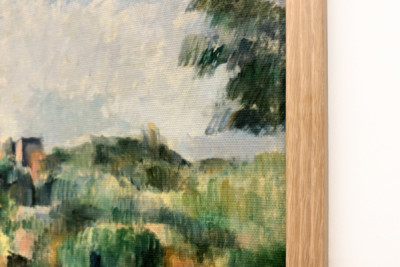
With this work on Salvador’s matt canvas, it is worth viewing it up close, as the weave does not disappear beneath a smooth surface: Its regular grid stands out clearly against the blue sky, and even the light, seemingly dabbed-on patches of cloud follow the tiny ridges and troughs of the threads. The eye lingers longest on the yellow house with the red roof, where dense layers of paint colour the fabric’s peaks vividly, whilst individual stitches remain lighter in the transitions to green and black; this does not create an artificial paste of colour, but rather a tangible relief that faithfully translates Cézanne’s broken brushstrokes. Further down, in the red expanse, orange, ochre and rosy patches run across the same grain, and the short brown stroke remains neatly defined, even though every row of threads visibly passes through it. A small detail, admittedly, but it is precisely this that determines whether such a translation succeeds. Without glass or a passe-partout, the fabric’s surface remains immediate, whilst Sinead’s narrow oak veneer merely draws a subtle boundary; measuring 59 by 48 centimetres, the piece hangs compactly on the wall, yet the wide sky zone makes the space in front of it appear noticeably more expansive.
 ×
× 





 +43 4257 29415
 support@meisterdrucke.com
 Mo-Do: 7:00 - 16:00 | Fr: 7:00 - 13:00