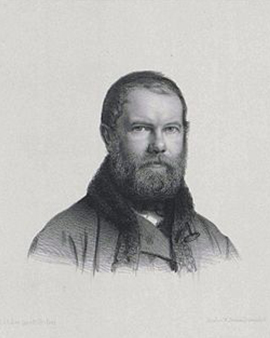
The story of Johann Wilhelm Schirmer, born in Jülich on September 7, 1807 and died in Karlsruhe on September 11, 1863, reads like a captivating narrative of an artistic journey. His footprints in the realm of art are deep and irrevocable. Each art print made of his works promises to immerse the viewer in the depths of this journey.
In the streets of Jülich, marked by the scars of his childhood and the siege of 1814, Schirmer's passion for art began. His beginnings were humble, but his thirst for knowledge led him to the Düsseldorf Academy of Art. Here he found not only education, but also inspiration. Under the watchful eyes of Wilhelm Schadow and Heinrich Kolbe, Schirmer shaped himself. His work "German Jungle" became a topic of conversation, and the gold medal he received at the Salon de Paris in 1838 solidified his place among the stars.
His vivid imagination, influenced by travels throughout Europe, resulted in a play of color and tone in his works that touched the soul. With each stroke of his brushes, Schirmer revealed not only the outer landscape, but also the inner landscape of the human spirit. His stay in Rome between 1839 and 1840 broadened his view of art. He was inspired by the eternal city and took many of his works in a more stylized and idealized direction, often using biblical motifs that emphasized his understanding of nature as divine revelation.
But Schirmer's contribution was not limited to his own creations. As a professor and eventually as the first director of the newly founded Karlsruhe Art School, he influenced generations of artists. Names like Hans Thoma and Anton Alexander von Werner are just a few of the many who flourished under his tutelage. His printmaking works, though lesser known, were of great importance to the emerging artist and reflect his diversity and depth.
Johann Wilhelm Schirmer left a legacy not only through his works, but also through his influence. His importance to 19th century German landscape painting remains undeniable, and streets named after him, as well as numerous honors, confirm this. For those fortunate enough to own an art print of his work, it is a window into his soul and a testament to his brilliance.
 ×
×







 Passionate Customer Service

.jpg "The Path on the Edge of the Wood, c. 1851 by Johann Wilhelm Schirmer")
.jpg)
.jpg "The Geroldsauer Valley near Baden-Baden by Johann Wilhelm Schirmer")
.jpg)
_-_(MeisterDrucke-1713834).jpg "Sea study near Étretat (with rocky coast to the left) by Johann Wilhelm Schirmer")
_-_(MeisterDrucke-1713834).jpg)
_-_(MeisterDrucke-1717641).jpg "Study of the Sea near Étretat with Rocky Coast on the Right by Johann Wilhelm Schirmer")
_-_(MeisterDrucke-1717641).jpg)
.jpg "Sea Surf on the Coast of Normandy by Johann Wilhelm Schirmer")
.jpg)
.jpg "Rocky Landscape, in the Foreground a Young Woman with Three Children and a Dog before a Romanesque Portal by Johann Wilhelm Schirmer")
.jpg)
_-_(MeisterDrucke-1711861).jpg "The Fall of Man (Genesis 3:6) by Johann Wilhelm Schirmer")
_-_(MeisterDrucke-1711861).jpg)
.jpg "Mountain Ranges near Altenahr by Johann Wilhelm Schirmer")
.jpg)
.jpg "The Geroldsau Valley near Baden-Baden by Johann Wilhelm Schirmer")
.jpg)
_-_(MeisterDrucke-1315227).jpg "An Arcadian Landscape by Johann Wilhelm Schirmer")
_-_(MeisterDrucke-1315227).jpg)
_c1856_-_(MeisterDrucke-590904).jpg "The Departure of the Man to Jericho (Morning) by Johann Wilhelm Schirmer")
_c1856_-_(MeisterDrucke-590904).jpg)
.jpg "The Wetterhorn by Johann Wilhelm Schirmer")
.jpg)
.jpg "Johann Wilhelm Schirmer, The Wetterhorn by Johann Wilhelm Schirmer")
.jpg)
_c1856_-_(MeisterDrucke-590903).jpg "The Rescue of the Injured Man by the Merciful Samaritan (Evening) by Johann Wilhelm Schirmer")
_c1856_-_(MeisterDrucke-590903).jpg)
 (oil on paper laid down on canvas) - (MeisterDrucke-87865).jpg "Italian Landscape (Study) by Johann Wilhelm Schirmer")
 (oil on paper laid down on canvas) - (MeisterDrucke-87865).jpg)
.jpg "Forest Stream by Johann Wilhelm Schirmer")
.jpg)
_c1856_-_(MeisterDrucke-590902).jpg "The Ambush (Afternoon) by Johann Wilhelm Schirmer")
_c1856_-_(MeisterDrucke-590902).jpg)
.jpg "Abraham Enters the Land of Palestine 2250 BC by Johann Wilhelm Schirmer")
.jpg)
.jpg "Autumn Forest by Moonlight by Johann Wilhelm Schirmer")
.jpg)
.jpg "The Wetterhorn by Johann Wilhelm Schirmer")
.jpg)
.jpg "Landscape with Forge by Johann Wilhelm Schirmer")
.jpg)
.jpg "Ruined Stairs at Neuss by Johann Wilhelm Schirmer")
.jpg)
.jpg "Mountainous Landscape with a River, 1807-63 by Johann Wilhelm Schirmer")
.jpg)
.jpg "Landscape with Sabine Mountains by Johann Wilhelm Schirmer")
.jpg)
.jpg "Hunters Leaving a Forest by Johann Wilhelm Schirmer")
.jpg)
.jpg "View of Santa Costanza by Johann Wilhelm Schirmer")
.jpg)
.jpg "Cypresses in the Park at Villa d’Este in Tivoli by Johann Wilhelm Schirmer")
.jpg)
.jpg "Landscape near Civitella by Johann Wilhelm Schirmer")
.jpg)
.jpg "The Large German Landscape by Johann Wilhelm Schirmer")
.jpg)
.jpg "Breaking Waves with Distant Ships by Johann Wilhelm Schirmer")
.jpg)
.jpg "Cypresses in the Park at Villa d’Este in Tivoli by Johann Wilhelm Schirmer")
.jpg)
.jpg "Italian Landscape by Johann Wilhelm Schirmer")
.jpg)
.jpg "Under the Shady Linden Tree by Johann Wilhelm Schirmer")
.jpg)
_-_(MeisterDrucke-1257076).jpg "The Praying Nun by Johann Wilhelm Schirmer")
_-_(MeisterDrucke-1257076).jpg)
.jpg "View of Vaison-la-Romaine by Johann Wilhelm Schirmer")
.jpg)
.jpg "The Large Italian Landscape by Johann Wilhelm Schirmer")
.jpg)
.jpg "View of Tivoli by Johann Wilhelm Schirmer")
.jpg)
.jpg "The Praying Nun by Johann Wilhelm Schirmer")
.jpg)
.jpg "Cypresses in the Park at Villa d’Este in Tivoli by Johann Wilhelm Schirmer")
.jpg)
.jpg "The Large German Landscape by Johann Wilhelm Schirmer")
.jpg)
.jpg "From the White Cross Down the Ahr by Johann Wilhelm Schirmer")
.jpg)
.jpg "The Large Italian Landscape by Johann Wilhelm Schirmer")
.jpg)
.jpg "Approaching Spring by Johann Wilhelm Schirmer")
.jpg)
_Hagar_in_der_Wueste_(unten)_Aus_dem_Zyklus_Zwoelf_b_-_(MeisterDrucke-1718670).jpg "The Expulsion of Hagar (above). Hagar in the Wilderness (below). From the cycle “Twelve Biblical Landscapes with the Story of Abraham” by Johann Wilhelm Schirmer")
_Hagar_in_der_Wueste_(unten)_Aus_dem_Zyklus_Zwoelf_b_-_(MeisterDrucke-1718670).jpg)
.jpg "The “Casina di Raffaello” and a Lookout Tower in the Park of Villa Borghese by Johann Wilhelm Schirmer")
.jpg)
.jpg "Swiss Mountain Stream by Johann Wilhelm Schirmer")
.jpg)
.jpg "Swiss Alpine Landscape with River and Lake by Johann Wilhelm Schirmer")
.jpg)
.jpg "Italian forest and mountain landscape, a rider and three men by the fire by Johann Wilhelm Schirmer")
.jpg)
.jpg "Landscape in the Sabine Mountains by Johann Wilhelm Schirmer")
.jpg)
.jpg "View from the East of Rocca Canterano and the Mamelles in the Background by Johann Wilhelm Schirmer")
.jpg)
_Abrahams_Klage_um_Sarah_(unten)_Aus_dem_Zyklus_Zwoelf_bi_-_(MeisterDrucke-1713842).jpg "The Sacrifice of Isaac (above). Abraham")
_Abrahams_Klage_um_Sarah_(unten)_Aus_dem_Zyklus_Zwoelf_bi_-_(MeisterDrucke-1713842).jpg)
_Begraebnis_Abrahams_(unten)_Aus_dem_Zyklus_-_(MeisterDrucke-1718158).jpg "Eliezer and Rebecca at the Well (above). Burial of Abraham (below). From the cycle \"Twelve Biblical Landscapes with the Story of Abraham\" by Johann Wilhelm Schirmer")
_Begraebnis_Abrahams_(unten)_Aus_dem_Zyklus_-_(MeisterDrucke-1718158).jpg)
.jpg "Forest Lake, from whose shore a boat with three men is setting off by Johann Wilhelm Schirmer")
.jpg)
.jpg "Monastery of Saint Scholastica near Subiaco by Johann Wilhelm Schirmer")
.jpg)
.jpg "Landscape near Civitella by Johann Wilhelm Schirmer")
.jpg)
.jpg "By the Stream by Johann Wilhelm Schirmer")
.jpg)
.jpg "Via Mala by Johann Wilhelm Schirmer")
.jpg)
.jpg "Morning, The Wanderer")
.jpg)
.jpg "Noon, the Attack on the Wanderer by Johann Wilhelm Schirmer")
.jpg)
.jpg "Mountainous Landscape with a River by Johann Wilhelm Schirmer")
.jpg)
.jpg "Swiss Mountain Stream by Johann Wilhelm Schirmer")
.jpg)
_-_(MeisterDrucke-1724303).jpg "Abraham")
_-_(MeisterDrucke-1724303).jpg)
_-_(MeisterDrucke-1721085).jpg "Work (Genesis 3:19) by Johann Wilhelm Schirmer")
_-_(MeisterDrucke-1721085).jpg)
_Abrahams_und_Isaaks_Gang_zum_Opfer_(unten)_Aus_de_-_(MeisterDrucke-1717545).jpg "Salvation and Promise (above). Abraham and Isaac Going to the Sacrifice (below). From the cycle “Twelve Biblical Landscapes with the Story of Abraham” by Johann Wilhelm Schirmer")
_Abrahams_und_Isaaks_Gang_zum_Opfer_(unten)_Aus_de_-_(MeisterDrucke-1717545).jpg)
.jpg "The “Casina di Raffaello” in the Park of Villa Borghese by Johann Wilhelm Schirmer")
.jpg)
.jpg "Landscape - with tall old deciduous trees and a hill with a castle in the background by Johann Wilhelm Schirmer")
.jpg)
.jpg "Landscape with a Mountain Stream by Johann Wilhelm Schirmer")
.jpg)
_-_(MeisterDrucke-1720686).jpg "On the Alb I (with resting riders) by Johann Wilhelm Schirmer")
_-_(MeisterDrucke-1720686).jpg)
.jpg "Roer Landscape by Johann Wilhelm Schirmer")
.jpg)
.jpg "Mountain Stream with Seated Painter by Johann Wilhelm Schirmer")
.jpg)
.jpg "Swiss Mountain Landscape by Johann Wilhelm Schirmer")
.jpg)
.jpg "Sea surf with distant ships by Johann Wilhelm Schirmer")
.jpg)
_-_(MeisterDrucke-1717672).jpg "Cain")
_-_(MeisterDrucke-1717672).jpg)
.jpg "Rocky Coast near Étretat by Johann Wilhelm Schirmer")
.jpg)
.jpg "Tivoli with the Temple of Vesta by Johann Wilhelm Schirmer")
.jpg)
.jpg "Woodland Slope with Tree Trunk by Johann Wilhelm Schirmer")
.jpg)
.jpg "Forest Landscape by Johann Wilhelm Schirmer")
.jpg)
.jpg "Landscape near Vaison in Southern France by Johann Wilhelm Schirmer")
.jpg)
.jpg "Landscape near Civitella by Johann Wilhelm Schirmer")
.jpg)
.jpg "Oak Trees in the Forest by Johann Wilhelm Schirmer")
.jpg)
.jpg "Barren High Mountain Landscape by Johann Wilhelm Schirmer")
.jpg)
_-_(MeisterDrucke-1719780).jpg "The Interior of a Primeval Forest (In Paradise II) by Johann Wilhelm Schirmer")
_-_(MeisterDrucke-1719780).jpg)
.jpg "Landscape near Civitella with a View North towards Rocca Canterano by Johann Wilhelm Schirmer")
.jpg)
_-_(MeisterDrucke-1717680).jpg "The Expulsion from Paradise (Genesis 3, 23-24) by Johann Wilhelm Schirmer")
_-_(MeisterDrucke-1717680).jpg)
_-_(MeisterDrucke-1724532).jpg "Abraham")
_-_(MeisterDrucke-1724532).jpg)
.jpg "Oak Tree by Johann Wilhelm Schirmer")
.jpg)
.jpg "The Praying Nun by Johann Wilhelm Schirmer")
.jpg)
.jpg "Clearing in the Fir Forest by Johann Wilhelm Schirmer")
.jpg)
.jpg "Rock Study near Goldau by Johann Wilhelm Schirmer")
.jpg)
.jpg "Forest Edge with Pond in the Foreground by Johann Wilhelm Schirmer")
.jpg)
.jpg "Eifel Landscape by Johann Wilhelm Schirmer")
.jpg)
_-_(MeisterDrucke-1721920).jpg "The Flood (Genesis 7:23) by Johann Wilhelm Schirmer")
_-_(MeisterDrucke-1721920).jpg)
.jpg "River Landscape with Rising Moon by Johann Wilhelm Schirmer")
.jpg)
.jpg "Rocky Path in Switzerland by Johann Wilhelm Schirmer")
.jpg)
.jpg "The Night, the Arrival of the Samaritan with the Injured Man at the Inn by Johann Wilhelm Schirmer")
.jpg)
_-_(MeisterDrucke-1721997).jpg "Harfleur near Le Havre (View of Saint Martin) by Johann Wilhelm Schirmer")
_-_(MeisterDrucke-1721997).jpg)
.jpg "Italian Landscape, Two Monks in the Foreground by Johann Wilhelm Schirmer")
.jpg)
.jpg "Cloud Study by Johann Wilhelm Schirmer")
.jpg)
.jpg "Rock staircase in the park of Villa Chigi in Ariccia by Johann Wilhelm Schirmer")
.jpg)
.jpg "Water Mill by Johann Wilhelm Schirmer")
.jpg)

 +43 4257 29415
 support@meisterdrucke.com
 Mo-Do: 7:00 - 16:00 | Fr: 7:00 - 13:00