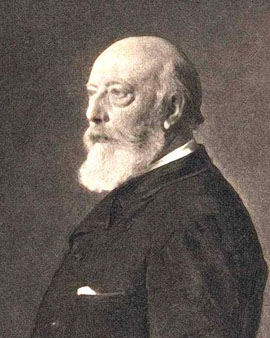
Andreas Achenbach can be considered a painterly wunderkind of the 19th century, who studied painting at the age of twelve at the Düsseldorf Art Academy, among others with Wilhelm von Schadow. He promoted his talent at an early age through extensive travels to Holland, the Scandinavian countries, Italy and France. The more than thousand paintings he painted in the course of his life are predominantly to be assigned to Landscape painting. His preferred subject were large-sized seascapes.
In the painting "A Sea Storm on the Norwegian Coast" from 1837, forces of nature roar with furious force. Meter-high waves break in the storm at karstic rocks in the foreground and threaten to tear a ship into the abyss. Achenbach has painted this large-format piece of sea in strong blue.
The viewer, standing in amazement in front of this work in Frankfurt's Städelmuseum, almost sees himself exposed to the dangers of the wild, threatening waves that crash against the rocks with all their might. He may ask himself anxiously whether the ship, whose bow will soon rise vertically out of the water, will withstand this violence or whether its sinking is inevitable.
With his sharp eye for details and the lifelike reproduction of impressive landscapes Andreas Achenbach is regarded as founder of the German Realism.
Highly respected for his work by the greats in politics and society, the painter was buried in Düsseldorf by downright princely standards.
 ×
×







 Passionate Customer Service

.jpg "Clearing Up - Coast of Sicily, 1847 by Andreas Achenbach")
.jpg)
.jpg "Italian Cloisters by Andreas Achenbach")
.jpg)
.jpg "Snowy Forest, 1835 by Andreas Achenbach")
.jpg)
.jpg "A Sea Storm off the Norwegian Coast by Andreas Achenbach")
.jpg)
.jpg "After the Storm, 1853 by Andreas Achenbach")
.jpg)
.jpg "A fisherman inspects his catch by a mountain stream by Andreas Achenbach")
.jpg)
.jpg "The Entrance to the Harbour at Hellevoetsluys, 1850 by Andreas Achenbach")
.jpg)
.jpg "A Winter Landscape with Hunters on the Ice by Andreas Achenbach")
.jpg)
.jpg "Winter boat landing stage by Andreas Achenbach")
.jpg)
.jpg "Sunset after a Storm on the Coast of Sicily, 1853 by Andreas Achenbach")
.jpg)
.jpg "By the mountain stream by Andreas Achenbach")
.jpg)
.jpg "Ships in a Storm on the Dutch Coast, 1854 by Andreas Achenbach")
.jpg)
 - (MeisterDrucke-21349).jpg "Mill by the Mountain Stream (1861) by Andreas Achenbach")
 - (MeisterDrucke-21349).jpg)
.jpg "The Coast of Naples, 1877 by Andreas Achenbach")
.jpg)
.jpg "A. Achenbach, Nordic Waterfall with Rainbow by Andreas Achenbach")
.jpg)
.jpg "View of Neuss by Andreas Achenbach")
.jpg)
_-_(MeisterDrucke-876363).jpg "The Academy Courtyard (The Old Academy in Düsseldorf) by Andreas Achenbach")
_-_(MeisterDrucke-876363).jpg)
.jpg "Surf on a Rocky Coast by Andreas Achenbach")
.jpg)
.jpg "A Timbermill in Westphalia by Andreas Achenbach")
.jpg)
.jpg "Harbour of Ostende by Andreas Achenbach")
.jpg)
.jpg "Seascape, 1894 by Andreas Achenbach")
.jpg)
.jpg "Paddle Steamer in Stormy Sea by Andreas Achenbach")
.jpg)
.jpg "Coming Ashore by Andreas Achenbach")
.jpg)
.jpg "Fish Market in Ostend by Andreas Achenbach")
.jpg)
.jpg "Fishermen on the Beach / A. Achenbach by Andreas Achenbach")
.jpg)
_Peinture_de_Andreas_-_(MeisterDrucke-1322881).jpg "Landscape with a River by Andreas Achenbach")
_Peinture_de_Andreas_-_(MeisterDrucke-1322881).jpg)
.jpg "A Mountainous Landscape with a Torrent by Andreas Achenbach")
.jpg)
.jpg "Off Ostend by Andreas Achenbach")
.jpg)
.jpg "Landing of the Fishermen by Andreas Achenbach")
.jpg)
.jpg "Westphalian Watermill by Andreas Achenbach")
.jpg)
.jpg "Departure of a Steamer by Andreas Achenbach")
.jpg)
.jpg "Ebb by Andreas Achenbach")
.jpg)
.jpg "Large Marine with Lighthouse by Andreas Achenbach")
.jpg)
.jpg "The Beach at Scheveningen by Andreas Achenbach")
.jpg)
.jpg "Artists in Stormy Weather in Sognefjorden by Andreas Achenbach")
.jpg)
.jpg "Clearing Weather by Andreas Achenbach")
.jpg)
.jpg "Sunset after a Storm on the Coast of Sicily by Andreas Achenbach")
.jpg)
_-_(MeisterDrucke-690508).jpg "Harbor Scene in Amsterdam (Dutch Beach Scene) by Andreas Achenbach")
_-_(MeisterDrucke-690508).jpg)
.jpg "Fishing Boat in Distress by Andreas Achenbach")
.jpg)
.jpg "A. Achenbach, Neapolitan Fishermen near Naples by Andreas Achenbach")
.jpg)
.jpg "View of Neuss by Andreas Achenbach")
.jpg)
.jpg "Forest Edge by Andreas Achenbach")
.jpg)
.jpg "Hunter in Landscape by Andreas Achenbach")
.jpg)
.jpg "Rocky Coast in the Surf by Andreas Achenbach")
.jpg)
.jpg "Hunter in Landscape by Andreas Achenbach")
.jpg)
.jpg "The Academy Courtyard The Old Academy in Düsseldorf, 1831 by Andreas Achenbach")
.jpg)
.jpg "The Beach at Scheveningen by Andreas Achenbach")
.jpg)
.jpg "A. Achenbach, Marine by Andreas Achenbach")
.jpg)
.jpg "Towboat Leaving the Port of Ostend at Heyday by Andreas Achenbach")
.jpg)
.jpg "Clearing Weather by Andreas Achenbach")
.jpg)
.jpg "Mountainous Landscape by Andreas Achenbach")
.jpg)
.jpg "A Windy Day by Andreas Achenbach")
.jpg)
.jpg "Seascape by Andreas Achenbach")
.jpg)
.jpg "Landscape with a River by Andreas Achenbach")
.jpg)
.jpg "The Old Academy in Düsseldorf by Andreas Achenbach")
.jpg)
.jpg "The Coal Gate on the Düsseldorf Rhine Bank by Andreas Achenbach")
.jpg)
.jpg "Snowy Forest by Andreas Achenbach")
.jpg)
.jpg "Farewell to the Fleet by Andreas Achenbach")
.jpg)
.jpg "The Trollhättan Falls by Andreas Achenbach")
.jpg)
.jpg "Harbor Entrance in Stormy Sea by Andreas Achenbach")
.jpg)
_-_(MeisterDrucke-1132606).jpg "The North Sea by Andreas Achenbach")
_-_(MeisterDrucke-1132606).jpg)
.jpg "The Entrance to the Harbour at Hellevoetsluys by Andreas Achenbach")
.jpg)
.jpg "Storm at Sea by Andreas Achenbach")
.jpg)
.jpg "Ebbtide, Scheveningen by Andreas Achenbach")
.jpg)
.jpg "Landscape with a River by Andreas Achenbach")
.jpg)
.jpg "Procession of Düsseldorf Artists by Andreas Achenbach")
.jpg)
.jpg "Dutch Fishermen after the Catch by Andreas Achenbach")
.jpg)
.jpg "Coast near Syracuse. 1861 by Andreas Achenbach")
.jpg)
.jpg "A Tugboat Leaving the Port of Ostend at High Tide by Andreas Achenbach")
.jpg)
.jpg "A Tugboat Leaving the Port of Ostend at High Tide. 1878 by Andreas Achenbach")
.jpg)
_-_(MeisterDrucke-1563018).jpg "The Altenberg Cathedral (Study) by Andreas Achenbach")
_-_(MeisterDrucke-1563018).jpg)
.jpg "Mountainous Landscape by Andreas Achenbach")
.jpg)
.jpg "A Harvester by Andreas Achenbach")
.jpg)
.jpg "Westphalian Mill by Andreas Achenbach")
.jpg)
.jpg "A Sea Storm on the Norwegian Coast by Andreas Achenbach")
.jpg)
.jpg "Storm at Sea off the Norwegian Coast by Andreas Achenbach")
.jpg)
.jpg "Sunset after a Storm on the Coast of Sicily by Andreas Achenbach")
.jpg)
.jpg "A Tug Leaving the Port of Ostend at High Tide by Andreas Achenbach")
.jpg)
.jpg "Storm at Sea by Andreas Achenbach")
.jpg)
.jpg "Surf on a Rocky Coast, 1835 by Andreas Achenbach")
.jpg)
.jpg "Corner in a Courtyard by Andreas Achenbach")
.jpg)
.jpg "Ostend by Andreas Achenbach")
.jpg)
.jpg "Landscape with Cottages and Windmill by Andreas Achenbach")
.jpg)
.jpg "On the Shore of the North Sea by Andreas Achenbach")
.jpg)
.jpg "A Driving Accident by Andreas Achenbach")
.jpg)
.jpg "Zons on the Rhine by Andreas Achenbach")
.jpg)
.jpg "Clearing Up - Coast of Sicily by Andreas Achenbach")
.jpg)
.jpg "Seascape by Andreas Achenbach")
.jpg)
.jpg "View of Lübeck, 1869 by Andreas Achenbach")
.jpg)
.jpg "Norwegian Landscape with Sawmill by Andreas Achenbach")
.jpg)
.jpg "Sea Storm by Andreas Achenbach")
.jpg)
.jpg "Boatmen by a Frozen-In Ship by Andreas Achenbach")
.jpg)
.jpg "Norwegian Landscape by Andreas Achenbach")
.jpg)
.jpg "Altenberg Cathedral. Study by Andreas Achenbach")
.jpg)
.jpg "Beach by Scheveningen by Andreas Achenbach")
.jpg)
.jpg "Scheveningen by Andreas Achenbach")
.jpg)

 +43 4257 29415
 support@meisterdrucke.com
 Mo-Do: 7:00 - 16:00 | Fr: 7:00 - 13:00