In January 1525, the council of the Free Imperial City of Nuremberg had three young painters from Albrecht Dürer's circle arrested. They were Georg Pencz, Barthel Beham and his brother Sebald Beham, an engraver born in Nuremberg in 1500. Older literature calls him Hans Sebald Beham, although no document attests to the first name Hans - even the name of this defendant remains an open question. The three were charged with blasphemy, sectarianism and the denial of secular authority; according to later sources, they declared in essence that they believed in God but thought nothing of Christ, baptism and the sacraments, and recognized no authority but God. The sentence passed on 26 January 1525 was banishment; the council refrained from torture, and by November all three were permitted to return to the city. What remained was the name in the records: the three godless painters.
Three years later, Beham once again found himself at odds with the council. A few months after Dürer's death, he published a small book on the proportions of the horse in 1528; he was accused of drawing on Dürer's unpublished studies of proportion, and Dürer's widow was behind the complaint. In July 1528, the council prohibited its sale until Dürer's own, still unpublished work on proportion had appeared. Beham withdrew to Ingolstadt, returned to Nuremberg in February 1529 - and calmly reused the disputed material a second time in 1546, in a textbook of his own.
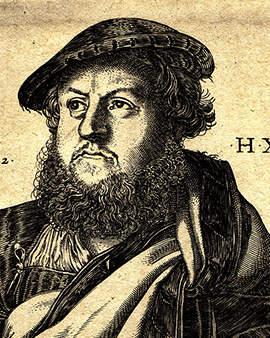
Who was this man? A German engraver, etcher and designer of woodcuts, trained, judging by everything the early prints reveal, in Dürer's circle; no apprenticeship contract has survived. Together with his brother Barthel and Georg Pencz, art history numbers him among the Little Masters, named for the tiny format of their engravings. When Sebald Beham died in Frankfurt am Main in 1550, he left behind around 270 engravings and well over 1,000 woodcuts; he had signed them with a monogram like a trademark, first HSP, reflecting the Franconian pronunciation Peham, and later HSB. The sources differ on what the H stood for - the monogram, too, leaves his first name unresolved.
Just how small this art truly is can be seen in the series of apostles from the mid-1540s, whose plates measure approximately 4.8 by 3.2 centimetres. In “Saint Mathias,” the twelfth print in the series, a bearded apostle with a radiant halo stands before a wooden fence, a closed book tucked beneath his arm, his right hand resting on a long-handled axe, barefoot, with pouches at his belt - and every line is perfectly placed. In “Fortune” from 1541, the winged goddess of fortune strides forward carrying a bundle of ears of grain. A large sphere rests beside her foot, while in her left hand she holds the Wheel of Fortune; perched atop the wheel is a tiny man imploring her with an outstretched arm to stop it. Behind her, a sailing ship and a town on the shore pass by. This entire theatre of the world measures 79 by 51 millimetres.
Reproducing such prints is itself a process, and it hinges on just one critical point - whether the line remains a line. The screenless printing process Meisterdrucke uses to reproduce the engravings places neither halftone screens nor visible printing dots over the image, while a fine, natural white paper carries the delicate strokes. Every engraved hatch thus remains a line and does not tip into grey, even in the densest cross-hatching. In the end, therefore, it is not the print that is tested, but the engraver - and Beham's 79 by 51 millimetres withstand the scrutiny.
According to current research, Beham opened up an entirely new field as well: the peasant festival as a pictorial subject in its own right. Beginning in 1528, he cut large-format woodcuts of church fairs in Nuremberg, including the Mögeldorf Church Fair; tiny series of engravings followed in Frankfurt. In “The Peasants' Brawl” from 1540, peasants attack one another with swords and fists. Amid the turmoil, a woman kneels with her arms flung upwards, one man is already lying on the ground, and above their heads flutters a banderole bearing the rhyme: If you strike me, I will stab you. The same banderole flies above “The Peasant Wedding or the Twelve Months: No. 9, 1547,” a print from the Frankfurt series of 1546/47, which distributes the twelve months across ten small engravings and labels its celebrating, brawling peasants with the names of the months; here they fight beside a vine trellis, with a hat and pitchfork lying between the combatants. Scholars disagree on whether such scenes are mockery from above or celebrations of festivities witnessed first-hand - both can be seen in them. A generation before the Netherlandish painter Pieter Bruegel made the peasant festival a subject of world art, Beham had given it form.
Beham, the exile of 1525, ultimately became a citizen of another city. In 1531, Beham entered the service of Cardinal Albert of Brandenburg, for whom he painted prayer-book miniatures and a tabletop with scenes from the life of King David, which later entered the Louvre. From 1532, he lived in Frankfurt am Main, illustrated the 1533 Biblical Histories for the publisher Christian Egenolff, relinquished his Nuremberg citizenship in 1535 and took the Frankfurt citizens' oath in 1540. When Barthel died during a journey to Italy in 1540, Sebald took over his copper plates and continued printing his brother's subjects. He sold his work himself at the Frankfurt Book Fair, and by 1547 he lived right beside the fairgrounds; the large wall prints went to a broad public, while the small series went to collectors who pasted them into books. The market from which he made his living was thus directly outside his door.
 ×
× 






 Passionate Customer Service

.jpg "Saint Matthias, 1541-46 by Hans Sebald Beham")
.jpg)
.jpg "The Peasant Wedding or the Twelve Months: No. 9, 1547 by Hans Sebald Beham")
.jpg)
.jpg "The Peasants")
.jpg)
.jpg "Fortune by Hans Sebald Beham")
.jpg)
.jpg "Saint Bartholomew and Saint Matthias by Hans Sebald Beham")
.jpg)
.jpg "The Saviour by Hans Sebald Beham")
.jpg)
_(title_on_object)Zeven_Vrije_Kunsten_(series_title)_-_(MeisterDrucke-1362441).jpg "Logic (Dialectic) (title on object) Seven Liberal Arts (series title) by Hans Sebald Beham")
_(title_on_object)Zeven_Vrije_Kunsten_(series_title)_-_(MeisterDrucke-1362441).jpg)
.jpg "Standard-Bearer and Drummer by Hans Sebald Beham")
.jpg)
.jpg "Farmer and His Mistress by Hans Sebald Beham")
.jpg)
.jpg "Seven nude boys by Hans Sebald Beham")
.jpg)
.jpg "Eight Nude Boys by Hans Sebald Beham")
.jpg)
_-_(MeisterDrucke-1374912).jpg "The Night by Heinrich Aldegrever")
_-_(MeisterDrucke-1374912).jpg)
.jpg "Nude Girl with a Dog by Hans Sebald Beham")
.jpg)
.jpg "The Prodigal Son III: Son among the Swine by Hans Sebald Beham")
.jpg)
_-_(MeisterDrucke-1384609).jpg "Sleeping Nude Woman as the Night by Hans Sebald Beham")
_-_(MeisterDrucke-1384609).jpg)
.jpg "Sleeping Girl and Death, 1548 by Hans Sebald Beham")
.jpg)
.jpg "Fortune, 1541 by Hans Sebald Beham")
.jpg)
_-_(MeisterDrucke-1277330).jpg "Feasting Farmers (May and June) by Hans Sebald Beham")
_-_(MeisterDrucke-1277330).jpg)
.jpg "Death and the Sleeping Woman by Hans Sebald Beham")
.jpg)
.jpg "Study Sheet with Figures by Hans Sebald Beham")
.jpg)
.jpg "Return of the Prodigal Son from the series The History of the Prodigal Son by Hans Sebald Beham")
.jpg)
.jpg "St. Mark, from The Four Evangelists by Hans Sebald Beham")
.jpg)
.jpg "Hercules and the Pillars by Hans Sebald Beham")
.jpg)
_-_(MeisterDrucke-1259500).jpg "Peasant Woman at Market: To Wine We Will Run by Hans Sebald Beham")
_-_(MeisterDrucke-1259500).jpg)
.jpg "The Weather Peasant: \"That Does No Harm\" by Hans Sebald Beham")
.jpg)
_-_(MeisterDrucke-35704).jpg "The Fall of Adam and Eve, c. 1525-27 by Hans Sebald Beham")
_-_(MeisterDrucke-35704).jpg)
.jpg "The Prodigal Son Wasting his Fortune from the series The History of the Prodigal Son by Hans Sebald Beham")
.jpg)
.jpg "Fortune by Hans Sebald Beham")
.jpg)
.jpg "Leda and the Swan by Hans Sebald Beham")
.jpg)
.jpg "Vase Ornate with Children, 1531 by Hans Sebald Beham")
.jpg)
_-_(MeisterDrucke-1363175).jpg "Venus and Cupid by Hans Sebald Beham")
_-_(MeisterDrucke-1363175).jpg)
.jpg "The Knowledge of God and the Seven Cardinal Virtues: Knowledge of God - Cognicio by Hans Sebald Beham")
.jpg)
.jpg "St. Simon, plate 11 from The Twelve Apostles by Hans Sebald Beham")
.jpg)
.jpg "Mars, plate three from The Seven Planets with the Zodiacs by Hans Sebald Beham")
.jpg)
_-_(MeisterDrucke-1733383).jpg "Christ Presented to the People (Ecce homo) by Hans Sebald Beham")
_-_(MeisterDrucke-1733383).jpg)
.jpg "The Wedding Procession: Couple Walking Left, Woman Wearing a Bonnet by Hans Sebald Beham")
.jpg)
.jpg "The Peasant")
.jpg)
.jpg "Adam and Eve by Hans Sebald Beham")
.jpg)
.jpg "Misfortune by Hans Sebald Beham")
.jpg)
.jpg "Fortune, 1541 by Hans Sebald Beham")
.jpg)
.jpg "Troops of Soldiers, Foremost an Officer on Horseback by Jan Theodor de Bry")
.jpg)
.jpg "The Labors of Hercules: Hercules Strangling the Nemean Lion by Hans Sebald Beham")
.jpg)
.jpg "The Saviour by Hans Sebald Beham")
.jpg)
.jpg "St. John, 1541-46 by Hans Sebald Beham")
.jpg)
.jpg "St. John, from The Four Evangelists by Hans Sebald Beham")
.jpg)
.jpg "The Weather Peasant:")
.jpg)
.jpg "Mars, from The Seven Planets by Hans Sebald Beham")
.jpg)
.jpg "Moon, Plate Seven from The Seven Planets with the Zodiacs by Hans Sebald Beham")
.jpg)
.jpg "Coat of Arms with an Eagle by Hans Sebald Beham")
.jpg)
.jpg "St. Jude, plate 10 from The Twelve Apostles by Hans Sebald Beham")
.jpg)
.jpg "Hercules and Nessus by Hans Sebald Beham")
.jpg)
.jpg "The Penance of Saint John Chrysostom by Barthel Beham")
.jpg)
.jpg "The Virgin and Child surrounded by a Border with a Hunter and some Rabbits by Hans Sebald Beham")
.jpg)
_-_(MeisterDrucke-1338272).jpg "Panel with a Mascaron (ornament with a mask) by Hans Sebald Beham")
_-_(MeisterDrucke-1338272).jpg)
.jpg "Peasants")
.jpg)
.jpg "St. Mark by Hans Sebald Beham")
.jpg)
.jpg "Jupiter, plate two from The Seven Planets with the Zodiacs by Hans Sebald Beham")
.jpg)
.jpg "Woman with a Harp by Hans Sebald Beham")
.jpg)
.jpg "The Market Peasant by Hans Sebald Beham")
.jpg)
.jpg "The Weather-Peasant")
.jpg)
.jpg "Fortune by Hans Sebald Beham")
.jpg)
.jpg "Entombment by Hans Sebald Beham")
.jpg)
.jpg "The Man of Sorrows by Hans Sebald Beham")
.jpg)
.jpg "St. Philip by Hans Sebald Beham")
.jpg)
.jpg "The Wedding Procession: Couple walking left, woman wearing a wreath by Hans Sebald Beham")
.jpg)
.jpg "The Labors of Hercules: Hercules Dragging Cerberus from the Underworld by Hans Sebald Beham")
.jpg)
.jpg "Venus and Cupid by Hans Sebald Beham")
.jpg)
.jpg "Saturn, plate one from The Seven Planets with the Zodiacs by Hans Sebald Beham")
.jpg)
.jpg "Mercury, from The Seven Planets by Hans Sebald Beham")
.jpg)
.jpg "Sun, plate four from The Seven Planets with the Zodiacs by Hans Sebald Beham")
.jpg)
.jpg "The Mask by Hans Sebald Beham")
.jpg)
.jpg "Dido by Hans Sebald Beham")
.jpg)
_-_(MeisterDrucke-1282473).jpg "Fortuna by Hans Sebald Beham")
_-_(MeisterDrucke-1282473).jpg)
_-_(MeisterDrucke-1259771).jpg "The Peasants")
_-_(MeisterDrucke-1259771).jpg)
.jpg "The Expulsion from Paradise by Hans Sebald Beham")
.jpg)
.jpg "Melencolia by Hans Sebald Beham")
.jpg)
.jpg "Hercules and Nessus by Hans Sebald Beham")
.jpg)
.jpg "The Mask by Hans Sebald Beham")
.jpg)
.jpg "Adam and Eve by Hans Sebald Beham")
.jpg)
.jpg "Misfortune by Hans Sebald Beham")
.jpg)
.jpg "Triumph of the Women by Hans Sebald Beham")
.jpg)
.jpg "Death of Lucretia by Hans Sebald Beham")
.jpg)
.jpg "The Labors of Hercules: Hercules Killing the Lernean Hydra by Hans Sebald Beham")
.jpg)
_-_(MeisterDrucke-272819).jpg "The Feast of Herod by Hans Sebald Beham")
_-_(MeisterDrucke-272819).jpg)
.jpg "Fortune by Hans Sebald Beham")
.jpg)
_-_(MeisterDrucke-655365).jpg "Coat of Arms with a Cock, 1543 by Hans Sebald Beham")
_-_(MeisterDrucke-655365).jpg)
.jpg "The Saviour by Hans Sebald Beham")
.jpg)
_(engraving_on_laid_paper)_-_(MeisterDrucke-655364).jpg "Misfortune by Hans Sebald Beham")
_(engraving_on_laid_paper)_-_(MeisterDrucke-655364).jpg)
.jpg "The Labors of Hercules: Hercules Strangling the Nemean Lion by Hans Sebald Beham")
.jpg)
_-_(MeisterDrucke-939407).jpg "Music by Hans Sebald Beham")
_-_(MeisterDrucke-939407).jpg)
.jpg "Coat of Arms with an Eagle by Hans Sebald Beham")
.jpg)
.jpg "St. Judas by Hans Sebald Beham")
.jpg)
.jpg "Frieze with Two Putti Fleeing from an Eagle by Hans Sebald Beham")
.jpg)
.jpg "The Labors of Hercules: Hercules Strangling the Nemean Lion by Hans Sebald Beham")
.jpg)
.jpg "The Wedding Procession: Couple Walking Left, Facing Away by Hans Sebald Beham")
.jpg)
.jpg "The Knowledge of God and the Seven Cardinal Virtues: Prudence by Hans Sebald Beham")
.jpg)
.jpg "The Moon, from The Seven Planets by Hans Sebald Beham")
.jpg)
.jpg "Departure of the Prodigal Son from the series The History of the Prodigal Son by Hans Sebald Beham")
.jpg)
_-_(MeisterDrucke-1073071).jpg "Saint Christopher by Hans Sebald Beham")
_-_(MeisterDrucke-1073071).jpg)
.jpg "The Man of Sorrows by Hans Sebald Beham")
.jpg)

 +43 4257 29415
 support@meisterdrucke.com
 Mo-Do: 7:00 - 16:00 | Fr: 7:00 - 13:00