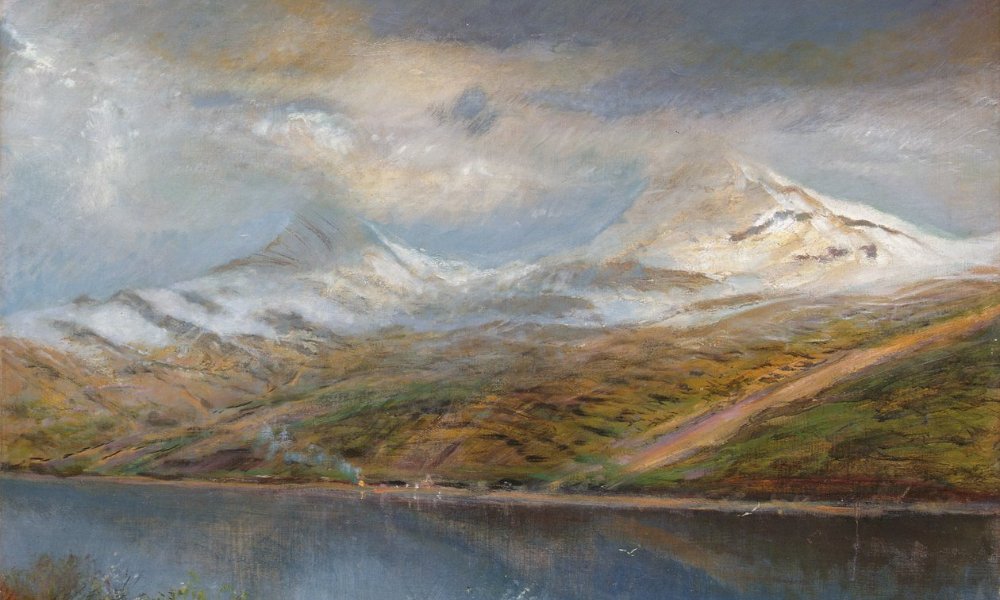
A gentle shimmer of light and colour greets the viewer when they stand in front of Ladislav Mednyánszky's "Forest Path in the Mist". The contours become blurred, as if the artist himself had captured the breath of the Carpathian Mountains and captured it on canvas. It is like stepping through a veil into another world - a world in which nature and emotion are inextricably interwoven. Mednyánszky, one of the most important Slovakian painters, was a master at capturing moods that oscillate between melancholy and hope. His works are not mere depictions of the landscape, but poetic reflections on human existence, on loneliness and connectedness, on the passing of time.
But Slovakian art history is far more than just an echo of nature. It is a kaleidoscope of colours, techniques and ideas that is constantly being reassembled. While painting in the 19th century was still strongly influenced by the Hungarian and Austrian art scene, an independent, often experimental visual language developed in the 20th century. Modernist artists - such as Ľududovít Fulla and Mikuláš Galanda - dared to break with tradition. They used bold colours, abstracted forms and combined folklore with the avant-garde. Fulla's paintings, for example, glow in rich red and deep blue, his figures seem to have sprung from a Slovakian fairy tale and yet at the same time like messengers of a new age. Galanda, on the other hand, experimented with collages, prints and drawings, taking inspiration from Parisian modernism and creating works that balance between dream and reality.
A surprising chapter in Slovakian art history opens up with photography. While in many countries the art of photography was long regarded as a mere craft, in Slovakia it was recognised early on as a means of artistic expression. The interwar period produced photographers such as Martin Martinček, who documented rural life in the Liptov mountains with an almost meditative calm. His black and white photographs tell of hard work, celebrations and farewells, of a world that was about to change fundamentally. Later, in the decades of socialism, artists such as Tono Stano used photography to play with light and shadow, to capture bodies and movement in suggestive compositions - a silent resistance to the uniformity of official art.
What makes Slovakian art so fascinating is its constant oscillation between tradition and new beginnings. In Zoltán Palugyay's watercolours, for example, the gentle hills of his homeland merge with expressive areas of colour, as if the landscape itself were beginning to dream. In Vincent Hložník's prints, you can sense the unrest of a time characterised by political upheaval - his prints are full of symbolism, allusions and questions. And even today, in the studios of Bratislava or Košice, he creates works that cannot be pinned down: Paintings that flirt with digital media, drawings that tell stories, photography that makes the invisible visible.
Slovakian art is a river that is constantly seeking new paths. It invites you to take a closer look, to engage with nuances, to discover the familiar in the unknown. Those who embark on this journey will not only see pictures, but also sense moods, hear stories and perhaps even find a piece of their own longing in them.
A gentle shimmer of light and colour greets the viewer when they stand in front of Ladislav Mednyánszky's "Forest Path in the Mist". The contours become blurred, as if the artist himself had captured the breath of the Carpathian Mountains and captured it on canvas. It is like stepping through a veil into another world - a world in which nature and emotion are inextricably interwoven. Mednyánszky, one of the most important Slovakian painters, was a master at capturing moods that oscillate between melancholy and hope. His works are not mere depictions of the landscape, but poetic reflections on human existence, on loneliness and connectedness, on the passing of time.
But Slovakian art history is far more than just an echo of nature. It is a kaleidoscope of colours, techniques and ideas that is constantly being reassembled. While painting in the 19th century was still strongly influenced by the Hungarian and Austrian art scene, an independent, often experimental visual language developed in the 20th century. Modernist artists - such as Ľududovít Fulla and Mikuláš Galanda - dared to break with tradition. They used bold colours, abstracted forms and combined folklore with the avant-garde. Fulla's paintings, for example, glow in rich red and deep blue, his figures seem to have sprung from a Slovakian fairy tale and yet at the same time like messengers of a new age. Galanda, on the other hand, experimented with collages, prints and drawings, taking inspiration from Parisian modernism and creating works that balance between dream and reality.
A surprising chapter in Slovakian art history opens up with photography. While in many countries the art of photography was long regarded as a mere craft, in Slovakia it was recognised early on as a means of artistic expression. The interwar period produced photographers such as Martin Martinček, who documented rural life in the Liptov mountains with an almost meditative calm. His black and white photographs tell of hard work, celebrations and farewells, of a world that was about to change fundamentally. Later, in the decades of socialism, artists such as Tono Stano used photography to play with light and shadow, to capture bodies and movement in suggestive compositions - a silent resistance to the uniformity of official art.
What makes Slovakian art so fascinating is its constant oscillation between tradition and new beginnings. In Zoltán Palugyay's watercolours, for example, the gentle hills of his homeland merge with expressive areas of colour, as if the landscape itself were beginning to dream. In Vincent Hložník's prints, you can sense the unrest of a time characterised by political upheaval - his prints are full of symbolism, allusions and questions. And even today, in the studios of Bratislava or Košice, he creates works that cannot be pinned down: Paintings that flirt with digital media, drawings that tell stories, photography that makes the invisible visible.
Slovakian art is a river that is constantly seeking new paths. It invites you to take a closer look, to engage with nuances, to discover the familiar in the unknown. Those who embark on this journey will not only see pictures, but also sense moods, hear stories and perhaps even find a piece of their own longing in them.
 ×
×







 Passionate Customer Service




 +43 4257 29415
 support@meisterdrucke.com
 Mo-Do: 7:00 - 16:00 | Fr: 7:00 - 13:00